A Blade Repair Tech's Log Template for Weather-Day Fatigue
Three Lines That Missed the Day
A rope-access blade repair tech unclips from the horizontal lanyard at 70 meters on the leading edge of a Siemens Gamesa 8MW blade at 14:40, descends for 30 minutes, lands on the nacelle roof, packs down, and reaches the CTV transfer platform at 15:35. The day has been five hours suspended, two coating patches complete, one ply-delamination inspection deferred because the sun wrapped around the blade face. The CTV master wants to leave. The tech pulls out the day logbook and writes three lines: "LE patch at 72m complete. Sun glare afternoon. Back pain manageable." The CTV departs at 15:50. The log has been filed. The weather window for the next blade pack closes Thursday evening, and the shift leader is already sketching Wednesday's assignments on the SOV back to port.
Those three lines erased almost everything the shift leader would need to make Wednesday's assignment right. The patch location matters, but the time-in-harness doesn't appear. The glare is noted, but the two repositionings it forced are not. Back pain "manageable" is the honest word for "will hurt tomorrow," and neither the tech nor the shift leader will reread the line when Wednesday's blade task is assigned. The IRATA 2025 Work and Safety Analysis Report documents that 71% of rope-access incidents are tied to human factors — the signals in the logbook are the most common early warning, and the underreported logbook is the most common missed chance. Blade repair teams running campaigns on Vestas V164 blades or Siemens Gamesa B81 blades generate logbook entries across 200-300 rope-access shifts per season; the aggregate signal in those entries is structurally richer than the gearbox condition-monitoring dataset most operators already treat as mission-critical.
A ScienceDirect review of fatigue risk management system effectiveness found self-report daily logs, diaries, and behavioural monitoring are proactive FRMS controls with good evidence of working — when used. The rope-access world has the logbook infrastructure: IRATA and SPRAT both require logbooks with task type, hours, and conditions, and the SPRAT and IRATA logbook question guides at Pacific Ropes detail the expected structure in depth. What is missing is a blade-repair-specific fatigue template that fits the real field constraint: the tech is tired, the vessel is waiting, and the log needs to be honest in under four minutes. The template also has to fit the physical reality — tablet screen readable through a gloved hand, form fields that survive a post-descent shake, autofill that respects the eight-tech CTV's loading sequence.
The Garden's Fatigue Log Template
Verdant Helm treats the blade tech's logbook as the daily soil report from the tech's own perennial bed. A gardener who hand-writes a card after tending each bed captures pruning done, wilt observed, water added, pest pressure seen. The blade-day log serves the same function, and the template mirrors it.
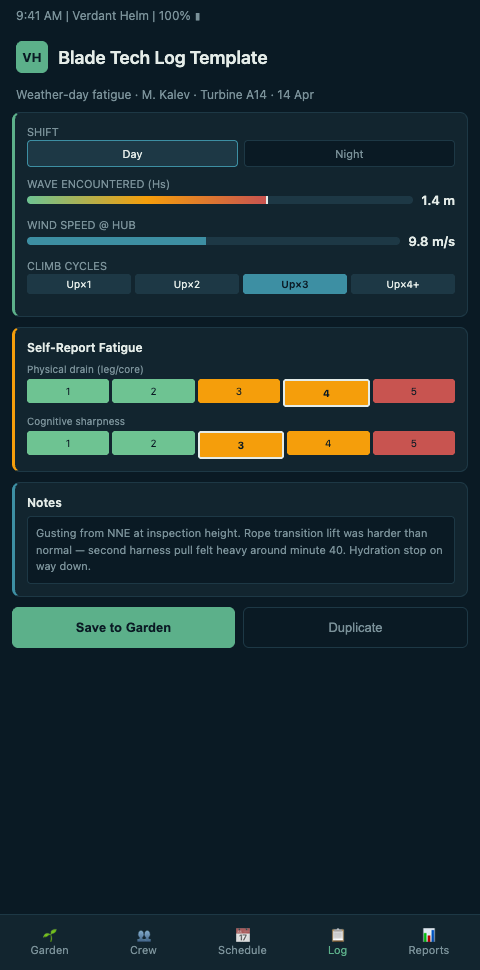
Eight fields make up the template. Time in harness — total suspended minutes, cleanly. Repositioning count — every full re-rig under load, not just planned moves. Grip fatigue self-score — 1 to 5, where 3 means "noticed at 50% of job" and 5 means "rest stops every 10 minutes." Heat exposure window — blade face sun direction and minutes in direct sun. Task completion state — complete, partial, deferred, aborted, and the reason in one phrase. Notable observations — delamination, bond-line voids, lightning receptor condition, leading-edge erosion. Recovery request — "normal rest sufficient," "needs light duty Wednesday," or "prune from rope-access Wednesday." Sleep last night — hours self-report, not a spreadsheet fiction. The field set is deliberately small: exhaustive templates fail the four-minute test, and a tech who cannot finish the log before the CTV departs will start omitting the fields that matter most.
The fields are non-negotiable, but the interface is. Verdant Helm ships the template as a tablet form that auto-populates time, location, and weather from the work pack, leaving the tech with roughly four text or slider inputs to fill. The template preserves the bloom, wilt, prune language from the broader garden so the shift leader reads it as a single coherent signal at the Wednesday brief — a bed that reported wilt yesterday opens Wednesday with a light-duty bias already pre-loaded, and the CTV pairing reflects that without the shift leader having to remember the conversation at 15:50.
Ørsted's four-pillar fatigue risk management model, documented by Human Factors Hull, relies on the detection pillar working in exactly this form: pre-shift and post-task logs that capture signal where the tech is the only person with access to it. A validated ScienceDirect FRMS diagnostic tool for shift work organisations notes that logging practice quality is one of the strongest predictors of an organisation's FRMS maturity. The template turns a compliance ritual into a soil report, and the garden view turns the soil report into an assignment decision the next morning.
Advanced Tactics
Four practices separate teams that use the template well from teams that merely fill it.
First, protect the four minutes. The most common failure is the CTV master pressuring the tech to skip the log because the vessel window is tight. Crewing managers need to write the four-minute log completion into the CTV departure protocol so the boat does not leave until the blade team has closed out the template on deck. HSE UK guidance on fatigue as a human factors topic is explicit that employers must identify fatigue risks and maintain records for control review — which means the log is not optional administrative overhead but the regulated evidence trail the scheme rests on. Treating it as such changes the CTV departure cadence in precisely the right direction.
Second, keep the log honest through anonymised aggregation. A tech who fears being stood down for a "grip fatigue 4" rating will self-report a 2 by the fourth shift of the week. The fix is structural: Verdant Helm stores the tech's self-report as a personal baseline and only shows the shift leader the amber/red bloom colour derived from the aggregate, not the raw number. The tech retains their honesty by never having the number read back at them in a performance context. Teams that get this right see logs that actually shift Wednesday assignments; teams that get it wrong see uniform "grip 2" logs and no signal.
Third, calibrate the template per site. A North Sea site in November has different heat exposure risk than an East Mediterranean site in August; a fixed-bottom foundation has different blade-face geometry than a floating asset with its extra sway cycles. Verdant Helm ships with three preset profiles — cold-water North Sea, temperate East Coast US, warm-water floating wind — and a fourth open profile for custom sites. The fields stay the same; the default ranges shift so the baseline comparisons stay meaningful. Deploying the wrong profile is the most common calibration error in the first month; deploying the right one after is silent.
Floating wind campaigns on Hywind Tampen and the pilot arrays off Portugal and California have found the sway cycle at the turbine itself adds a second load channel the fixed-bottom profile does not see — rope-access shifts on a floating foundation accumulate cost faster, and the log template's grip fatigue score drifts up half a point for the same task duration as a North Sea fixed-bottom equivalent.
Fourth, make the weekly review a shared read. The log has full value only when the shift leader and the tech read it together at the Friday forecast meeting — not to audit but to close the loop. The garden metaphor does the work here: "The bed flagged wilt three times this week. What does Monday look like?" is a conversation the template enables that a spreadsheet would not. Teams that hold the Friday read see the template's hit rate on real Wednesday reassignments climb over the first three weeks, and the shared read also trains the shift leader to spot template fatigue — the tech whose entries are drifting toward boilerplate, which usually precedes a drop in log quality by a week or two.
The blade log gains most of its compounding value when it wires into the broader calendar. Wiring GWO training records into garden-based schedules lets the log's recovery request trigger refresher bookings rather than dispatcher memory, and sequencing blade inspections around team fatigue cycles uses the aggregated bed states to build the campaign plan a month out. The cadet version lives in the same family — cadet logbook practice for watch-based fatigue shows what honest entry-level logging looks like in deep-sea ops and the same discipline transfers.
Issue the Template for Next Wednesday's Window
Offshore Wind O&M teams running blade campaigns can roll the template out across a single rotation and have useful Friday reviews within a week. Verdant Helm provides the tablet form, the aggregation layer, and the preset profiles out of the box. Blade supervisors and rope-access leads get a template the techs will actually fill — and the Wednesday dispatch gains a soil report the shift leader can read in 45 seconds. Start with one blade crew, and by the next weather window the log will be changing assignments.
Pick the blade crew most likely to give the template a fair test. That usually means a four-tech team with at least one IRATA Level 3 supervisor and one Level 1 tech in their first season. The mix matters: the senior supervisor anchors the field interpretation of each log entry against 200-plus descents of experience, and the newer tech stress-tests whether the template is genuinely usable in the 15:50 CTV pressure. If the Level 1 tech completes the log honestly inside four minutes for three straight shifts, the template works. If she skips fields or boilerplates the notes, the template needs one more pass before a wider rollout.
Print the template on a weatherproof card too, at least for the pilot period. A tablet is the primary surface, but a laminated card in the rope-access bag is the backup when the CTV deck is wet or a glove is too saturated to type through. The card carries the eight fields, a one-line prompt for each, and nothing else. Techs who resist the tablet in rough weather will still fill a card if it fits in the chest pocket of their dry suit. By the end of the campaign, you will have a mix of tablet entries and card entries; Verdant Helm reconciles both into the same bloom record, and the Wednesday brief reads the same regardless of which surface captured the log.