Wiring GWO Training Records Into Garden-Based Schedules
The WINDA Export That Sits in a Drawer
A crewing manager for a Dutch offshore wind operator — picture Eneco or Crosswind's Hollandse Kust project running Siemens Gamesa 11MW turbines — pulls the Friday morning WINDA export to finalise next rotation's SOV roster. Three techs show GWO Basic Safety Training modules expiring between day 18 and day 32 of the 28-day rotation — one Working at Heights, one Sea Survival, one First Aid. The manager notes the dates in a spreadsheet cell, reschedules the refresher week in his head to "some point before December," and approves the rotation. Two weeks into the deployment, the Working at Heights certificate lapses. The tech technically cannot climb until the refresher is completed. The SOV is 180nm offshore. The rotation back to port isn't scheduled for 11 days.
The campaign manager quietly lets the tech keep climbing, because the alternative is pulling a helicopter out of the budget for a single BST module. The tech's first climb after lapse is on Wednesday of week three, at 115m hub height, on a turbine with a known-problematic yaw system; the manager signs the climb brief with a feeling in his chest he does not name.
This pattern is routine enough that GWEC has publicly flagged workforce readiness as the structural gap beyond entry-level certification, warning that competency-management infrastructure lags the certification-issuing infrastructure. The RenewableUK Wind Industry Skills Intelligence Report 2025 maps the competency-versus-rotation gap at UK scale. An NREL U.S. Offshore Wind Workforce Assessment calls out the same need for standardised safety training tracking across offshore wind — the records exist, but the integration into the operational schedule does not. The problem compounds at sector scale: every UK, German, Dutch, and Danish operator runs the same WINDA-versus-rotation spreadsheet workaround, and every operator absorbs the same quiet cost when a certificate lapses mid-campaign.
The authoritative record is already there. The Global Wind Organisation's Basic Safety Training Standard defines the five BST modules — First Aid, Working at Heights, Manual Handling, Fire Awareness, Sea Survival — with 24-month validity windows. The WINDA database holds per-tech records with expiry dates. What the sector is missing is the wiring that turns those records into scheduling inputs rather than drawer documents.
The Garden's View of Competency as Soil Readiness
A gardener does not plant a delicate cutting into a bed with depleted nitrogen. She reads the soil report first, amends the bed if needed, and plants only when the conditions match the crop. Verdant Helm treats GWO validity as a soil-readiness attribute of each tech's bed — a non-negotiable scheduling constraint that shows up on the same dashboard as bloom state, wilt risk, and recovery ledger, rather than sitting in a separate spreadsheet that nobody opens before the rotation closes.
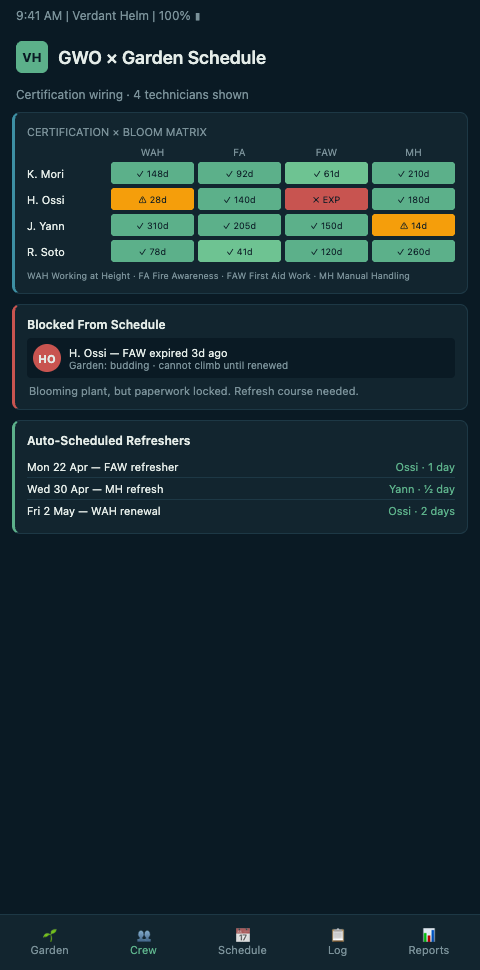
The integration is technical and direct. Verdant Helm pulls the WINDA official record per-tech via the published API, reads each of the five BST validity dates plus any applicable Advanced Rescue Training or Blade Repair certifications, and overlays the expiry timeline onto the proposed rotation calendar. A tech with a Working at Heights certificate expiring on day 22 of a 28-day rotation shows amber on the calendar from day 16 forward and red from day 22. The rotation planner sees the expiry in context — against weather forecast, against bloom state, against the tech's logged climb count — so the decision to schedule the refresher is made alongside the decision to schedule the rotation.
The garden framing holds because the refresher is not competence remediation but perennial tending. GWO's 24-month cycle is built around the fact that safety skills fade with time and disuse, exactly like a bed needs amendment every second season to bloom reliably. A ScienceDirect review of FRMS effectiveness underlines that competency tracking is a core proactive control, not a paperwork compliance function. An STL USA industry analysis on competency-based wind tech systems notes that most industry training stops at the certification level, and that competency-aware rotation is where the operational gap lives. Verdant Helm fills that gap by treating WINDA validity as part of the same garden reading that drives tomorrow's climb assignment.
A tech whose Sea Survival certificate lapses mid-rotation does not have a scheduling problem — she has a bed that cannot bloom at the edge of the field until the soil is amended, and the dashboard frames the amendment alongside the climb it enables rather than in a separate compliance tab.
The American Clean Power guidelines for entry-level wind technician training describe the onboarding competency scaffolding; the BZEE Network Wind Turbine Service Technician training program provides an industry-standard path that Verdant Helm can map alongside WINDA so the first-year tech's bed shows both BST validity and progressive competency milestones. The dashboard reads as one surface — bloom colour, wilt risk, training validity, competency scaffolding — with no separate compliance tab required.
Advanced Tactics
Four practices get the full value from wiring training records into the garden.
First, schedule refreshers on weather-gated downtime, not calendar pressure. The standard pattern is to batch refreshers in January when Hs forecasts are poor and the training centre capacity is light. This ignores the per-tech expiry spread. Verdant Helm's scheduler recommends refresher slots during forecast-predicted downtime windows across the year, so a tech with a November expiry gets their Working at Heights refresher booked into an October 2.8m Hs gap rather than a compressed January batch that risks overlapping with another tech's rotation. The annual refresher load distributes across 12 months rather than bunching into 6, which preserves bloom state across the full campaign.
Training centres at Maersk Training, Falck Safety Services, RelyOn Nutec, and MIST certification providers all confirm that the January crush drives their delivery cost up 18-25% through overtime and surge staffing; the distributed booking pattern saves the operator training cost as a secondary benefit.
Second, pair refresher completion with bloom state. A tech returning from a BST refresher week arrives fresh and rested — excellent timing to take the heavy climbs in the first days of the rotation. A tech whose refresher is overdue shows a reduced bloom reserve in the dashboard not because of certification alone but because the scheduling system has been routing them to the easier tasks, which over time trains them away from the harder assignments. Verdant Helm flags the pattern so crewing managers see refresher overdue as a competency-and-bloom signal rather than a pure paperwork one.
The feedback loop is real: a senior gearbox tech who has been tacitly routed to lighter blade ply checks for four months because her refresher slipped loses some of the muscle memory for heavy torque operations, and the dashboard makes the gradient visible so the refresher booking becomes obvious before the muscle memory is gone.
Third, make the refresher booking a single-click action from the dashboard. The most common reason refreshers slip is simple administrative friction: the manager notices the expiry, meant to book the slot, got pulled into a dispatch decision, forgot. Verdant Helm's scheduler opens the GWO-accredited training centre calendar directly and holds a provisional slot for three days, so the booking becomes a 45-second decision rather than a 20-minute form exchange. Teams that enable this report refresher-on-time rates rising above 95% within two rotations, and the compressed booking time also means the tech learns about the slot three weeks earlier on average, which lets her sort out accommodation and travel without the last-minute scramble that often gets refreshers treated as disruption rather than tending.
Fourth, use the WINDA record as the recovery-request counterpart. When a tech's bloom state shows sustained wilt over a rotation, the dashboard offers recovery options: one-week stand-down, light duty, or a booked refresher week. Refresher weeks serve the recovery purpose while satisfying the compliance clock — a double-dividend that most crewing managers currently miss because the training calendar and the rotation calendar are in separate tools. Verdant Helm's merged view makes the double-dividend visible and easy to select. A blade tech whose grip-strength trace is drifting downward through a stacked window is a strong candidate for a Working at Heights refresher week scheduled onto her next shore rotation; the refresher is cognitively different from climbing, satisfies the compliance clock, and gives the bed seven days of actual pruning while the tech is still being paid and the training centre slot is productive.
The training-garden integration compounds when wired into broader rotation work. The blade repair tech's weather-fatigue log feeds the same bloom reading that training validity joins, and jack-up campaign calendars driven by predictive energy shows the campaign-scale view where training-aware rotation pays the largest dividends. The cross-sector parallel is useful too — cruise director huddles trigger garden actions run daily refresher-and-recovery decisions on the same combined dashboard for hospitality crews, and the operational pattern transfers cleanly.
Stop Letting WINDA Sit in the Drawer
Offshore Wind Ops teams can pull the WINDA export once and wire it into Verdant Helm's rotation planner inside an afternoon. Crewing managers and training coordinators find that the first merged view surfaces at least two expiry risks that would have become helicopter costs or quiet lapses. Open next rotation's planning with the soil report in hand, and the refresher schedule builds itself around the weather rather than fighting it.
Start with the full 12-month expiry view rather than the next rotation only. Most crewing managers import WINDA data with a 60-day lens because that is the horizon of the immediate scheduling problem. The 12-month view shows the expiry clustering across the whole roster — where three BST modules stack into February, where an Advanced Rescue Training cohort all comes due in the same week of August — and lets the training coordinator negotiate centre slots at Maersk Training or Falck Safety Services against a readable demand curve rather than a series of last-minute bookings. The long view also surfaces the techs who are closest to their competency gradient slipping, so the refresher schedule protects muscle memory as deliberately as it protects the certificate clock.
Run the first integrated planning session as a three-person meeting: crewing manager, training coordinator, and occupational health lead. Each brings a different read of the same soil report. The crewing manager sees the rotation implications. The training coordinator sees the centre capacity. The occupational health lead sees the bloom trajectory of the techs approaching expiry. The meeting will usually produce two decisions in the first hour — a tech whose refresher was going to get quietly pushed is now booked into a specific October slot, and a second tech whose bloom has been drifting into amber is rerouted onto a refresher week as a recovery action. Those two decisions are the first dividend, and they pay the integration cost inside a single planning cycle.