Calendar Rotations Are Dead: Energy-Gated Windows
The Rotation That Doesn't Match the Work
A 14/14 rotation assumes two things: that fourteen days on delivers a reasonably steady work profile, and that fourteen days off restores the tech to baseline. Offshore wind breaks both assumptions. The work profile across a 14-on is anything but steady — it is shaped entirely by the weather, with stacked-window weeks that compress ten days of climbs into five and quiet weeks that produce almost no productive hours. The 14-off assumption fails too, because a tech who finished a hot stacked window with 20 climbs and three missed breakfasts does not restore to baseline in fourteen off-rotation days the way the calendar assumes.
The evidence has been accumulating for a decade. A PubMed study on sleep quality among German EEZ offshore wind workers found 47.9% of OWF workers reported worse sleep offshore versus onshore — a fundamental break in the calendar's recovery assumption. A PubMed examination of sleep quality over 2-week-on/2-week-off offshore day shift rotations shows fatigue climbing steeply after week one on calendar rotation, confirming the calendar approach fails on its own terms. A peer review of biomathematical models for fatigue in work settings from Accident Analysis & Prevention examined models for data-gated rotations replacing calendar duty and concluded the data-gated approach is both feasible and preferable.
Planting an Energy-Gated Rotation
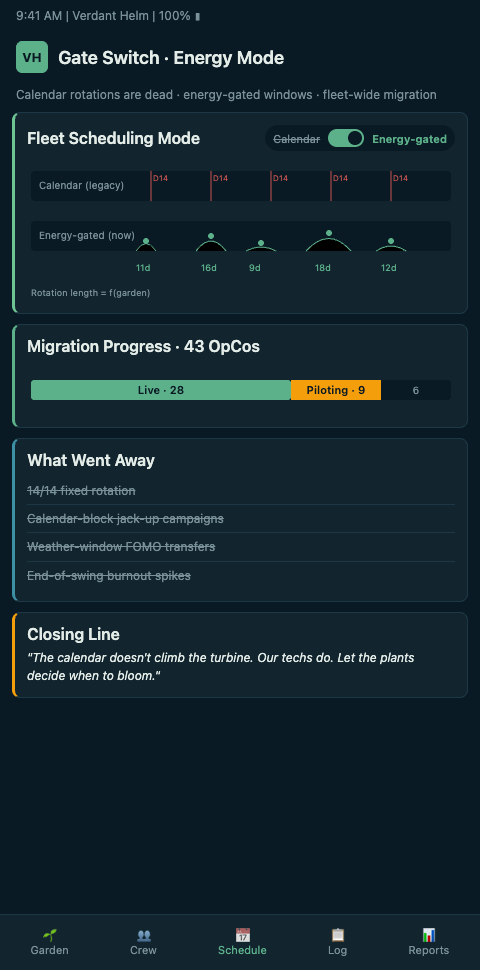
Treat the rotation as a gated garden, not a scheduled one. Each tech's on-off transition is governed by bloom-state evidence, not by the calendar alone. The calendar sets the minimum scaffolding — a tech cannot be kept onshore beyond a regulatory maximum, cannot be called back before a minimum recovery window — but within those bounds the gate opens when the garden says the bed is ready. Verdant Helm implements this as a state machine per tech: off-rotation becomes on-rotation only when the recovery ledger is in credit and the bloom projection for the next 14 days is above the operational threshold. The calendar becomes a boundary condition, not the driver.
The cross-sector template exists. ICAO's Fatigue Management framework defines the Fatigue Risk Management System (FRMS) as data-driven monitoring of fatigue risks across aviation operations. IATA's 2025 FRMS white paper documents performance-based FRMS replacing prescriptive duty-hour limits — the same shift offshore wind needs. SKYbrary's FRMS reference walks through the aviation-standard framework balancing safety with commercial needs. Aviation made the transition from calendar duty limits to data-gated duty management over roughly fifteen years. Offshore wind is at the start of the same arc and has the telemetry foundation to move faster.
The labour-contract implications of the transition need spelling out explicitly. Existing 14/14 contracts specify duty and rest periods in calendar days. Energy-gated rotations need contract language that preserves the calendar floor (a tech cannot be held on rotation beyond the contracted maximum) while permitting data-gated adjustment within that envelope. The early-mover opcos are negotiating two-page addenda to existing collective agreements rather than redrafting the whole contract, which lets the gated system operate alongside the existing framework without requiring a full labour-relations rebuild. This incremental path is how aviation FRMS actually deployed over its transition decade — and it is the path offshore wind can learn from rather than reinvent.
Sleep-science consensus reinforces the need. AASM/SRS guiding principles on work shift duration in the Journal of Clinical Sleep Medicine show performance degrades beyond 8-hour shifts in ways the calendar 14-on ignores. A calendar rotation that imposes back-to-back 12-hour shifts across 14 days without gating on actual readiness is writing off performance by construction.
The regulatory precedent is building too. European workforce directives have been trending toward outcome-based safety frameworks rather than prescriptive hour limits, and UK HSE's focus on human-factors integration in high-hazard industries creates the receptive environment for data-gated rotation pilots. The first opco to formally publish its energy-gated rotation outcomes in a regulator-reviewed format becomes the reference case that subsequent opcos cite, shortening the adoption curve across the sector. The structural advantage goes to the early movers who build the evidence base before the regulatory posture hardens around either prescriptive hours or data-gated frameworks.
The operational tools for energy gating are live. Circadian's biomathematical fatigue model provides real-time fatigue-risk scoring that flags workers at risk — the same class of model that aviation FRMS uses. Verdant Helm combines biomathematical scoring with bloom-state evidence from logged climbs, wearable aggregates, and tech-reported readiness to produce a gate decision that a crewing manager can defend in a review. The gate is not a black box; it is a set of named criteria with documented evidence, ready to show an HSE auditor or a commercial counterparty.
Implementation needs a specific political sequence. The crewing manager needs ops-committee authority to run the gate as advisor. The HSE lead needs the legal team to bless the evidence archive format. The commercial team needs to see the gate's implications for OEM SLA conversations before the policy launches, not after. The techs themselves need to understand that the gate can extend their off-rotation as well as shorten it, so the system is not perceived as one-way restriction. Energy gating that launches without any one of these constituencies bought in produces a rollback within one season. Launches that work have all four aligned before the first gate decision fires.
Advanced Tactics
Three design choices separate an energy-gated rotation that lands from one that gets rolled back after a crewing-manager complaint.
First, make the gate bidirectional. The politically easy version only gates on-rotation — a tech in poor bloom state gets held off. The more useful version also gates off-rotation — a tech whose work window did not deplete their garden can be offered an optional extension, with matching off-rotation credit, when an upcoming hot window has a roster gap. This turns the gate from a restriction-only instrument into a capacity-flex one, and the commercial team stops seeing the system as a cost centre.
Second, run the gate as an advisor before running it as a rule. For the first season, Verdant Helm's gate produces a recommendation alongside the calendar rotation, and the crewing manager chooses whether to follow it. After one season of recommendation-and-outcome data, the opco has evidence for which gate decisions would have changed outcomes — good or bad — and the transition to a binding gate becomes defensible. Skipping the advisor phase produces legal and cultural fragility the rotation shift cannot survive.
Third, document the gate decisions in contract-grade form. Every gate open and gate close generates a record with the bloom-state evidence, the biomathematical score, and the acting manager's decision. This archive is what makes the gated rotation auditable, defensible in a tribunal, and usable as evidence in the next O&M contract negotiation. Without the archive, the gate is an undocumented exercise of managerial discretion. With it, the rotation policy has the same evidentiary depth that aviation FRMS achieved over its fifteen-year transition.
Fourth, coordinate the gate rollout with the union and the works council. Energy gating changes the labour contract's implicit terms even if the formal rotation maximums stay unchanged, and proceeding without labour-side engagement creates grievances the gate cannot easily absorb. The right engagement treats the gate as a co-designed policy, with the union participating in schema review and the works council signing off on the evidence archive format. This is not a slower path; it is the path that survives the first contested gate decision and the first collective-bargaining review.
Fifth, publish annual reports on the gate's outcomes. Techs who see a public record of how the gate changed dispatch decisions, which outcomes followed, and which individual-level privacy protections were maintained build trust in a system that otherwise looks opaque. Verdant Helm's annual gate report publishes aggregate statistics — gates opened, gates held closed, outcomes under each — with full individual anonymisation, matching the transparency standards that aviation FRMS has developed. Transparency is what converts the gate from a management tool into a credible workforce protection.
Energy-gated windows are the capstone of a governance stack. They are the crewing-policy partner to fatigue-weighted SLAs in offshore wind O&M contracts — the gate generates the evidence the SLA carveout relies on. They are downstream of the 50,000 transfer attempts dataset's intensity lessons, which calibrate the bloom thresholds that drive the gate. And for the cruise-sector parallel, ending the 9-month contract with garden-gated hospitality rotations shows the same structural shift reshaping a sibling maritime labour contract, with adoption lessons that transfer directly back to offshore wind.
Run the Gate as Advisor This Season
Offshore Wind Ops crewing managers with a 14/14 roster in place can deploy Verdant Helm's gate as an advisor layer this season — no policy change, no contract revision, no regulatory filing. The gate runs alongside the calendar, generates its recommendation, and logs the delta. At season end, the manager has an evidence base showing how many dispatch decisions the gate would have changed and what happened instead. That is the proof required to take the binding-gate conversation to HSE, legal, and commercial next winter — and the moment the calendar rotation stops being the source of truth.
Engage the union representative at the advisor launch, not at the binding-gate decision point. The advisor phase is the low-risk window to invite labour-side scrutiny of the bloom-state schema, the evidence archive format, and the anonymisation protections — and opcos that treat this engagement as a box-tick during the advisor season produce grievances during the binding season that are structurally harder to resolve. A union representative who has sat through a season of advisor-phase data and understands the schema's edge cases is the ally the binding-gate rollout needs; a union representative who learns about the gate for the first time at the binding-gate proposal is an opposition the rollout may not survive.
Hold the season-end review as a formal structured meeting rather than an end-of-quarter aside. The advisor phase produces evidence the binding-gate case depends on, and the evidence has four audiences: crewing management, HSE, commercial, and the union. Each reads the same dataset differently, and the structured review gives each audience time to ask the questions that will otherwise surface later under pressure. Crewing management asks about the specific dispatch decisions the gate flagged. HSE asks about incident correlation. Commercial asks about the SLA implications. The union asks about the individual cases and the anonymisation discipline. A single three-hour review meeting at season end, with a written record signed by all four audiences, is what converts advisor-phase data into the structural artifact that makes the binding-gate conversation defensible the following winter.