Intensity Spike Modeling for Floating Wind Assets
The Crew Load Starts Before the Climb
A floating wind technician at Hywind Scotland boards a CTV in Peterhead on a Monday morning for a 24 km transit to a spar platform in 100 m of water. By the time she reaches the asset, her inner ear has processed three hours of pitch-and-heave motion that a fixed-bottom tech in a Grimsby CTV never sees. Her climb has not started. Her garden bed has already drawn water. Equinor's five-year data from Hywind Scotland — the world's first floating OWF, 54% capacity factor, survival through Ophelia and Caroline with 10m waves — makes the operational case for floating obvious. The crew-intensity case needs a different model.
Principle Power's Kincardine baseline established the WindFloat semi-submersible pattern offshore Scotland, and Spinergie's writeup of heavy maintenance at Kincardine documents the step change in intensity: a $4 million marine spread for the first heavy repair, towed 400 miles to Rotterdam because UK port infrastructure could not handle the semi-sub. Every one of those 400 miles is crew time on a transit under motion. The NREL report on challenges and opportunities for floating offshore wind walks through the substructure spectrum — spar, semi-sub, TLP — and flags ultradeep O&M intensity as a core unresolved cost.
The Hywind Tampen build-out off Norway, the ScotWind leasing round, and the Celtic Sea pilot awards together map out roughly 25 GW of floating capacity planned by 2035, and the workforce implications for crew intensity modelling are already landing on crewing managers who have only worked fixed-bottom rotations before. The float-to-fixed gate is the organisational knowledge gap the sector is about to run through at scale, and the opcos that build intensity models now are the ones whose first floating campaigns will land cleanly rather than expensively.
Modelling the Spike as a Garden Under Tidal Pull
Fixed-bottom wind gardens experience intensity as weather windows. Floating wind gardens experience it as weather plus motion plus transit plus tow-to-port risk plus port-scarcity compounding. The garden is not on firm soil; it is on a raft that moves with the swell. Verdant Helm models floating intensity as a tidal pull beneath every bed, so even during nominal bloom the soil is being worked harder than the fixed-bottom equivalent. The bloom projection for a floating-asset tech accounts for this baseline draw and tightens the wilt threshold accordingly.
The modelling stack assembles four layers. Base crew state matches the fixed-bottom model — sleep, readiness, logged climbs, near-misses. On top, a transit-motion layer estimates cumulative pitch/heave/roll exposure across CTV transits and SOV station-keeping hours, calibrated against the IEA Wind Task 49 reference floating wind design, VolturnUS-S semi-sub baseline for mooring and motion modelling. A third layer tracks heavy-maintenance campaign exposure: when a platform enters a tow-to-port cycle, the attached crew roster inherits an elevated intensity tier for the duration, because the campaign compresses what would normally be weeks of work into a contained window under unusual logistics.
The modelling also needs to handle the substructure diversity explicitly. Spar platforms like Hywind produce a pitch-dominated motion signature that affects vestibular fatigue differently from the heave-dominated signature of semi-submersibles like WindFloat. Tension leg platforms restrict motion across multiple axes but concentrate it at specific harmonic frequencies that couple poorly with human physiology. Each substructure type needs its own transit-motion coefficient set, its own recovery decay curve during off-shift hours, and its own campaign-intensity amplifier during tow-to-port events. Verdant Helm ships reference coefficient sets for all three substructure families and accepts per-platform overrides as the operator accumulates campaign-specific data.
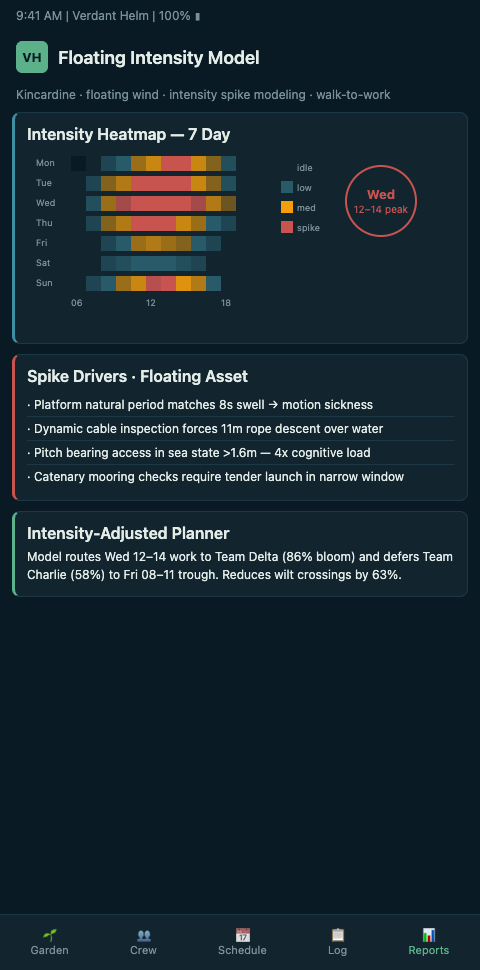
The fourth layer handles intensity spikes — the real value of the floating model. A storm-driven motion event does not just break a climb plan; it breaks recovery itself, because the SOV berthed alongside a floating asset moves more than one berthed alongside a fixed monopile. The Carbon Trust Floating Wind Joint Industry Project, with 16 developers, has been tackling heavy-lift maintenance and tow-to-port risk, and the JIP data feeds several commercial motion models that Verdant Helm can ingest for per-platform calibration. A 2025 MDPI Energies review of digital twin applications for floating offshore wind documents floating-specific motion and fatigue modelling via digital twin as the path to operational spike forecasting. Verdant Helm's crew layer attaches to those same DTs as a consumer, so the platform's motion state and the crew's bloom state are joined at query time, not bolted together in a spreadsheet later.
Seasonal stacking on floating assets also behaves differently from fixed-bottom equivalents. A floating-asset roster that absorbs a hot window in summer carries more residual ledger debit into the following quarter than a fixed-bottom roster absorbing the same window, because the motion baseline during off-shift SOV hours kept drawing against recovery all season long. The cumulative year-end ledger for a floating roster therefore looks worse at any given productivity level, and the operator needs to plan a longer off-season recovery cycle to restore the garden before the next working season. Operators that treat floating O&M as "same as fixed-bottom plus transit time" miss this systemic difference and end up with wilted rosters entering their second season.
The result is a garden view where the dispatcher sees the expected intensity curve for a floating asset under next week's forecast, and the curve already has the motion and tow-risk amplifiers baked in. A 36-hour workable window at a floating asset is not equivalent to a 36-hour window at a fixed-bottom one, and the dispatch decision reflects that.
The intensity spike is not abstract. A specific example: a Kincardine-style semi-sub platform in 9m swell sees each turbine top execute 1.5-2m of motion at the nacelle, amplified from the waterline. A blade inspection that would take 90 minutes at a fixed-bottom platform takes 120-140 minutes at the floating one because the tech is bracing against motion for the entire inspection window. The 40-minute differential compounds across a campaign — twelve blade inspections absorb an additional eight hours of crew time per platform, and the bloom-state impact of those eight hours under motion is measurably greater than eight hours of static climbing. Verdant Helm's campaign view captures this as a campaign-specific intensity coefficient, logged per platform per campaign type.
Port infrastructure risk is its own modelled layer. When the Kincardine semi-sub required tow-to-port for repair, the 400-mile tow introduced a distinct crew-state pattern: the marine spread crew worked extended hours through the tow, the wind techs waited idle at the destination port with ledger implications both for the idle days and for the returning transit, and the receiving port workers experienced a concentrated burst of heavy-lift activity. Each of these three cohorts experienced a distinct intensity profile during what the project plan treated as a single "tow-to-port event." The garden view partitions the event by cohort so the bloom-state accounting matches the operational reality.
Advanced Tactics
Three modelling choices decide whether the floating intensity view holds up under the first real heavy-maintenance campaign.
First, calibrate per platform, not per sector. Spar platforms, semi-submersibles, and TLPs produce distinct motion signatures. A Hywind spar in 100 m swell behaves nothing like a WindFloat semi-sub in equivalent conditions, and the crew-intensity amplifier must reflect that. Verdant Helm accepts a per-platform motion response surface as configuration, so the same software runs correctly across a mixed portfolio without averaging away the thing that actually matters — the specific platform the tech is working on today.
Second, model the recovery asymmetry. Fixed-bottom techs recover on an SOV that holds station within a narrow window. Floating-asset techs recover on SOVs or walk-to-work vessels that are themselves experiencing motion. Sleep quality on a moving platform is measurably worse, which means the "off-shift" half of the 14/14 is less restorative than the same half would be at a fixed-bottom asset. The garden needs to debit the recovery ledger for motion during off-shift hours, not just during active work — otherwise day-ten wilt arrives a day or two earlier than the model expects, and the dispatch plan fails in exactly the moment the campaign cannot absorb the loss.
Third, plan tow-to-port campaigns as distinct intensity artefacts. When a platform is towed for heavy repair, the crew rotation attached to the campaign lives through an operational profile that calendar scheduling does not represent. Verdant Helm generates a campaign-specific bloom projection, with separate recovery logic and separate wilt thresholds, and archives the campaign as a discrete dataset. Over successive campaigns, the opco builds an intensity library that calibrates future bids and SLAs with real data rather than assumed equivalence to fixed-bottom experience.
Floating wind sits inside a larger intensity conversation. The 50,000 transfer-attempts intensity dataset is the fixed-bottom baseline that floating models benchmark against. The compressed-window problem — tech exhaustion curves inside a 10-day weather window — applies with sharper slope to floating assets because the motion baseline compounds faster. And rotation reform at the oil-and-gas end of the sector — beyond 28/28 fatigue-gated rotations — traces the same governance shift that floating wind rotations will need as deepwater assets scale past prototype status.
Calibrate One Floating Platform This Campaign
Offshore Wind Ops teams running or preparing for floating asset operations should book a scoping session, pick one platform, and instrument it end to end for the next heavy-maintenance campaign. Wire Verdant Helm's crew layer to the platform's digital twin, ingest CTV and SOV motion during the campaign, and log the bloom trajectory of the attached roster across the full tow-and-return cycle. The post-campaign comparison against a fixed-bottom roster of similar size is the calibration artifact that makes the next three floating campaigns defensible — and makes the next SLA negotiation arrive with data nobody else in the room has.
Pick the platform whose substructure family matches the operator's wider pipeline. Calibrating a WindFloat semi-sub is operationally different from calibrating a Hywind spar, and an operator whose ScotWind pipeline is mostly semi-submersible gets more value from a semi-sub calibration than from a spar calibration even if the spar is more accessible. The coefficient set derived from the first calibrated platform will seed the next three campaigns in the same family, which is the compounding that turns a single calibration into a portfolio-scale asset.
Instrument the full cohort spectrum, not just the wind techs. The tow-to-port example in the body of this post partitions the event across three cohorts — marine spread, wind techs, receiving port — and each needs its own bloom-state stream for the calibration to hold. Most opcos start with only the wind-tech stream because that is the cohort they already manage, and then discover mid-campaign that the marine spread ledger was the real bottleneck. Scoping the instrumentation plan with all three cohorts named from day one is cheaper than retrofitting the marine spread during the first tow.
Commit to the year-end ledger comparison before the campaign starts. The systemic difference between floating and fixed-bottom rosters shows up in the year-end ledger, not in the single-campaign debrief, and opcos that close the campaign without scheduling the annual comparison lose the compounding benefit. Name the finance analyst, the HSE lead, and the crewing manager who will co-sign the year-end comparison document, and book the review slot in Q1 of the following year before the first tow begins. That calendar commitment is what turns the instrumented platform into the permanent intensity library the next SLA negotiation will draw from.