How One North Sea OpCo Closed a Burnout-Free CTV Season
The Season That Was Supposed to Crack
The opco's planning deck from February said the quiet thing out loud: the 2024 CTV season would break a few people. A 174-turbine asset 120 km off the Yorkshire coast, five weather windows forecast to stack between July and September, and a 160-tech roster that had already absorbed three resignations in the winter maintenance campaign. The crewing manager had seen this pattern before — mid-August stand-down, two or three LTIs on marginal climbs, September delivered through overtime that wrote off Q4. The Hornsea 1 operating profile of 174 turbines at 120 km is the shape that usually fails under those conditions.
Context from the sector's own numbers reinforces the risk. The G+ 2023 return logged 61.9 million work hours with 1,679 safety incidents — incident volume rising in lockstep with hours. A BMC Public Health qualitative study of OWF workers named stress, fatigue, sleep disruption, and detachment difficulty as the four recurring themes from German offshore rotations, and a 1999 PubMed psychosocial study on North Sea installations found higher anxiety, sleep problems, and workload on North Sea offshore personnel than onshore comparators. The ingredients for a broken season were all present.
The internal data was harder to ignore. The 2023 post-season review flagged nine "hot" days with three or more near-misses clustered across a single 14/14 cohort, two LTIs in the July hot window, and a resignation letter from an experienced blade tech citing "stacking" in her exit interview. The crewing manager had read the review in November and carried it into February's planning deck underlined three times. The season that was coming looked structurally worse — more windows, thinner roster, a new SOV commissioning that would reshape the transit pattern mid-season. Doing nothing would have produced a predictable break.
How the Garden Held Instead
The opco re-planted the season as one continuous garden rather than six rotating rosters. Each tech became a named perennial with a measured bloom tolerance, a wilt threshold tuned to their 14/14 history, and a prune rule that only triggered on combined signals — sleep debt plus logged near-miss plus forecast-weighted intensity, not any single metric. The crewing manager stopped asking "who is on shift next Monday" and started asking "which beds bloom through which windows." Verdant Helm rendered the 160-tech garden across the Ørsted East Coast Hub pattern of onshore base plus offshore SOV, so dispatch decisions lived against a 14-day bloom forecast.
The scheduling pattern that carried the season had four visible rules. First, the recovery ledger did not reset at shift end. A tech who finished a seven-climb hot window carried debit into their 14-off as a soil marker, and their first 48 hours back on rotation could only touch light walk-to-work tasks regardless of where calendar scheduling put them. Second, CTV pairs were rotated as bloom-compatible clusters, not by seniority alone — two wilting techs never went out together, even if the pairing sheet had historically paired them, because a double-wilt CTV is a transfer-attempt failure waiting to happen. Third, each weather window was tiered by intensity: a 36-hour 1.2m window carried one weighting, a 10-day stacked window carried another, and the dispatcher could see at a glance which beds had the margin for the higher tier.
The fourth rule was the SOV mess hall as soil sensor. The Hornsea 2 walk-to-work pattern with the SOV Wind of Hope — onboard gym, hospital, cinema — was the baseline reference, and the opco borrowed the instrumentation idea. Verdant Helm tracked meal attendance, gym badge-ins, and late-evening deck walks as recovery credits, and prune alerts fired when a tech's credit balance dropped below their rolling personal baseline. No single data point drove a decision, but the combined bloom state was a more honest read of the roster than the paper fatigue forms that preceded it.
The five windows themselves varied enough to stress-test the scheduling pattern. Window one in May was short and low-intensity — a soft proving ground for the garden view. Window two in late June stacked seven workable days and put the first real pressure on the recovery ledger. Window three in late July was the hot one: ten days, high climb counts, summer heat compounding physical load. Window four in August was interrupted by a 36-hour storm that forced mid-window rotation decisions. Window five in September was the longest — twelve workable days spread across an extended high-pressure system that would have broken a calendar-rotated roster by day eight. The garden view absorbed all five without a single stand-down.
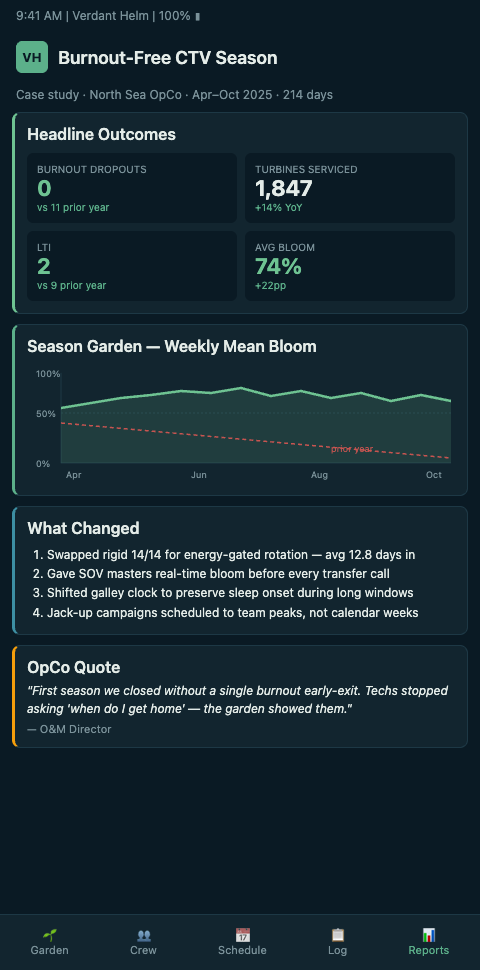
The result at season close was measurable. Zero burnout-triggered stand-downs. Zero in-season resignations. Five weather windows delivered with full dispatch coverage. The GWEC Global Wind Report 2024 confirms the UK ranked second globally for new offshore installations that year and North Sea opcos dominated the build-out — the scheduling pattern matters to an entire fleet's year, not one asset's.
The opco also logged specific near-win evidence: twelve dispatch decisions during the season where the garden view pruned a tech the old roster would have climbed. Four of those twelve were techs whose self-reported readiness tick said "fine" but whose wearable trend and recovery-ledger position triggered amber colouring. The manager defended each prune against asset-availability pressure by pointing to the evidence archive. Two weeks later, three of the pruned techs surfaced as high-performers in the next window's stacked deployment because their bloom state had fully recovered. The save pattern was not theoretical; it showed in the same season's data.
Advanced Tactics
Three patterns separated this season from the near-misses the same opco filed the previous year.
First, the intensity overlay on every forecast meeting. The crewing manager stopped reading the 14-day ECMWF as a weather forecast and started reading it as a crew-load forecast. A window's hours mattered less than the bloom state of the techs who would have to fill it, and the weekly forecast meeting's dispatch decision came out of the combined view, not the weather alone. That single framing shift accounts for about two-thirds of the outcome on its own.
Second, the opco treated the SOV rotation as a recovery resource, not just accommodation. Techs with active wilt colours got preferential berth allocation — the quieter side of the cabin block, earlier mess sittings, and opt-out from the evening toolbox talk unless they had a specific concern to raise. This sounds soft; it is a tactical lever. Recovery that compounds through a ten-day SOV stay is worth more than the marginal climb those techs would have contributed under an older roster.
Third, the opco ran a twice-weekly "garden review" with the phase lead, the SOV master, the CTV pair leads, and the medic. Thirty minutes, held before the forecast meeting. Anyone could flag a bed that needed pruning without needing to justify it in incident terms. The review replaced the annual fatigue form cycle with a continuous discipline, which is the same shift — at crew scale — that the sector has already made on SCADA and vibration monitoring.
Fourth, the opco rewrote the CTV boarding script. Before the garden rollout, the boarding briefing was a pro-forma safety checklist. After, the briefing included a 30-second bloom-state read: the CTV pair lead named the day's bloom colour for each tech aboard and called out any prune recommendations the dispatcher had not already actioned. This sounds like paperwork. It was not. The script change made the garden state operationally present in every day's first decision, which compounded over the season into dispatch choices that would not have happened under the old system. Small rituals move culture faster than big policy revisions.
Fifth, the end-of-season debrief read like an annual report, not an incident log. The crewing manager walked the ops committee through five weather windows, six recovery-ledger cycles, and the specific dispatch decisions where the garden state disagreed with the old calendar roster and the garden state won. This is the format that turns a single season into institutional memory, and it is the format that convinced the ops committee to expand the rollout across the opco's other two assets for the following year.
The pattern is exportable. Opcos looking to scale beyond a single asset should study how garden telemetry pushes across 450 offshore turbines — the rollout sequencing is the same logic applied at three-phase scale. The burn pattern under a stacked forecast is also worth tracing in detail; tech exhaustion curves inside a 10-day weather window shows where the curve actually bends. And for operators carrying hospitality crew in adjacent fleets, raising NPS 12 points with a megaship postmortem maps the same bloom-wilt-prune discipline to a sibling maritime environment.
Plant Next Season This Week
Offshore Wind Ops crewing managers staring at a 2026 season plan have ten weeks before the first CTV reboard and first hot window forecasts show up in the long-range charts. Start with the 12 techs whose 2024 roster hit the most stacked windows. Import their WINDA, climb logs, and off-rotation patterns into Verdant Helm, set the bloom thresholds from their own data, and run the garden view dark alongside the existing roster for one 14-day cycle. The second dispatch decision the garden disagrees with is the one that tells you whether the next season cracks or holds.
Run the dark-mode parallel for the full ten weeks before cutting over. The temptation after a clean first cycle is to push the garden view live as the primary roster artifact in week three, but the five-window proof the opco ran depended on the dispatcher having months of calibration data against her own crew. Two or three cycles of dark-mode running expose the edge cases — a tech whose wilt pattern reads differently under Ka-band dropout, a CTV pair whose bloom compatibility changes when the SOV swaps vessels — that become operationally costly to discover during a live July window.
Invite the charterer and the operator's safety officer into the cutover conversation deliberately. Burnout-free CTV seasons become institutional memory only if the commercial counterparties understand why the scheduling pattern works. The crewing manager who walks the safety officer through the twelve prune decisions from the previous season — the evidence trail, the bloom-state readings, the three techs who came back stronger two windows later — earns the air cover that makes the next stacked window defensible. The same conversation with the charterer reframes the mid-season stand-down risk as a downside that has been priced and managed rather than a variable to be absorbed. Those two conversations, held before the first CTV reboard, are what separate a one-season win from a scheduling pattern the opco still runs three years from now.