Rotating Blade Teams With Garden-State Transfer Rules
The Problem: Cross-Site Blade Rotation Runs on a Rigid Calendar
Blade teams in offshore wind increasingly work cross-site. The ORCA Crew analysis of cross-skilled, project-based crewing forecasts 628,000 wind technicians needed by 2030, and the model that ships blade teams across multiple fields in a season is already here. IRATA's renewable energy guidance and SPRAT's rope access team-rotation norms both govern the certifications, the supervision chain, and the handover protocol. Those frameworks work at the paperwork layer. They do not govern the day-to-day decision of whether a specific team is in shape to transfer on a specific morning.
The East Anglia blade lead running three rope pairs was 11 days into a campaign when two pairs crossed into amber on the same day. The cross-site transfer to a second field — a Thames Estuary project — had been pre-booked two months prior, based on the calendar model that assumed all three pairs would finish the East Anglia campaign in green bloom. The garden was telling him that two pairs needed watering, not boarding. The calendar was telling him the CTV was booked at 06:30 the next morning.
The Wiley/Wind Energy numerical study of major blade repair and replacement operations treats these campaigns as resource-constrained optimization problems, and the ScienceDirect state-of-the-art offshore wind O&M review does the same for broader maintenance scheduling. Both frame the problem around component-side constraints: tower lifts, rope-access time, drone survey coverage, weather windows. Neither framework carries the crew-side constraint in the same optimizer. The PMC musculoskeletal pain study of offshore wind industry workers and the MDPI drone inspection workflow review both name the fatigue dimension — the MSD prevalence is high, and the drone-plus-human workflow assumes human availability — but neither is wired into the rotation decision.
The rigid calendar is the industry default because the alternative — a calendar that responds to live garden state — requires two things most operators do not have. First, the bloom signal in real time across the team. Second, a transfer rule set that the lead can invoke without rewriting every downstream contract. The lead in the opening example had neither. He made the transfer call on intuition, pulled one pair back from the cross-site, and ate the schedule slip.
The Solution: Garden-State Transfer Rules That Flex the Rotation
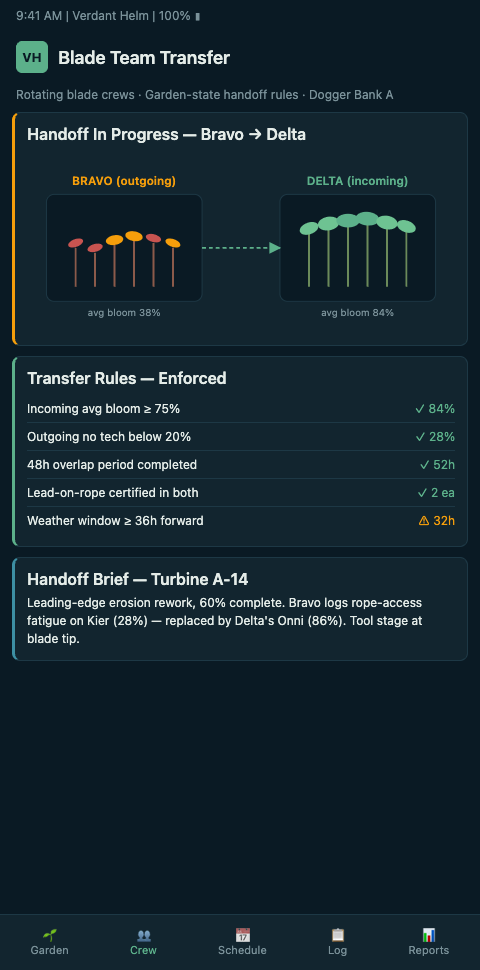
Verdant Helm runs the cross-site blade rotation as a garden with transfer rules keyed to bloom state. Each rope pair is a perennial in the bed. The bed has four transfer-rule tiers: green-transfer (pair can cross-site), amber-transfer (pair holds on current site for recovery), red-transfer (pair rotates to shore), and split-pair (the two techs in the pair are at different bloom states and the rule treats them individually). The lead reads the tier for each pair on the morning of the scheduled transfer and invokes whichever rule the garden justifies.
The green-transfer rule is the straightforward case. A pair in full bloom, with IRATA or SPRAT certification current, GWO refresher in date, and MSK screening clean, clears the cross-site transfer. The amber-transfer rule holds the pair on the current site for one to three days of watering — lighter climb load, a hub-only ticket day, or a shore-base logistics day — before re-evaluating. The red-transfer rule sends the pair to shore and triggers a bench pull from the on-call roster. The split-pair rule flags that the pair should be reconstituted — maybe Tech A pairs with a fresh Tech C for the cross-site, and Tech B holds for recovery.
The rule set is only useful if the lead can invoke it without renegotiating every downstream contract. Verdant Helm builds the transfer rules into the rotation plan upstream — the two-month-out contract with the second field already has flex-window language that the garden-state tier feeds into. The CTV booking, the second-field mobilisation, the IRATA supervision coverage on both sides, all carry the flex as a parameter. The lead's morning call becomes a tier pick inside a pre-agreed envelope, not a mid-campaign renegotiation.
The garden framing holds the rotation together even when the tiers shift. The bed layout makes it visible which pairs are close to crossover and when. The sink identification — the low corner where fatigue pools — tells the lead which roles are structurally under-watered and need rotation redesign, not just a one-day flex. The head-gardener analogy carries: you do not transplant perennials that are mid-bloom, you do not plant fresh into a bed that is over-watered, and you prune on the days the garden can absorb the pruning.
The Wiley/Wind Energy major-repair modeling assumes the workforce is fungible across the campaign. It is not. The bed of pairs certified for leading-edge erosion repair is different from the bed certified for structural rope rescue, and the MDPI drone-plus-human workflow explicitly couples drone operator skill to rope tech interpretation skill. The garden models these bed boundaries, and the transfer rules respect them — a bloomed pair that lacks the skill profile for the second field does not transfer, regardless of tier.
Sequencing blade inspections around team fatigue cycles is the sister-piece that covers the within-campaign pacing of the same teams, and SOV transit cycles from garden curves covers the SOV-side coordination when the transfer happens off a service vessel. For oil and gas teams running a compatible split-shift pattern, the mud engineer split-shift garden covers adjacent ground from the drilling side.
Advanced Tactics
Four extensions take the transfer rules from a morning-of call to a multi-site rotation system. The first is the split-pair reconstitution engine. When a pair falls into split-pair tier, the tool searches the bench and on-call roster for a compatible tech — same rope certification, same skill profile, same recent training — and produces two or three viable pair reconstitutions. The lead picks one; the tool updates the IRATA supervision chain and the GWO refresher coverage automatically. SPRAT's rope-access norms require continuity of supervision; the reconstitution engine honors that constraint without forcing the lead to hand-check it.
The second is the cross-site bloom debt carry. A pair that transfers in green bloom from East Anglia to the Thames Estuary does not arrive with a reset bloom — the carry-forward is real, and the second field's lead needs to see it. Verdant Helm carries the bloom-state metadata across the transfer, and the second-field dashboard reads the incoming pair's bloom curve as it continues from the first site. The rotation plan on the second field pre-seats the pair's first few days accordingly.
The third is the campaign-level transfer audit. At the end of a multi-site season, the tool generates a transfer audit showing every scheduled transfer, every tier invocation, every flex call, and the bloom trajectory across the season. The audit feeds the next season's rotation design — which transfer dates were reliable, which consistently required flex, which pair compositions held up, and which reconstitutions were forced. The ScienceDirect O&M review argues for data-driven maintenance scheduling; the garden audit is the crew-side analog.
The fourth is the MSK and training overlay. The PMC study on MSK pain prevalence in offshore wind shows that musculoskeletal debt accumulates across campaigns, and the tier rules should reflect that. Verdant Helm overlays the pair's MSK screening history, training refresher dates, and recent medical flags onto the bloom state, so the tier pick carries the full health context. A pair at technical green bloom but overdue for a GWO refresher does not clear for cross-site transfer — the rule treats the training lapse as an amber downgrade.
Pilot the Transfer Rules on Your Next Cross-Site Move
If your blade team rotation plan is still rigid across sites, your next scheduled transfer is probably sitting on top of a bloom crossover you cannot see yet. The Verdant Helm team will run a cross-site pilot — reconstruct bloom curves for your current blade teams, build the tier rule set against your real certification and rotation data, and wire the rules into the next scheduled transfer. Offshore Wind O&M blade leads running IRATA or SPRAT rope teams across North Sea, Irish Sea, Baltic, and US East Coast campaigns have used this pilot. Most leads flex at least one scheduled transfer in the first month and restructure one pair reconstitution before the season's second cross-site move.
Citations:
- IRATA International: Renewable Energy
- SPRAT: Rope Access
- ScienceDirect: Offshore Wind Turbine Operations and Maintenance — State-of-the-Art Review
- Wiley/Wind Energy: Numerical Study of Major Repair and Replacement of Offshore Wind Turbine Blades
- PMC: Musculoskeletal Pain Among Offshore Wind Industry Workers — Cross-Sectional Study
- MDPI: Review of Drone-Based Technologies for Wind Turbine Blade Inspection
- ORCA Crew: Offshore Wind Recruitment Is Reshaping Maritime Crewing
Book the cross-site pilot with the Verdant Helm team ahead of your next scheduled transfer.