Storm Pattern Analysis Across Atlantic vs Gulf Citrus Regions
Same Basin, Different Exposure Geometry
A Murcott grower with blocks on both coasts of Florida sat down in November 2024 and tried to reconcile his Atlantic-side and Gulf-side loss histories from the prior decade. The Atlantic blocks near Vero Beach had been hit by Ian's eastern wall in 2022, grazed by Dorian's Bahamas approach in 2019, and missed by Milton in 2024. The Gulf blocks near Arcadia had been hit hard by Ian's Gulf-side approach, caught the full Milton blast in 2024, and missed Irma's 2017 eye wall. His total 10-year loss ratio was roughly equivalent between the two operations, but the timing, the damage signatures, and the salt-aerosol patterns were completely different. Without basin-split 10-year loss ratio forecasting, his reinsurance tier assignment priced both coasts as one number. He needed basin-specific storm-pattern analysis to price each operation separately.
The underlying climatology supports the asymmetry. Hurricane frequency and landfall distribution research for Gulf coast wetlands documents that roughly two-thirds of Atlantic-basin landfalls hit the Gulf coast, and Florida's landfall incidence runs approximately 2x Texas's — defining the regional exposure market that reinsurers and crop-insurance underwriters price against. NOAA's tropical cyclone climatology tool provides the landfall-frequency-by-region data, with the season peaking September 11-20 and basin-specific seasonality curves that differ between Atlantic and Gulf approaches. The Murcott grower needed to translate that state-level climatology into block-level pull-forward and hedging decisions for each coast — and his existing vendor dashboard gave him one Florida-wide advisory that masked both coasts into a single threat.
The Helm-Charted Yield Forecast With Basin-Aware Logic
HarvestHelm treats basin asymmetry as a core input to the helm-charted yield forecast, not a footnote. The helm runs separate Atlantic-side and Gulf-side storm-pattern models for any operation with blocks on both coasts, and it overlays the Atlantic Multidecadal Oscillation phase signal to adjust the block-level loss ratio forward for the current 50-70 year cycle. The AMOC slowdown linked to the recent lull in major Atlantic hurricane frequency is built into the AMO layer so the Valencia block's expected exposure tracks basin-cycle rather than a stationary average.
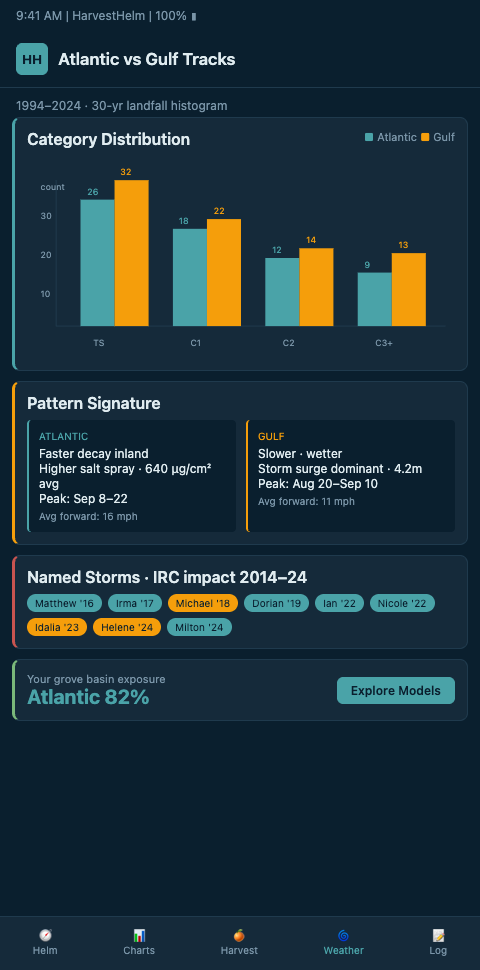
The basin-specific logic plays out in three axes on the helm chart. First, speed-of-approach. Hurricane climatology research for Tampa Bay documents that Gulf storms move slower than Atlantic-coast storms, producing different damage signatures — longer salt-aerosol exposure windows, more sustained wind at sub-hurricane intensity, and different fruit-drop kinetics on Valencia and Hamlin rows. HarvestHelm's Gulf-coast block profile uses a longer integration window on the hurricane-hour beacon and a lower salt-aerosol threshold trigger because the slow approach means more cumulative exposure before landfall. Atlantic-side blocks get a shorter integration window and a higher peak-wind weighting because the faster approach compresses the exposure into a narrower time window.
Second, genesis geography. The Yale Climate Connections analysis of Atlantic hurricane track futures documents a 44-year shift of 346 miles southward in hurricane genesis, driven by wind-shear reduction in the southern tropics. HarvestHelm incorporates that trend into the multi-year loss-ratio projection for Atlantic-side Valencia blocks, which are now exposed to a higher proportion of southern-track storms than they were in the 2000s. Gulf-side blocks get a different genesis layer driven by loop-current SST anomalies and east-Pacific teleconnection indices, which the helm pulls from NOAA reanalysis feeds.
Third, high-activity-era adjustment. NOAA's Atlantic high-activity-eras research documents AMO cycles driving high-activity eras in 1880-1900, 1945-70, and 1995-present, with severe hurricanes running 2x more frequent in warm phases. HarvestHelm's basin-aware helm pushes a higher kilo-cut expected harvest revenue for Atlantic-side blocks during warm-phase years — because the forecast models pull more fruit forward into early-harvest windows — and a more conservative baseline for cool-phase years. The captain reads two separate basin-specific charts on one screen, and the decision to commit crews on the Atlantic or Gulf side follows the chart that is currently firing. HarvestHelm is the fleet navigator handling two different sea states at once.
Advanced Tactics For Basin-Split Operations
The first advanced tactic is portfolio balancing across basins. A multi-block coastal citrus operation with Valencia on both the Atlantic and Gulf sides gains natural basin hedge — the statistical probability that both coasts see a major hurricane in the same season is lower than the single-basin probability. HarvestHelm quantifies the basin-hedge value on the helm so the operations manager can negotiate cooperative financing and insurance pricing that accounts for it. The portfolio smoothing stacks with the block-level actuarial math the 10-year loss-ratio export already surfaces in the broker's contract packet.
The second tactic is pull-forward threshold calibration per basin. HarvestHelm's Gulf-coast Valencia profile triggers pull-forward at a looser salt-aerosol threshold than the Atlantic profile because Gulf storms deposit more cumulative aerosol on the approach. The grower running blocks on both coasts would get two distinct alerting profiles tuned to the basin's actual damage geometry. This matters when staffing packinghouses — the Gulf-side crew mobilization on a Milton-class approach needs to start 12 hours earlier than the Atlantic-side crew mobilization on a Dorian-class approach. Cross-reference this tuning pattern with multi-year yield forecasting from hurricane frequency shifts for the forward-trend calibration.
The third tactic is cross-niche basin analysis. HarvestHelm runs parallel multi-season storm-pattern analyses for 15-consecutive-season monsoon shifts in tropical mango plantations, where the threat vector is Indian-Ocean monsoon timing rather than Atlantic-basin cyclone tracks. The statistical methodology translates — both are multi-season climatologies calibrated against block-level yield data — and cross-niche validation sharpens both helm products. Florida coastal citrus growers running Valencia, Hamlin, and Murcott blocks in both basins should be operating on a helm that knows which basin is firing. The kilo-cut revenue model means the basin-aware logic is paid for entirely by the harvest revenue it saves.
Salt-Aerosol Damage Signatures By Basin
The damage signature left on Valencia and Hamlin canopies differs between Atlantic and Gulf storms in ways that matter for post-storm triage. Atlantic-approach storms typically deliver a shorter but more intense salt-aerosol spike — the storm comes ashore fast, the plume is concentrated on the approach axis, and the blocks downstream see a sharp salinity curve that rises fast and decays fast. Gulf-approach storms linger in the warm-water loop-current region longer and deliver a broader, lower-intensity plume that accumulates gradually across wider acreage. The canopy damage from a Gulf plume often extends across more acres at lower intensity than the equivalent Atlantic plume, which changes the recovery calculus — more acres need post-storm freshwater flushing but fewer acres see catastrophic foliar burn.
HarvestHelm's helm encodes these basin-specific damage signatures so the post-storm triage plan matches the basin. Atlantic-storm post-storm workflows prioritize rapid identification of the high-intensity damage zone and fast packinghouse triage of any surviving fruit, while Gulf-storm post-storm workflows prioritize wider-acre freshwater flushing schedules and extended canopy monitoring over the 5 to 14 days that salt damage takes to fully express. These are different operational plans driven by the same helm infrastructure, and the grower running blocks on both coasts benefits from having one platform that handles both playbooks.
Forward Track Uncertainty And Basin-Specific Advisory Timing
One underappreciated difference between Atlantic and Gulf storms is the forward track uncertainty timeline. NHC's cone of uncertainty on an Atlantic approach typically narrows 48 to 72 hours before landfall as the steering flow consolidates, while Gulf storms in the deep-southern flow pattern can hold wider cones until 24 hours out. HarvestHelm's helm renders those cone evolutions explicitly — the Atlantic-side chart converges on a tight landfall range 48 hours before the storm, while the Gulf-side chart shows a wider band narrowing only in the final day. That difference drives different crew-mobilization timing: Atlantic growers can plan tighter, earlier mobilization with confidence, while Gulf growers need flexibility to accommodate late cone shifts. The helm builds that flexibility into the crew-scheduling module so the packinghouse queue can absorb a 12-hour schedule shift without cascading into the next day's harvest.
The basin-specific advisory timing also interacts with packinghouse staffing. An Atlantic grower with tight cone convergence can commit overtime staffing 72 hours ahead of landfall, while a Gulf grower often needs to hold staffing flexibility until the final cone update. HarvestHelm's helm generates the staffing plan for each basin automatically based on the current cone trajectory and the packinghouse's committed carton throughput, which eliminates the manual spreadsheet work that packinghouse managers typically do on the morning of every advisory update. The result is a staffing plan that flexes with the cone rather than locking in prematurely or scrambling at the last minute.
Coastal citrus growers with single-basin operations are underpricing their exposure in the wrong direction — Atlantic-only growers miss the Gulf-amplified high-activity-era signal, and Gulf-only growers miss the southern-genesis Atlantic shift. HarvestHelm's basin-aware helm-charted yield forecast resolves both blind spots on one chart, and the kilo-cut structure makes the deployment cost-free until the first basin-split harvest comes in. The Murcott grower in our opening story walked into his November 2024 review asking which coast to expand. He needed a helm that could tell him the answer. Every coastal citrus operator planning 2027 expansion should be asking the same question, and expecting a basin-specific answer grounded in AMO-aware climatology.