Documenting Brine-Damaged Fruit for USDA Disaster Claims
The $600M Claim Queue and Why Documentation Wins
Florida citrus farmers can apply for over $600M in USDA disaster grants (FreshFruitPortal) confirmed the scale of the 2026 block-grant pool and the FDACS documentation burden required to convert a claim into a payout. Growers who walked into that window with organized, timestamped, sensor-backed damage records moved through the claim queue in weeks. Growers reconstructing evidence from memory, photos on personal phones, and handwritten notes spent months in back-and-forth with adjusters — and often saw reductions on the final payout because the evidence chain had gaps.
The reductions tend to fall into patterns. Claims missing geotagged photos get the loss acreage estimated conservatively. Claims without pre-event baseline telemetry get the damage severity scored at the lower end of the range. Claims lacking lab confirmation of salt intrusion get brine damage categorized as "generalized storm damage" rather than the specific loss-type the program was designed to pay on. Every documentation gap moves the payout downward. A grower with a $280,000 documented claim might receive $210,000 with clean evidence or $135,000 with incomplete evidence — same physical damage, different payout, because adjusters can only approve what the file supports.
The documentation bar is not arbitrary. Natural Disasters and Crop Insurance (USDA RMA Fact Sheet) spells out the minimum: photographic evidence with date and location, maintained for 3 years from the date of destruction. Noninsured Disaster Assistance Program NAP (FSA) adds the Notice of Loss CCC-576 filing requirement within 15 days of the loss becoming apparent — 72 hours for hand-harvested crops. The Tree Assistance Program opens a separate 90-day application window for replant and rehabilitation cost-share after natural disasters.
For hurricane-specific events, MGR-24-007: Emergency Procedures for Crops Damaged by Hurricane Milton (RMA) authorizes delayed notices and hurricane-specific loss adjustments, but only when the grower files the required documentation package through the established workflow. The Supplemental Disaster Relief Program covers 2023-2024 hurricane, wind, and storm-surge losses with its own documentation requirements on top of the primary claim file.
Helm-Charted Evidence Chain for USDA Filing
HarvestHelm treats disaster-claim documentation the way a yacht captain treats ship's log: every significant event gets a timestamped, GPS-tagged, multi-source entry that stands up to audit. The helm-charted yield forecast captures the pre-event baseline, event trajectory, and post-event damage state automatically, then exports the combined record into the formats FSA and RMA adjusters accept.
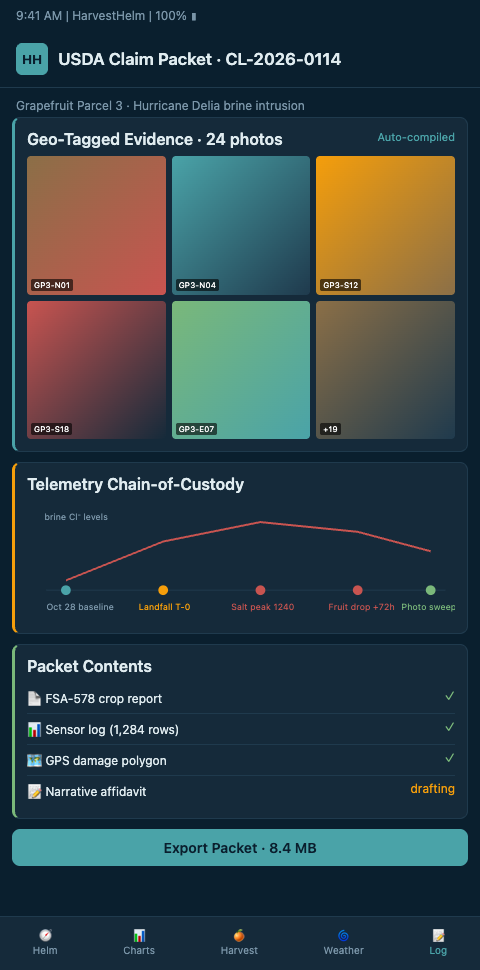
The evidence chain has five layers. Layer one: pre-event grove state. HarvestHelm maintains continuous block-level telemetry — canopy condition, sensor calibration logs, soil chloride baseline, prior-season yield records — so when an adjuster asks "what was the pre-event baseline," the answer is a dated export, not a recollection.
Layer two: event timeline. The sensor network captures salt-conductivity spikes, wind-gust peaks, precipitation totals, and soil-moisture trajectories at 15-minute resolution during active tracks. HarvestHelm bundles the event telemetry into a time-series export with GPS tags per block. Adjusters reviewing brine-damage claims can trace the deposition event directly to the damage footprint without relying on the grower's narrative.
Layer three: post-event damage documentation. The dashboard workflow during the T+24 through T+168 window generates a structured damage-inspection log with timestamped, geotagged photos per block, leaf-sample collection records, and quantified canopy-loss estimates. HarvestHelm's export includes the fields needed for both federal and state-level filings.
Layer four: expert-witness materials. Lab results for leaf chloride and sodium content, third-party agronomist inspection reports, and certified packhouse grading records. HarvestHelm routes block leaf samples through a lab-tracking workflow so the chloride and sodium values come back tied to the block GPS and the event date, which is what an adjuster needs to validate a brine-damage claim.
Layer five: financial exposure documentation. Contract commitments, packhouse reservations that were or were not honored, juice-plant diversion routing logs, and the economic impact calculation that translates physical damage into dollar loss. Our citrus futures hedging workflow covers the upstream hedge-placement documentation that feeds into the financial layer.
Advanced Tactics: Adjuster Collaboration, Appeal Preparation, and Long-Tail Recordkeeping
The first conversation with the adjuster is a preview of the claim outcome. Growers who present a structured, time-indexed damage portfolio in the first meeting compress the claim timeline materially. Growers who show up with loose photo folders and verbal narratives get a second visit request — and the second visit often happens weeks later, after the physical damage has degraded further.
Appeal preparation is a separate discipline. If the initial claim is reduced or denied, the appeal process has its own documentation requirements and short filing windows. HarvestHelm retains the complete evidence chain for the 3-year RMA requirement plus whatever longer period state programs or private insurance policies specify. Growers appealing brine-damage denials with clean telemetry records have a materially higher success rate than growers appealing with only photos.
Long-tail recordkeeping matters for multi-year programs. The Tree Assistance Program TAP (FSA) replant window runs 90 days from the qualifying event, but the rehabilitation cost-share disbursement often stretches 12 to 24 months. HarvestHelm tracks replant progress — planting dates, survival rates, block-level cost accounting — to support the TAP reimbursement cycle and any subsequent adjudication.
Cross-loss comparison: our 10-year loss ratios analysis shows how multi-event documentation allows a grove to negotiate better insurance terms going forward. Adjusters and underwriters look at documentation quality as a proxy for operational sophistication; groves that document well pay less for equivalent coverage.
Cross-niche pattern: mountain apple growers filing insurance claims for slope frost documentation face a structurally identical challenge with different hazard specifics. The underlying principle — continuous sensor telemetry plus structured post-event damage documentation — generalizes across hazards and crops. HarvestHelm's evidence-chain architecture serves both use cases.
The packhouse link matters. Grading records from certified packhouses that document brine-damage rejection rates per block and per cultivar are strong third-party corroboration. Keep copies in the claim file even when the packhouse itself retains originals.
Block-Level Damage Quantification Methodology
USDA adjusters expect quantified damage estimates per block, not impressionistic totals. HarvestHelm uses a structured methodology: divide each damaged block into 25-tree survey plots, count affected trees per plot, rate damage severity on a 0-4 scale (0 = unaffected, 4 = total loss), and integrate to block-level loss percentage. Damage Documentation Tips for Hurricane Season (Citrus Industry Magazine) documents the grower-focused walkthrough of photo and log evidence that FSA and private insurers accept, and HarvestHelm's methodology is documented in the evidence-chain export so adjusters can replicate the calculation if they choose.
The 0-4 severity scale ties to specific criteria: 0 is less than 5 percent canopy affected; 1 is 5-25 percent with recoverable function; 2 is 25-50 percent with moderate recovery; 3 is 50-80 percent with significant recovery doubt; 4 is 80+ percent or tree kill. Standardizing the scale across blocks produces comparable metrics that adjusters find more trustworthy than free-form descriptions.
Fruit-on-ground quantification matters separately. A block with 60 percent canopy damage might have 45 percent fruit-on-ground if the damage happened late in the maturity cycle, or only 15 percent fruit-on-ground if the damage happened before commercial maturity. HarvestHelm documents both metrics because they trigger different claim lines: canopy damage lands in TAP and replant cost-share; fruit loss lands in yield-based claims.
Filing Cadence and Multi-Program Coordination
Hurricane-impacted growers often have simultaneous filings across NAP, TAP, Supplemental Disaster Relief Program SDRP (RMA), state-grant programs, private insurance, and tax casualty-loss deductions. Each program has its own documentation requirements, filing windows, and adjuster processes. HarvestHelm maintains a filing cadence calendar that tracks due dates across every active program and flags approaching deadlines.
Information reuse matters. The same telemetry export that supports the NAP Notice of Loss can support the SDRP application and the private insurance claim, but each program may require the data formatted differently. HarvestHelm pre-formats the data into each program's expected layout so the grower is not manually re-formatting under deadline pressure.
State programs vary significantly. Florida's FDACS block-grant program has different documentation requirements than Texas state-level citrus programs, and both differ from Georgia's emerging citrus disaster framework. HarvestHelm tracks state-program specifications for every state where subscribed growers operate, keeping the format library current as programs evolve.
Chain-of-Custody for Photos and Lab Samples
Photo evidence is only persuasive if the chain of custody survives adjuster scrutiny. HarvestHelm timestamps every inspection photo with GPS coordinates, device identifier, inspector identifier, and immutable storage commit hash. IRS Publication 547: Casualties, Disasters, and Thefts covers the federal tax documentation rules for casualty losses tied to FEMA DR declaration numbers, and those rules expect the same auditable provenance. An adjuster asking "how do we know this photo is from the specific block on the specific date" gets a cryptographic answer rather than a verbal one.
Lab samples follow a similar protocol. Each sample bag carries a QR code tied to the block GPS, collection timestamp, collector identifier, and storage conditions until shipment to the lab. The lab returns results electronically with the QR identifier attached, so the data point arrives with full provenance rather than a spreadsheet row that might or might not match the physical sample.
This level of rigor sounds excessive until the first time an adjuster questions the evidence and the response is a verifiable audit trail rather than a defensive explanation. Growers who invest in chain-of-custody discipline see claims processed without follow-up visits. Growers who skip the discipline often face a second inspection cycle weeks after the first — during which physical damage continues degrading and the claim's quantification becomes progressively harder.
File the Claim With the Evidence Chain Already Built
Coastal Valencia, Hamlin, Murcott, and Navel growers filing NAP, TAP, SDRP, or state-grant claims after brine-damage events cannot afford documentation gaps that delay payouts by months. HarvestHelm maintains the five-layer evidence chain — pre-event baseline, event telemetry, post-event damage log, lab and expert materials, financial exposure — continuously across the season, then exports the bundle in FSA and RMA-accepted formats. Zero platform fee. The kilo-cut on successful harvest keeps the tool's incentive aligned with getting your disaster claim paid, not generating reports nobody reads.