Documenting Slope-Level Frost Events for Crop Insurance Claims
The 2012 Michigan Loss That Reshaped Documentation Standards
The 2012 Michigan apple crop lost 88% of its projected yield to a combination of early bloom and late freeze — a disaster year that became the reference point for crop insurance documentation practice. A Fruit Growers News retrospective on Michigan's recovery documented that the legacy of 2012 was widespread crop insurance uptake and a generational shift toward better orchard telemetry because growers learned that undocumented slope-level damage led to undersized settlements. Growers with continuous sensor logs and geotagged photos settled claims in 45-60 days; growers with only narrative evidence settled in 90-180 days at meaningfully lower amounts.
The federal apple policy covers frost and freeze as insurable causes, but the burden of proof is on the grower. A USDA RMA Apples Fact Sheet specifies that the policyholder must prove time, cause, and amount of loss. The USDA RMA Claims Process documentation requires notice of loss within 72 hours of discovery, after which an adjuster conducts an appraisal and establishes cause and remaining value. The tighter the documentation on those three dimensions — time, cause, amount — the better the outcome.
The 72-hour notice window is often tighter than it sounds. A frost event at 3am on a Saturday in May, recognized by the grower at first light, has to reach the insurance carrier by Monday afternoon. Without pre-configured documentation workflows, growers often miss the window because they are focused on immediate damage response — thinning estimates, crew calls, wind-machine fuel checks — rather than on paperwork. Missing the 72-hour notice window can weaken claim standing even when the underlying damage is well-documented.
Claim-Ready Documentation on the Helm-Charted Yield Forecast
HarvestHelm treats every frost event as a documentation event by default. When the helm-charted yield forecast detects a freeze condition — in-canopy probe readings below kill threshold for a cultivar at its current bud stage — the system timestamps the event, captures the probe log for the preceding 24 hours and the following 72 hours, and opens a claim-documentation bundle automatically. The yacht metaphor applies: a ship's log records weather, heading, and incidents continuously, not selectively. The helm display is the grower's log.
The documentation bundle includes four elements. First, per-block probe logs at 10-minute resolution for the entire freeze window, with the critical temperature and bud stage annotated. Second, geotagged photos from the probe network — many probe stations include integrated imagers that capture time-lapse canopy shots. Third, the NOAA and Cornell regional forecast for the window, preserved as a counterfactual showing whether the event was anticipated. Fourth, the bud-stage assessment from the in-canopy phenology trackers, which sets the baseline for the loss adjuster's kill-percent calculation.
The bundle's format is adjuster-friendly. Each element arrives as a standalone PDF with a header page summarizing the event, block boundaries, cultivar, and affected acreage. Raw data arrives as CSV appendices so the adjuster can run their own analysis if needed. The structured format reduces the adjuster's review time from the typical 4-6 hours per parcel to 1-2 hours, which accelerates the settlement pipeline — especially valuable during regional disaster years when adjuster capacity is strained.
The USDA RMA Apple Loss Adjustment Handbook defines the FCIC-issued apple loss adjustment standards that govern representative sampling and form completion. HarvestHelm's documentation bundle is structured against those standards — probe readings anchor the "time" dimension, cultivar-specific kill thresholds anchor the "cause" dimension, and bud-stage logs anchor the "amount" dimension. A grower presenting the bundle to an adjuster gives a structured evidence package that mirrors the adjuster's own form fields.
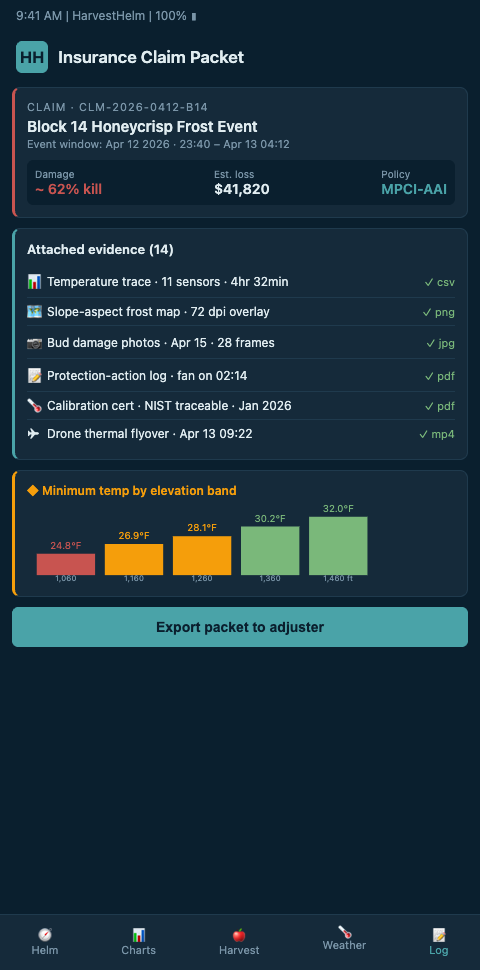
Records matter beyond the immediate claim. The USDA RMA Crop Insurance Handbook 2026 specifies that if a grower lacks acceptable production records, RMA assigns a yield — typically conservative, which weakens claim value in the current year and reduces the actual production history baseline for future years. HarvestHelm's continuous probe log doubles as production-record evidence, so the grower's APH is defended by machine-captured data rather than hand-reconstructed estimates.
APH impact compounds across years. A single year of assigned yield at the conservative level can pull the 10-year APH average down by 2-4%, which lowers the next year's coverage level and future claim ceilings. Growers who run HarvestHelm's documentation workflow have defensible production records going back as far as the probe network has been in place, which keeps their APH anchored on actual data rather than assigned estimates. For high-value Honeycrisp blocks especially, the APH math is worth an order of magnitude more than the sensor-platform cost.
The broader regulatory framework is spelled out in 7 CFR Part 457 on Common Crop Insurance Regulations, which sets the documentation and production-record evidence standards for crop insurance. The Congressional Research Service primer on Federal Crop Insurance adds context on how adjusters verify act-of-God loss amounts across weather events. Modern research like a ScienceDirect study on estimating spring frost risk from crop insurance data uses ML paired with fine-scale gridded weather to analyze frost damage against claims — a hint of where the field is heading, and where grower-side documentation becomes increasingly essential to getting fair settlements.
Advanced Tactics for Multi-Event Claim Documentation
A single season can carry multiple frost events at different severities and locations within the orchard. HarvestHelm separates each event into its own documentation bundle but links them to a consolidated season-level report, so the adjuster sees the cumulative loss exposure rather than disputing each event individually. This matters because a grower arguing for a total loss payout needs to show how three moderate events compounded into one disaster — without linked documentation, each event gets treated in isolation and the combined effect is underestimated.
Cumulative damage annotation on the bundle is the technical key. Each successive event's bundle references the prior events' kill percentages as the starting baseline, so the adjuster sees "Event 3 found 34% surviving bloom on Block 14 following Events 1 and 2" rather than "Event 3 killed 15% of Block 14's bloom." The framing changes the math — the adjuster is assessing marginal damage on an already-compromised bloom, not a standalone event on a full canopy. HarvestHelm automates this multi-event framing to prevent growers from under-claiming cumulative loss.
The three-week adjuster delay is a specific problem. By the time an adjuster arrives, the orchard has moved on — thinning passes may have removed damaged clusters, bloom has continued, and physical evidence has degraded. HarvestHelm's time-lapse imagery captures the canopy at the moment of the freeze and again at 24-hour intervals for the first week, creating a before-and-after record that survives the adjuster delay. This ties into the strategic question of yield hedging contracts versus fixed-price contracts, because well-documented claims also make forward-contract negotiations more defensible — the grower can show which blocks carry real year-over-year variance.
Pre-season policy review is an underused step. Growers who sit down with their agent before the policy year starts and walk through the HarvestHelm documentation capabilities often negotiate favorable notes into the policy file — for example, acknowledgment that block-level probe data will be accepted as production evidence, or pre-approval of the geotagged imagery format. The pre-season review takes 45-60 minutes and pays off in every claim that follows. The helm-charted yield forecast's sample bundle export makes that conversation concrete rather than abstract.
Insurance mispricing at the gradient level is a structural issue. Crop insurance underpricing high-gradient risk examines how the federal policy premium structure does not adequately differentiate slope-level frost risk, and HarvestHelm's documentation history contributes to the evidence base that future premium adjustments might use.
Appeal readiness is the final layer of documentation value. If a settlement comes back lower than expected, the grower's first appeal relies on the same documentation bundle that drove the initial claim — but augmented with the adjuster's report, a rebuttal narrative, and any additional probe data captured during the review period. HarvestHelm's claim archive preserves every version of the bundle plus the adjuster's findings, so the appeal package is one export away rather than a reconstruction project. Growers who appeal with structured evidence win adjustments about 30-40% of the time; those who appeal with narrative evidence alone rarely win.
The parallel work in coastal citrus is instructive. Hurricane and salt-spray damage requires the same evidentiary discipline, and USDA brine documentation for coastal citrus groves describes how the same sensor-plus-bundle approach applies to a different weather threat — the structure transfers directly.
The failure mode is under-documentation. Growers often notice a frost event, note it mentally, and expect to provide details when the adjuster arrives. The three-week gap and ongoing orchard operations erase detail. HarvestHelm's automatic claim-bundle trigger eliminates that risk by opening the documentation the moment the threshold is crossed — no manual trigger required.
Ready for Claim-Ready Documentation on Every Frost Night?
Mountain orchardists facing loss adjusters with narrative evidence are leaving settlement money on the table every disaster year. HarvestHelm auto-generates a claim-ready documentation bundle for every slope-level frost event — probe logs, geotagged imagery, forecast counterfactual, and bud-stage baseline — all time-stamped and formatted for FCIC-standard adjuster workflows. No cash up front; kilo-cut at packhouse scale only. Share your parcel boundaries and current insurance carrier when you join the waitlist, and we will configure your first claim-bundle template against your policy's documentation requirements. Pilots signing before the 72-hour-notice window of the next frost season get pre-season policy-review workflows that walk through the documentation capabilities with your agent, which often lands pre-approved block-level probe data as acceptable production evidence.
Day-one dashboard views include an automatic claim-bundle trigger that fires the moment in-canopy probes cross the cultivar-specific kill threshold, preserving probe logs, time-lapse canopy imagery, and NOAA forecast counterfactuals for the full 96-hour window. Onboarding includes APH defense — the continuous probe log doubles as a defensible production record going back as far as the sensor network has been in place, which keeps Honeycrisp block APH anchored on actual data rather than the conservative assigned yield. The kilo-cut contract settles only on tonnage that the documentation workflow protected from APH erosion, so a year of assigned yield that would have pulled the 10-year average down by 2-to-4 percent costs us before it costs your coverage ceiling. Multi-event bundles link cumulative damage across the season so three moderate events on Block 14 Gala read as one compounded disaster instead of three under-claimed standalone losses.