Why Traditional Crop Insurance Underprices High-Gradient Apple Risk
The Slope-Blind Pricing Problem
A mountain orchardist running Block 22 Honeycrisp at 1,980 feet on a northeast slope pays the same federal crop insurance rate as a flat-ground orchard 12 miles away at 1,100 feet. On paper, they are in the same county, same climate district, same APH pool. In reality, the high-gradient block has a cold-air drainage pattern that produces sub-critical frost events 3-4 times more frequently than the flat block, and carries an effective risk profile that is structurally different.
This is not a subtle mispricing. Stanford's Doerr analysis documents $27 billion in added US crop insurance losses between 1991 and 2017 attributable to warming — a pricing lag so large that the federal program is structurally under-reserved for current climate risk. EWG's analysis of $118.7 billion in weather-related crop insurance payouts shows freeze disproportionately hits specialty crops, and the policies lag actual high-gradient risk.
The RMA itself is signaling the problem. PM-25-009 modifications to Apple Tree Crop Insurance acknowledge apple program vulnerabilities driving rising loss ratios. The GAO's update on crop insurance cost-reduction opportunities finds that premium rate structures mismatch actuarial risk in ways that validate the underpricing critique. This is not a conspiracy theory about bad insurance — it is a structural limitation of locale-based pricing in a world where risk is now slope-specific.
The magnitude of the pricing gap becomes visible when you compare what growers pay to what the actuarial math would support. A mountain Honeycrisp block at 1,950 feet on a northeast slope has roughly 2.4-3.1 times the expected sub-critical frost-event frequency of a valley-floor block in the same county — yet both pay the same APH rate. The premium differential that would correctly price that risk differential is never applied because RMA's rating methodology does not ingest slope data. Growers are effectively subsidizing the valley-floor operation's premium rate while absorbing their own elevated tail risk directly.
Why Traditional Actuarial Models Cannot See Slope Risk
Think of traditional crop insurance pricing the way a yacht captain thinks about a weather forecast written for an entire ocean basin: the forecast is broadly correct at the basin level but cannot tell you that the leeward side of a specific island has 30% less swell than the windward side, or that a small bay on the north shore is protected from the prevailing swell by a reef structure not visible at the basin scale. A helm-charted yield forecast — built from block-level sensor telemetry — shows exactly that leeward/windward distinction for a mountain orchard, and exposes the pricing gap that locale-based models miss.
The USDA RMA Apples Fact Sheet documents that apple APH policies insure against frost and other natural causes, with pricing calibrated from county-level historical yield variance. This works when yield variance is driven by synoptic weather shared across the county. It fails when the variance is driven by slope-specific cold-air drainage that differs dramatically within a single county line. The model has been strained for decades, but climate volatility has turned strain into rupture — the actuarial shortcuts that worked in the 1990s stopped working around 2015 for topographically complex agriculture.
The RMA's revised premium ratings methodology documentation exposes the core issue: premium structure is locale-based rather than slope-based. Two adjacent orchards on opposite aspects of the same ridge pay the same rate despite having different effective risk distributions. This is not a rating error — it is a design limitation that cannot be fixed within the existing rating framework without moving to sensor-verified slope-specific data inputs. The Congress.gov CRS report on FCIC specialty crop coverage confirms that while FCIC covers about 80 fruit types, the premium subsidy architecture does not account for topographic heterogeneity within the insured area.
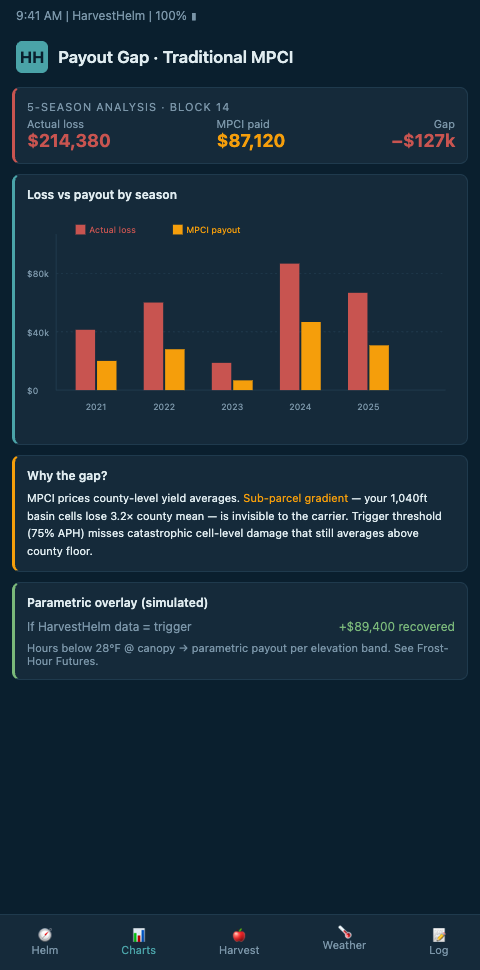
HarvestHelm quantifies the pricing gap block by block. By running parallel analysis of actual sensor-measured frost exposure against APH-implied frost exposure, the helm produces an "under-insurance ratio" per block. A Block 22 Honeycrisp in a cold sink might carry an actual 27% chance of a critical frost hour annually while the APH-implied rate is calibrated to the county-average 11%. That gap is pure underpricing — the grower is effectively self-insuring 16 percentage points of tail risk through the structure of the policy they already pay for.
The under-insurance ratio becomes actionable when aggregated across the entire orchard. A mountain operation with 12 blocks might show ratios ranging from 0.8 (slight over-insurance on low-risk valley blocks) to 2.6 (significant under-insurance on frost-prone elevated blocks). This map identifies exactly where to layer supplementary parametric coverage — the high-ratio blocks, not all blocks uniformly. Targeted layering keeps the overall premium cost manageable while closing the coverage gap specifically where the gap exists.
This is the data that drives parametric alternatives. Once the slope-level risk is quantified, growers can structure supplementary parametric frost-hour contracts to cover the gap that traditional APH leaves exposed — and they can document their actual exposure when negotiating private ag-risk products. Without block-level telemetry, this conversation cannot even start.
The underpricing critique is not academic. When a covered loss event hits a mountain orchard, the claim payout is calibrated to the county-average APH yield — which typically undervalues the productive capacity of the higher-quality mountain fruit by 15-40% because mountain Honeycrisp commands a premium above county-average pricing. So growers pay premiums on undervalued yields, then receive claim payouts at the same undervalued basis. The gap compounds on both the premium side and the claim side, further tilting the economics against mountain operations.
Advanced Tactics for Quantifying the Underpricing Gap
Three moves turn "the insurance is underpriced" from a complaint into an actionable dataset. First, run parallel loss-event logging against policy language. Every time a sensor-verified sub-critical event occurs that does not trigger the policy threshold (because the policy measures at a regional station), log the gap. Over three seasons, the aggregate gap is the grower's actual under-insurance quantum.
Second, stratify the gap by block characteristics. Slopes over 15% gradient, aspects facing northeast, and elevations in the 1,600-2,400 foot band systematically carry the largest gaps. This stratification is the input data for a block-by-block parametric supplement or a renegotiation with a private insurer willing to write slope-sensitive coverage. Growers who bring a stratified risk profile to the conversation typically negotiate 15-25% better terms than growers who bring generic county data.
Third, use the data to support claims documentation under existing policies. When a loss does occur, block-level sensor logs dramatically strengthen the claim file compared to regional weather-station data alone. This dovetails directly with frost insurance documentation practice and feeds the emerging slope-level underwriting future that parametric and AI-driven insurers are building. Desert date palm growers face a parallel mispricing problem around sandstorm risk; see oasis insurance mispricing for a cross-niche read on how locale-based actuarial models fail in topographically complex agriculture.
A fourth tactic: present the data proactively to private-market ag insurers. Some specialty insurers write slope-sensitive products for growers who can demonstrate block-level risk data. A proactive underwriting conversation with three seasons of HarvestHelm block-level history can unlock custom coverage that RMA does not offer. This usually starts with a broker review of the grower's block-level data, proceeds to a risk-modeling exercise by the insurer's actuaries, and concludes with a custom policy that sits alongside APH. The key is that no such conversation is possible without high-resolution orchard-side data — which returns the grower to the same prerequisite of block-level telemetry.
The structural fix will not come from RMA alone — the regulatory process is too slow to keep up with climate drift. The near-term fix is block-level telemetry that lets growers see, document, and partially hedge their own slope-specific exposure.
The structural fix will not come from RMA alone — the regulatory process is too slow to keep up with climate drift, and the political economy of federal crop insurance actively resists slope-specific rating because it would raise premiums for topographically disadvantaged operations that are often small, independent, or politically disadvantaged themselves. The near-term fix has to come from the private market, and the private market needs orchard-side data to write rational contracts.
This puts mountain orchardists in a position where the ones who build block-level data infrastructure now will be the ones who can negotiate custom coverage in 2-4 years. Growers who wait for RMA reform may wait a decade while absorbing the compounding cost of undertreated tail risk. The data investment pays off as underwriting leverage, not just as operational decision support.
Document Your Real Slope Risk, Not the Locale Average
Mountain Honeycrisp growers paying county-average crop insurance premiums on high-gradient orchards are quietly self-insuring the tail risk that the policy structure cannot price. HarvestHelm delivers the block-level telemetry that quantifies the underpricing gap and builds the evidence base for parametric supplements, claim documentation, and next-generation slope-sensitive coverage. Zero upfront cost, kilo-cut on cleared harvest only. Mountain Apple Orchards growers on the HarvestHelm waitlist get priority access to our 2026 underwriting-support analytics package. Start seeing your real slope risk, not the regional average, and stop absorbing the premium gap that the county-line policy refuses to quote accurately. Pilots signing before the next renewal cycle get the under-insurance ratio calculated block by block against APH-implied frost exposure, so the gap on a Block 22 Honeycrisp cold-sink block running 27-percent actual risk versus 11-percent county-average risk becomes a documented number rather than a hunch.
Day-one dashboard views stratify the gap by slope gradient, aspect class, and elevation band so the 1,600-to-2,400-foot northeast-facing blocks where the largest underpricing lives get flagged for parametric supplement layering. Onboarding includes broker-review workflows that translate your three-season HarvestHelm history into a custom-coverage conversation with specialty insurers who write slope-sensitive products outside RMA. The kilo-cut contract settles only on cleared Honeycrisp, Gala, and Enterprise tonnage from documented-gap blocks, so a Block 14 Gala under-insurance ratio of 2.6 that never gets layered with supplemental coverage costs us before it costs your next claim cycle. Growers who bring stratified risk profiles to private-market renewals typically negotiate 15-to-25-percent better terms than growers relying on generic county data alone.