The Future of Slope-Level Yield Underwriting for Mountain Orchards
The Underwriting Gap That Is About to Close
A mountain Honeycrisp orchardist currently chooses between two imperfect risk-transfer options: federal APH insurance that prices slope-blind, or self-insurance that absorbs the full tail. Both are legacy structures. Neither matches the granularity of the risk. And both are about to be disrupted by a new generation of parametric and telemetry-backed products that finally price risk at the block level where it actually lives. The disruption is not speculative — it is underway in commercial pilot programs, and the structural shift to orchard-side data as the underwriting substrate is already visible.
Swiss Re's parametric agriculture insurance offerings already use temperature and rainfall indices to trigger payouts, with localized weather data expanding coverage into frost and hail perils. Descartes Underwriting's agriculture parametric products deploy AI-driven underwriting using satellite imagery for yield protection — a next-generation underwriting blueprint that is already commercially deployed in vineyards, coffee, and grain. Arbol's parametric freeze-risk insurance triggers on temperature thresholds and is a direct precedent for slope-level apple products.
The market capital is real. Insurance Journal documents investor interest validating market growth for parametric agricultural insurance — this is not a pilot phase, it is scaling. IFPRI's analysis of weather-index insurance for climate adaptation frames the role of index-based products in climate adaptation, and establishes why telemetry-backed underwriting is the structural future. The only question for mountain orchardists is whether they have the block-level data infrastructure ready when these products roll out to apple growers.
The timing is tighter than many growers realize. The first parametric apple products targeted at specialty fruit are already in pilot in Washington State and the Midwest, typically offered to large operations with existing sensor infrastructure. Mountain operations in the Northeast and Southeast have lagged in sensor adoption and will therefore lag in parametric product access — not because the products are unavailable, but because the orchard-side data is not in place to underwrite against. Closing this lag requires 3-5 years of data accumulation starting now.
The Helm-Charted Yield Forecast as Underwriting Substrate
Think of the future of slope-level yield underwriting the way a yacht captain thinks about the transition from paper charts to integrated electronic chart plotters with live AIS overlay: the old system worked, but the new system integrates so many more real-time inputs that it fundamentally changes how the captain navigates. Slope-level underwriting will do the same for apple risk. Instead of locale-based APH calibrated on county yield variance, next-generation products will draw on block-level telemetry as the settlement reference — and the helm-charted yield forecast is the substrate that makes this possible.
HarvestHelm is positioned as the telemetry layer that next-generation underwriters need. The block-level sensor network produces exactly the data streams that parametric products settle against: minimum temperatures by block, frost-hour accumulation by phenological stage, chill-portion drift per elevation band. The EOS analysis of index-based crop insurance explains the parametric mechanics and basis risk that future slope-level products must minimize — and basis risk is directly determined by the density and accuracy of the underlying sensor network.
Basis risk is the make-or-break variable in parametric products. If the settlement sensor reads 28.5F when the actual fruit zone was at 26.8F, the contract under-pays and the grower is worse off than with traditional APH. Minimizing basis risk requires sensor density of roughly one reference station per 5-10 acres, GPS-tagged placement at fruit-zone height (not 10m met-station standard), and continuous cross-calibration among stations. This is exactly the architecture HarvestHelm deploys, which is not a coincidence — the product was designed from the start to be underwritable-grade at the block level.
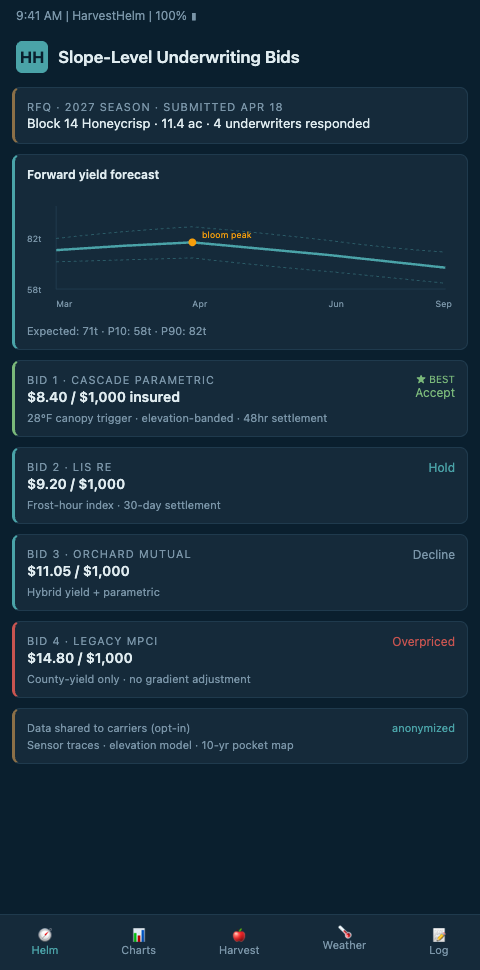
Springer's review of advancements in weather index insurance covers the data-driven design, pricing, and risk management advances in weather index products — the theoretical foundation is mature. What has been missing in mountain apple specifically is the orchard-side data infrastructure. A helm-charted yield forecast with 15 sensors per 60 acres, gateway mesh coverage, and multi-year historical data creates an orchard that is underwritable at the block level. Without it, the underwriter defaults back to county-average proxies — which is the current mispricing problem.
Swiss Re's analysis on strengthening crop insurance with digital solutions reinforces that digital weather-data integration is the direction for next-generation policies. For mountain orchards, this translates into supplementary parametric frost-hour layers bolted onto existing APH, eventually evolving into primary parametric coverage for growers whose telemetry supports it. The transition window is 3-7 years. Growers who build the data infrastructure now will be the first pool when the products go live; growers who wait will pay legacy pricing for another decade.
The intermediate product layer is worth describing. Before fully replacing APH, growers will most likely adopt a stacked structure: APH as the primary policy (federally subsidized, broad yield-loss coverage), with a parametric frost-hour rider that specifically covers the tail risk APH under-prices on high-gradient blocks. The rider pays out when sensor-measured frost-hours exceed a defined trigger, regardless of whether APH yield loss has been triggered. This stack closes the coverage gap without requiring the grower to abandon federal coverage, which is politically and economically easier than a full product switch.
Advanced Tactics for Preparing Your Orchard to Be Underwritable
Three moves prepare a mountain orchard to be first-in-line for slope-level yield underwriting. First, build the multi-year data record now. Parametric underwriters will require 5-10 years of validated block-level data before writing slope-specific policies. A grower starting sensor deployment in 2026 has a 2031 readiness date for first-generation products. Waiting until the products exist means waiting another decade beyond that for data accumulation.
Second, standardize the data format. Parametric settlement requires auditable, third-party-verifiable data streams. Proprietary vendor formats with closed data access are not acceptable to underwriters. A block-level telemetry network with open standards, sensor-level metadata, and documented calibration procedures is a requirement, not a nice-to-have. HarvestHelm's architecture explicitly targets underwriter-grade data lineage.
Third, participate in the actuarial design process. Growers with clean block-level data are effectively contributing to the calibration of next-generation products. Early-stage engagement with parametric insurers gives growers input into threshold design, settlement mechanics, and basis-risk minimization — ensuring the products that roll out actually fit the mountain orchard use case rather than being repurposed vineyard or grain structures. This connects directly to the frost-hour futures model framework and the insurance underpricing gradient critique that demands the new products exist. Coastal citrus growers are navigating a parallel transition to parametric hurricane-risk products; see coastal climate-risk pricing for how the same underwriting transition is unfolding in salt-aerosol risk.
A fourth dimension: financing and land values. Lenders are increasingly assessing climate-risk exposure as part of orchard loan underwriting. An operation that can demonstrate sensor-backed risk quantification and parametric-ready data infrastructure is a lower-risk borrower than one relying on legacy APH alone. This translates into favorable loan terms, faster refinancing cycles, and higher appraisal values on exit. The underwriting infrastructure investment pays off not just in insurance premium savings but in cost-of-capital advantages across the orchard's financial life.
The next decade of mountain apple orchard finance is going to be defined by which operations are underwritable at block level and which are not. The gap will be visible in premium rates, claim processes, and eventually in land values.
Consolidation dynamics will amplify the gap. Large orchard consolidators — private equity-backed aggregators buying up small mountain operations — are already prioritizing targets with existing sensor infrastructure because it accelerates the underwriting transition at the acquired asset. Independent growers who want to remain independent need to build the same infrastructure to avoid being squeezed by both higher insurance costs and a capital-market discount on their orchard's exit valuation.
One real-world precedent is instructive. Vineyards in California and Oregon moved through a similar underwriting transition between 2018 and 2023, driven by wildfire smoke-taint risk. Vineyards with block-level air-quality sensor networks became underwritable against smoke-exposure parameters; those without remained stuck with generic crop-insurance coverage that routinely failed to pay adequately on smoke-taint losses. The apple industry is tracking the vineyard trajectory roughly 4-6 years behind, which places the critical data-building window for mountain apple at 2024-2028. Growers who build now will be in the first underwritable pool; growers who wait until 2028 will be starting the 5-year data window when first-generation apple parametric products are already being priced off competitor data.
Be First in Line When Slope-Level Underwriting Goes Live
Mountain Honeycrisp, Gala, and Fuji growers who position their orchards as underwritable at the block level today are setting up the next decade of risk-adjusted economics. HarvestHelm builds the telemetry foundation that parametric underwriters will require: block-level data, open standards, multi-year records, documented calibration. Zero upfront cost and a kilo-cut only on cleared harvest means no capex on the data infrastructure — the underwriting readiness accrues as a byproduct of the yield-protection system. Join the HarvestHelm waitlist for Mountain Apple Orchards to anchor your orchard to the underwriting future and be in the first pool when slope-sensitive apple products reach your Hudson Valley, Green Mountain, Blue Ridge, or Appalachian region.
Pilots signing in the 2024-2028 data-building window track the California vineyard transition path roughly 4-to-6 years behind, which places your orchard in the first underwritable pool when first-generation apple parametric products land. Day-one dashboard views show one reference station per 5-to-10 acres at fruit-zone height with continuous cross-calibration so basis risk stays low enough for a 28.5F settlement sensor to match a 26.8F actual fruit-zone reading within tolerance. Onboarding includes lender-review documentation for climate-risk borrower assessments, since sensor-backed risk quantification translates into favorable loan terms and higher appraisal values on exit compared to legacy APH alone.