Yield Hedging vs Fixed-Price Wholesale Contracts for Variable Slopes
The Fixed-Price Contract That Cost $240K in a Frost Year
A Pennsylvania mountain grower signed a fixed-price wholesale contract in July 2023 for a projected 45,000 bushels at 72 cents per pound. A late-May frost had already knocked out Block 22 Honeycrisp on the north-facing upper terrace, but the grower estimated the rest of the blocks would absorb the loss. By September, yield was 31,000 bushels. The fixed-price contract still required delivery at the agreed tonnage, and the grower covered the shortfall by buying fruit at spot — $240,000 out of pocket to make the contract whole. A Good Fruit Grower analysis of apple producer pricing documented that Washington apple grower payouts have stagnated at roughly 70 cents per pound since 2018 while retail climbed to $1.80 per pound — so the margin between forward price and spot price has become punishingly thin.
The underlying risk is yield variability, which on a variable-slope orchard is not an orchard-wide number. A USDA ERS primer on managing farm risk makes the point directly: forward pricing effectiveness at reducing risk depends entirely on the grower's ability to predict the yield that will back the contract. If Block 14 Gala on the south slope is highly correlated with last year's yield but Block 22 Honeycrisp varies 40% year-over-year with frost exposure, a single-number yield projection is the wrong input to the contract math. A USDA ERS report on farm use of futures and contracts frames this precisely — forward contracts lock price for a specified future quantity but transfer yield risk to the grower.
Penalty clauses compound the exposure. Many fixed-price wholesale contracts include delivery tolerances of 5-10% before penalties apply, and shortfall penalties can run 5-15% of the contract value per bushel below the tolerance floor. A grower short 10,000 bushels on a 45,000-bushel contract at 72 cents/lb pays not just the spot-market difference but also contract penalty fees — the cash-flow hit lands in a season when yield has already disappointed. The contract that looked like insurance in July becomes a second source of loss in October — which is also why a parallel track of documenting slope-level frost events for insurance claims matters: the crop insurance backstop and the contract structure are the two defenses against a bad frost year, and both need block-level documentation to work.
Block-Level Hedging via the Helm-Charted Yield Forecast
HarvestHelm approaches contract design as a parcel-by-parcel decision. The helm-charted yield forecast computes each block's 10th, 50th, and 90th percentile yield projection from multi-year frost exposure, cultivar rootstock pairing, and current-season chill and bloom telemetry. The contract logic then asks: which blocks carry yield variability low enough to fixed-price, and which should sit in a hedged pool or a pay-on-actual arrangement. A Choices Magazine analysis of vegetable grower contracts found that specialty crop growers use contracts primarily to reduce price risk but remain exposed to production risk — the same dynamic applies to apple growers with slope-level variability.
The yacht navigation metaphor is useful. On a long passage, a captain does not commit 100% of fuel to a single heading — they reserve capacity for weather diversion. HarvestHelm splits the orchard's projected harvest into three baskets. Low-variance blocks with 10+ years of stable telemetry can safely back a fixed-price contract at 80-85% of the 50th-percentile forecast. Medium-variance blocks sit in a pool contract — a University of Wisconsin paper on cooperative contract risk management describes how pool contracts at cooperatives redistribute yield variance across growers compared to individual fixed-price deals. High-variance blocks — typically north-facing upper terraces with frost exposure — go to pay-on-actual agreements where the price lifts or drops with delivered tonnage.
Pooling is especially valuable for mid-sized mountain orchards. A Wiley paper on risk-pooling cooperative games in contract farming shows that pooling coalitions lower per-farmer cost and create incentives to join — the insight transfers directly to variable-slope apple growers who can band together to smooth year-over-year yield variance. Good Fruit Grower's profile of the Premier Apple Cooperative documents exactly this model in practice: Eastern apple growers pool crop-size and pricing information to balance risk across members.
The three-basket arithmetic is worth making concrete. Suppose an orchard produces a forecast median of 50,000 bushels across 14 blocks. HarvestHelm's analysis might tag 6 blocks with stable 10-year histories that total 22,000 median bushels as fixed-price candidates; 5 blocks with moderate variance totaling 18,000 median bushels as pool candidates; and 3 frost-exposed blocks totaling 10,000 median bushels as pay-on-actual candidates. The grower locks in 80% of the stable basket — 17,600 bushels at fixed price — joins a packhouse pool for the moderate basket, and negotiates pay-on-actual for the exposed basket. The expected revenue floor rises 12-20% versus a single blanket contract, and the downside in a frost year shrinks by 25-40%.
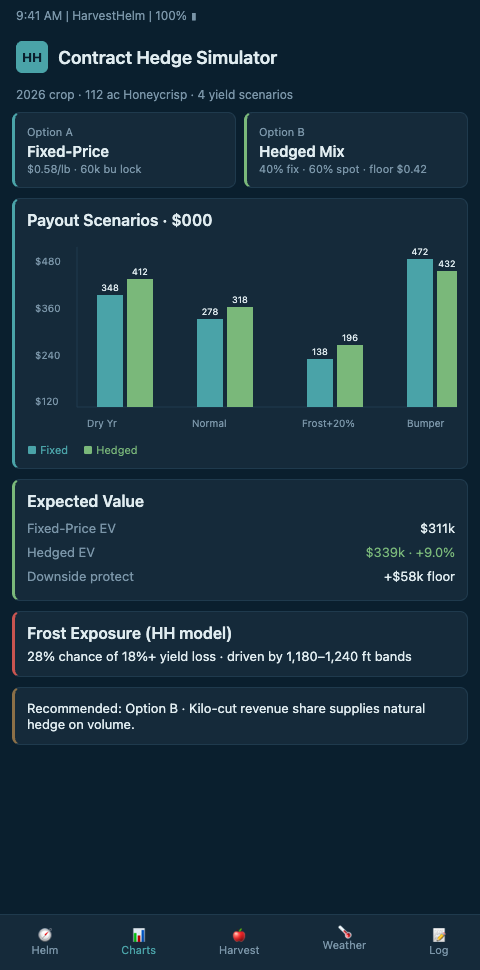
Contract structure discipline matters too. APAL's reminder on horticulture code of conduct requirements emphasizes that written packhouse-grower agreements must define pricing formula, pooling mechanism, rejection rules, and payment terms — vagueness here costs growers in disputes. HarvestHelm exports a block-level yield forecast package that growers can attach to contract negotiations, so the packhouse sees the underlying variability the grower is being asked to carry.
Grade and size distribution is a second dimension beyond raw tonnage. A contract priced on a 70% grade-A assumption pays poorly when the actual packout is 55% grade-A because a heat event stressed color. HarvestHelm tracks grade-predictive variables — growing-degree-day accumulation, night temperature dips, water stress indicators — and reports expected grade distribution alongside tonnage forecast. Growers negotiating contracts can use the grade forecast to argue for grade-adjusted pricing tiers rather than flat per-pound rates, which protects margin when the grade mix is unfavorable.
Advanced Tactics for Variable-Slope Contract Design
The advanced work is about year-over-year contract adjustment. A grower who negotiates fresh contracts each year using last year's yield as the anchor is always looking backward. HarvestHelm's multi-year forecast panel projects forward using chill-hour accumulation, bud-stage telemetry, and early-season probe data to refine the contract baseline by March — a month before buds break. That forward view lets the grower negotiate from a defensible position rather than reacting to packhouse counteroffers.
Multi-packhouse diversification is worth considering for operations with enough volume. A grower with 45,000 bushels can split blocks across two packhouses with slightly different contract structures, so a rejection dispute or payment delay at one does not threaten the whole season's cash flow. HarvestHelm's contract dashboard supports per-packhouse block tagging so the grower can track how each packhouse's pool performs over time and shift more volume toward the better-performing partner in future years.
Pay-per-harvest contract models are the natural companion. HarvestHelm's own kilo-cut pricing — we take nothing until the packhouse scale clears — is the same logic applied to the sensor platform. For growers interested in the broader structural shift, pay-per-harvest sensor contracts and cash flow walks through the cash-flow implications across a season. The crop insurance documentation pairing discussed earlier plus pay-per-harvest software pricing together give growers two lines of defense against a bad frost year — a contract that pays out only on delivered tonnage plus a documented frost claim.
Contract-renewal timing also deserves attention. Growers who negotiate contracts after the pick window closes have the most information but the least leverage — packhouses know the actual crop by then. Growers who negotiate in July have full leverage but imperfect yield visibility. HarvestHelm's forecast confidence bands sharpen across the season, and the contract-negotiation panel shows when the confidence band has tightened enough to support a specific basket mix decision. Most growers find the sweet spot is late June for stable blocks, late July for moderate-variance blocks, and post-bloom for frost-exposed blocks where fruit-set is the main unknown.
The failure mode to avoid is over-hedging. A grower who pools every block and fixes nothing loses the upside in a strong yield year. HarvestHelm's contract panel shows the expected outcome across three scenarios — bottom 10th percentile, median, top 10th percentile — so the grower can see what a different basket mix yields in each. The goal is not to eliminate risk but to shape it. Coastal citrus growers face the same problem against hurricane risk instead of frost — citrus futures hedging against salt damage loss applies identical contract logic to a different threat geometry.
Mid-season contract adjustment is the emerging frontier. Some packhouses now offer "early-call" options where the grower can convert part of a pool contract to a fixed-price contract if yield estimates firm up favorably by July. HarvestHelm tracks every block's yield trajectory against prior-year curves and alerts the grower when a block has moved out of its variance envelope — a signal that the mid-season call option may be worth exercising. Contracts are becoming more flexible, but the flexibility is only useful if the grower has the data to exercise the option intelligently.
Ready to Rebuild Wholesale Contracts Around Block-Level Telemetry?
Mountain orchardists signing blanket fixed-price contracts on variable-slope production are carrying too much yield risk for the price they receive. HarvestHelm delivers block-by-block yield variance forecasts that let you fixed-price your stable blocks, pool your medium-variance blocks, and pay-on-actual your frost-exposed terraces. Zero cash upfront — our kilo-cut lands only when the packhouse scale clears. Tell us your current contract structure and which blocks scared you last season when you join the waitlist, and we will model a three-basket contract mix against your five-year yield record first. Pilots signing before June get the March-window forecast package assembled before packhouse counteroffers start landing, so negotiations begin with a defensible block-by-block 10th, 50th, and 90th percentile projection.
Day-one dashboard views group your Honeycrisp, Gala, and Enterprise blocks into fixed-price, pool, and pay-on-actual baskets with the expected revenue floor drawn for each scenario. Onboarding includes a packhouse conversation template with grade-adjusted pricing tier language pulled directly from your block-level growing-degree-day and night-dip probe history. The kilo-cut contract settles only on cleared tonnage that backed the recommended basket mix, so if Block 22 Honeycrisp loses 40 percent to a May frost, HarvestHelm absorbs the forecast miss before it lands as a contract penalty on your cash-flow sheet. Mid-season early-call option tracking comes standard in the dashboard so growers can convert pool blocks to fixed-price when yield trajectories firm up favorably by late July.