How Pay-Per-Harvest Sensor Contracts Change Orchard Cash Flow Math
The Cash-Flow Squeeze That Blocks Tech Adoption
A block-level Honeycrisp grower running 60 acres across 8 Hudson Valley parcels tallies their 2025 input bill: labor up 19%, crop protection up 31%, diesel up 44%, packaging up 28%. Fruit Growers News documents that overall grower costs are up 73% since 2020 while apple prices are up only 22% — a margin compression that is forcing acreage reductions across the industry. For mountain orchards already running thin because of elevation-driven labor premiums and fragmented parcel logistics, there is no $45,000 in the spring operating line for preventive sensor capex, even when the math says it pays back in one frost save.
This is not a technology adoption problem. It is a cash-flow sequencing problem. Farm Credit East's 2026 Apple Industry Outlook quantifies how margin pressure and financing constraints are tightening the tech adoption window precisely when climate volatility is demanding more sensor coverage. Growers are caught between "I need this to survive" and "I cannot cash-flow it until September."
The traditional ag-tech sales model assumes a farmer who can absorb $45,000 of capex, depreciate it over five years, and wait for the yield-protection payoff to show up in year two. That is not the financial profile of most mountain Honeycrisp operations. It is a venture-scale balance sheet applied to a seasonal cash-flow business, and the mismatch is why sensor penetration in specialty fruit remains under 15% despite 15 years of ROI pitches.
The depreciation math compounds the mismatch. A $45,000 sensor package on a 5-year MACRS schedule generates roughly $9,000 of depreciation benefit annually, but only offsets income during profitable years. A frost-hit year with minimal taxable income produces no depreciation benefit at all — meaning the sensor capex sits on the balance sheet as a non-deductible expense exactly when the grower needs the cash most. Traditional capex pricing fails the mountain orchard cash-flow profile in both good years (tied-up working capital) and bad years (no tax offset). A kilo-cut structure sidesteps both failure modes entirely.
How a Kilo-Cut Helm-Charted Yield Forecast Rewrites the Math
Think of pay-per-harvest contracts the way a yacht charter captain thinks about a revenue-share voyage: the captain does not pay the crew before the passage starts — they pay out of the charter fees earned at the end. A helm-charted yield forecast under a kilo-cut model works the same way. HarvestHelm deploys the full sensor network, mesh, and dashboard at zero upfront cost, and gets paid only when the packhouse scale clears the recovered or protected harvest. The kilo-cut is a per-kilo fee on fruit that made it to market — typically a few cents per kilo, capped well below the yield-protection value the sensors delivered.
This model aligns incentives the way venture-backed SaaS pricing rarely does. HarvestHelm only earns when the grower ships fruit. If the sensor network fails to prevent a crop loss, HarvestHelm earns nothing on that block. If it saves a frost-struck Block 22 Honeycrisp block from a 90% revenue cliff, HarvestHelm earns a few thousand dollars and the grower keeps the rest.
There is a second incentive layer worth naming explicitly. Under a kilo-cut, HarvestHelm benefits from Grade 1 yield, not just total yield. That means the vendor has a direct financial stake in the quality of the intervention, not just the presence of sensors. A wind machine triggered 40 minutes too late might save the block from total loss but produce marginal Grade 2 fruit — which pays the grower roughly 15% of Grade 1 prices and pays HarvestHelm roughly 15% of the cut. This pushes the vendor toward high-quality early alerting and integration with physical actuators rather than passive monitoring that just records the damage.
The MDPI Sustainability meta-analysis of farm-level precision agriculture found that precision-ag adoption raises ROI by 22.3% and net profit by 18.5%. Traditional pricing captures none of that upside for the grower until the capex is amortized — which on a 5-year schedule means years 1 and 2 are cash-negative even when agronomic ROI is strongly positive. A kilo-cut structure makes years 1 and 2 cash-neutral for the grower (or cash-positive net of frost save) because payment only flows when fruit flows.
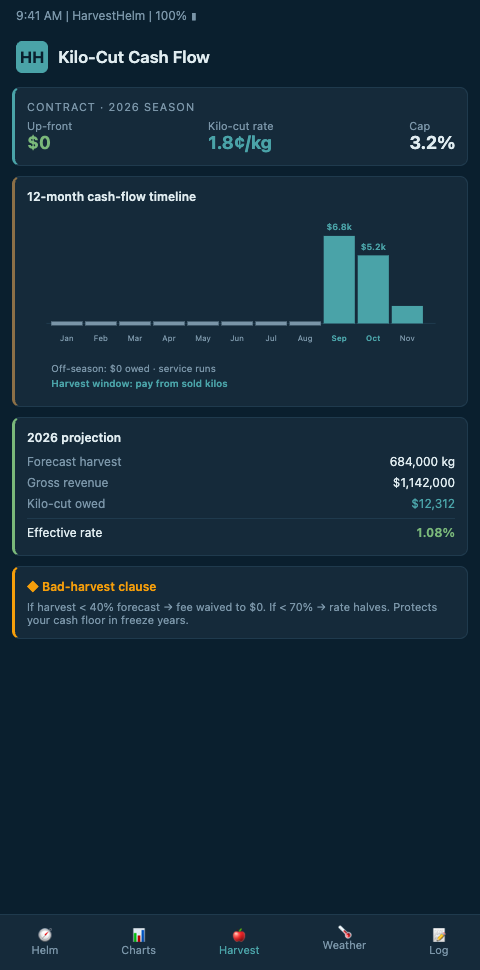
Monetizely's analysis of agricultural SaaS pricing evolution identifies pay-for-performance as the structural future of ag-tech monetization — vendor payments aligned with yield outcomes. The Penn State Extension tree fruit budget tools and Cornell Lake Ontario Fruit Program partial-budget platform let growers model exactly how a kilo-cut contract changes the enterprise P&L versus a traditional subscription or capex model. The short version: cash-flow timing shifts from March (planting-season capex outflow) to October-November (post-harvest inflow net of cut), which is exactly when a mountain orchard has liquidity.
A simple worked example. A 60-acre Honeycrisp operation averaging 800 bins per acre at $500 per bin nets $24M gross. A traditional 3% SaaS contract on estimated yield-protection value runs roughly $18,000 per year, paid March through September regardless of actual harvest. A kilo-cut at $0.025 per Grade 1 kilo (roughly 3 cents per pound) on the same operation runs about $19,000 in a good year — paid out of October's packhouse deposits. In a frost-hit year where Grade 1 volume falls to 300 bins per acre, the kilo-cut drops to about $7,200. The SaaS model charges $18,000 regardless. The kilo-cut model paid out $7,200 because the grower shipped less fruit. The alignment is exactly the point.
Advanced Tactics for Structuring Pay-Per-Harvest Terms
The first structural move is unit definition. A kilo-cut can be applied to total harvested kilos, Grade 1 kilos only, or revenue-weighted kilos. HarvestHelm defaults to Grade 1 kilos because that is the fruit whose price the sensors actually protect — frost-damaged Grade 2 cider fruit at $60/bin would not justify the same cut as $600/bin Honeycrisp. Growers should confirm the grade basis in writing before signing.
The second move is cap structure. A raw kilo-cut with no cap can become punitive in a bumper year. A sensible structure includes a per-acre cap tied to a percentage of yield-protection value — for example, 15% of the demonstrable frost-save value calculated from sensor logs. This aligns long-term partnership without turning a record crop into an extraction event. Oregon State University's orchard economics benchmark provides the establishment cost-and-return baseline that grounds cap negotiations in real per-acre economics.
The third move is exit and replacement terms. Sensors that stay in the ground for 10 years need a clear upgrade and replacement schedule. A well-drafted pay-per-harvest contract includes hardware refresh at vendor expense at year 5 and gateway replacement at year 7, preventing the "depreciated out" trap where the grower is paying kilo-cut on sensors that are no longer state-of-the-art.
A fourth tactic: data portability. Growers should insist on contractual rights to their block-level sensor data regardless of who holds the service contract. Five years of elevation-band chill history, cold-pocket mapping, and yield correlation is a strategic asset that exceeds the value of the hardware. If a grower switches vendors or the original vendor is acquired, the data must travel with the orchard — not stay locked in the original vendor's system. HarvestHelm ships contracts with explicit data-portability clauses because we know mountain orchards are 20-year assets and vendor relationships rarely last that long.
This cash-flow model connects directly to yield hedging contracts at the packhouse layer — the same logic of variable payment tied to realized volume applies. It also interacts with insurance underpricing gradient risk, because a kilo-cut model monetizes the yield-protection gap that traditional crop insurance leaves underwater. Mango plantation exporters have applied the same structure to their margin math; see kilo-cut export margins for a cross-niche view of how pay-per-harvest pricing aligns with export-grade fruit economics.
Legal and accounting treatment varies by state, but the general framework is that kilo-cut payments count as a cost of goods sold rather than as a financing expense or depreciable asset. This puts the expense on the same line as packing fees and broker commissions — predictable, variable with volume, and fully deductible against current-year income. Growers should confirm treatment with their accountant, but the structural logic mirrors how packhouse throughput fees and broker commissions already work, which is a familiar pattern for most orchard bookkeeping.
The decade-scale view shows the payoff. A 10-year kilo-cut relationship at an average of $15,000 annually costs $150,000 in total vendor payments, but delivers a sensor infrastructure, gateway network, and decade of block-level historical data that would cost $180,000-250,000 under a traditional capex-plus-service contract — plus the capex risk of asset obsolescence and the cash-flow risk of paying during bad years. The net financial benefit compounds for operations that experience one or more significant frost-save events across the decade.
Stop Paying for Tech That Might Not Save Your Crop
Mountain apple orchardists with tight spring cash flow can stop treating sensor deployment as a capex problem. HarvestHelm deploys the full helm-charted yield forecast system at zero upfront cost, with payment coming only as a small kilo-cut after the packhouse scale clears your harvest. No cash until the fruit ships. No subscription during a frost-hit year with no crop. The incentive structure means we only win when you ship Grade 1 fruit. Join the HarvestHelm waitlist for Mountain Apple Orchards and align your tech spend with your actual harvest cash flow. Pilots signing before spring operating-line decisions get the per-acre cap structure tied to 15 percent of demonstrable frost-save value calculated from sensor logs, so a bumper Honeycrisp year does not turn into an extraction event.
Day-one contract language includes explicit data-portability clauses so five years of elevation-band chill history and cold-pocket mapping travel with your orchard when vendor relationships change, which matters because the 20-year asset outlasts most ag-tech vendors. Onboarding includes a hardware refresh at vendor expense at year 5 and gateway replacement at year 7, preventing the depreciated-out trap where you pay kilo-cut on sensors that are no longer state-of-the-art.
The kilo-cut contract settles only on cleared Grade 1 Honeycrisp, Gala, and Enterprise tonnage, so a wind machine triggered 40 minutes too late that produced Grade 2 fruit at 15 percent of Grade 1 pricing drops our revenue to 15 percent of the full cut before it drops your packhouse margin. Legal and accounting treatment puts the kilo-cut on the same COGS line as packing fees and broker commissions — predictable, volume-variable, fully deductible — which mirrors how mountain orchard bookkeeping already handles packhouse throughput charges.