How Kilo-Cut Pricing Aligns Sensors With Mango Export Margins
The Upfront-Capex Trap That Kills Plantation IoT
A 200-acre Alphonso plantation looking at a full HarvestHelm deployment under traditional sensor economics would write a check north of INR 2.8 crore. Agrifarming's smart-farming ROI work pegs per-unit IoT sensor costs at INR 40,000-70,000 in India, and multiplied across a multi-variety plantation with mesh gateways, aggregators, and a helm-synthesis layer, those numbers compound fast. That capex sits on the owner's books the year before a monsoon shift decides whether the 2026 Alphonso crop collapses 80% like Konkan this season or clears a premium export window. The capex does not care which outcome arrives. The sensor budget still runs full while the harvest can run empty.
This asymmetry is why Indian mango plantation IoT adoption has stalled despite the underlying technology being mature. A Ratnagiri family estate that lost 80% of its bloom in 2026 cannot amortize INR 2.8 crore of sensors against a harvest that grosses one-fifth of normal. Most plantations cannot finance the downside even once. Capex-heavy sensor rollouts force growers into a false choice between eating monsoon-shift risk blind or paying for visibility they cannot afford in the year they most need it. The helm-charted yield forecast becomes irrelevant if the capex contract sinks the plantation before the sensors earn back their cost.
How Kilo-Cut Pricing Rewrites Sensor Economics
Kilo-cut pricing is outcome-based pricing fitted to mango export reality. HarvestHelm deploys the full sensor mesh, gateway backbone, digital-twin layer, and helm-synthesis engine at zero upfront cost. We take a defined cut — measured in rupees per kilo — only on Grade A fruit that clears the packhouse for export. If the monsoon shifts, anthracnose wipes the bloom, and the block produces 4 tonnes of domestic-grade fruit instead of 28 tonnes of Hapus export, our revenue scales down with the plantation's. The ResearchGate work on outcome-based pricing for precision agriculture frames this directly — results-based pricing matched to measurable ag outcomes is the only structure that survives climate-shift volatility on both sides of the contract.
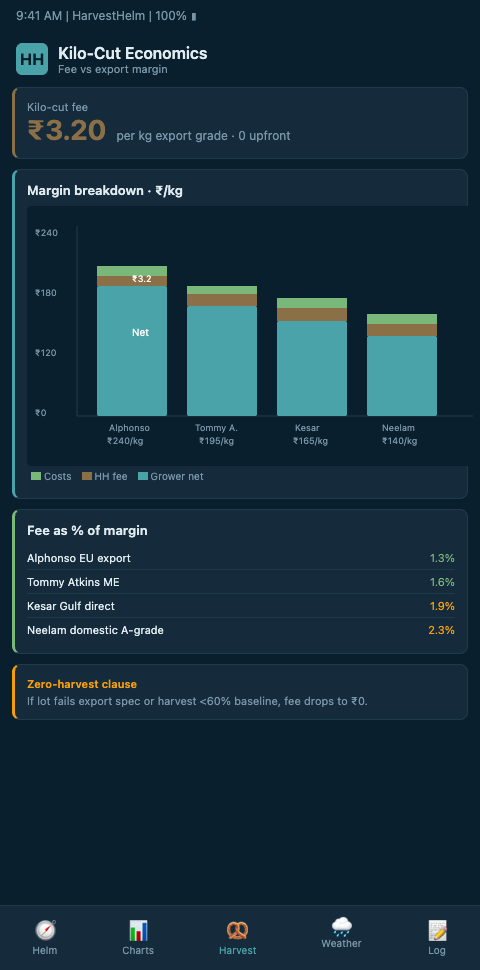
The kilo-cut math works because mango export margins have room to absorb it. Tradologie's mango export guide documents Grade A Alphonso clearing Gulf wholesale at INR 120-200 per kilo, with Grade A Kesar close behind. The APEDA mango monthly dashboard provides the official export volume and value data that grounds the kilo-cut pricing math against real margins. A kilo-cut of INR 4-9 per exported kilo sits inside the spread between Grade A and Grade B pricing — meaning the cut comes entirely out of the upside HarvestHelm helped create. When the helm-charted yield forecast rescues a bloom from an anthracnose collapse and pushes 41 tonnes of Hapus through the packhouse at Grade A rather than Grade B, the kilo-cut is paid out of fruit that would not have existed at Grade A without the sensors. That is the only way plantation IoT can honestly claim alignment.
DigitalRoute's explainer on outcome-based pricing describes the XaaS model where IoT telemetry measures and verifies the outcome itself — which is what makes a kilo-cut contract enforceable. The sensors that determine spray timing are the same sensors that record the bloom's progression into Grade A fruit, and the helm-synthesis layer produces an auditable record that both exporter and HarvestHelm reference when settling the kilo-cut at end of season. This is structurally similar to the kilo-cut revenue model used across coastal citrus groves, where hurricane-track uncertainty demands the same provider-absorbs-downside structure. It also feeds directly into the disease pressure futures framework that gives exporters a forward curve to plan around, since kilo-cut revenue is itself the empirical anchor for that model.
Worked Example: A 240-Acre Plantation Running the Math
A worked example illustrates the kilo-cut math at plantation scale. A 240-acre Alphonso plantation with a normal-year expected Grade A tonnage of 380 tonnes would, under a flat INR 6 per kilo kilo-cut, contribute roughly INR 22.8 lakh in vendor revenue per year. In a monsoon-drift rescue season like 2026 where the helm preserved 120 tonnes of Grade A that would otherwise have gone to Grade B, the incremental margin for the plantation was roughly INR 1.4 crore.
The kilo-cut on that rescue alone cleared the vendor's cost of servicing the plantation for the year. In a collapse season where the bloom fails even with sensors, the plantation's kilo-cut obligation drops to near zero because there is no Grade A tonnage to take a cut from — which is exactly the downside alignment that makes the structure survivable.
Advanced Tactics for Export-Margin-Aligned Sensor Contracts
Volume-graded cuts are the first refinement sophisticated exporters insist on. Rather than a flat INR 6 per kilo, a volume-graded structure takes INR 7 on the first 50 tonnes of Grade A, INR 5 on the next 100 tonnes, and INR 3 thereafter. This matches the reality that the marginal value of the helm-charted yield forecast is highest on the tonnage that would otherwise have slipped to Grade B, and flattens once the plantation is already running at cultivar potential. HarvestHelm contracts with plantations above 150 acres default to volume-graded structures because the bracket math aligns with where our engineering time actually produces lift.
The second tactic is cultivar-differentiated kilo rates. Alphonso export margins sit higher than Tommy Atkins, and Kesar often lands between the two depending on the Gulf market. A single flat kilo-cut across all cultivars either over-charges the Tommy Atkins blocks or under-compensates the Alphonso rescue work. Cultivar-differentiated rates keep each block's economics clean. The OECD-FAO Agricultural Outlook 2025-2034 reports global mango exports rose 6.7% to 2.6M tonnes in 2024, with cultivar-specific price premia that the kilo-cut structure can capture precisely.
The third tactic is contract-farming precedent alignment. The FAO study on farm-firm linkages through contract farming in India documents a decade of revenue-sharing and yield-linked payment structures in Indian horticulture. HarvestHelm kilo-cut contracts inherit that legal scaffolding, which matters because a plantation manager asking their auditor whether this is a legitimate structure wants to point at FAO precedent. Kilo-cut is contract farming flipped — instead of the buyer financing inputs in exchange for harvest rights, HarvestHelm finances the telemetry in exchange for a share of the premium tonnage. Exporters worried about how this plays against regional fungal mispricing also find that the kilo-cut structure gives them coverage the insurance product cannot — because the sensors are paid for by the fruit they helped save, not by a premium written against a regional index that misses canopy events.
Settlement Cadence and Floor-Pricing Design
The fourth tactic is settlement-cycle timing aligned to packhouse flows. Mango export packing typically runs in waves from late March to early June depending on cultivar and region. HarvestHelm's kilo-cut contracts settle monthly against packhouse manifests rather than requiring a season-end reconciliation, which smooths cash flow for both sides and avoids disputes piling up at the end of the season. Each month's kilo-cut is computed from that month's exported Grade A tonnage reported through APEDA's electronic manifest system, with a 14-day review window for either party to flag discrepancies. This operational rhythm matches how exporters already account for cold-chain charges and freight, so the kilo-cut slots into existing financial workflows rather than requiring a new process.
The fifth tactic is floor pricing during severe-loss years. A pure kilo-cut structure could leave HarvestHelm with zero revenue on a catastrophic-loss plantation, which creates an incentive problem: if the vendor is guaranteed zero in bad years, they might pull engineering resources away from the plantations most in need of rescue. HarvestHelm's contracts include a minimum maintenance fee — typically INR 2-4 lakh per quarter for 100-acre-plus estates — that covers sensor maintenance and helm-access costs even in a total-loss year. This floor pricing preserves vendor incentive to invest effort in the rescues that matter most. The math works because the floor is small relative to the kilo-cut upside on a normal year — roughly 4-7% of annual expected revenue — and it converts the contract from a pure equity-like structure into a hybrid that both plantation auditors and HarvestHelm investors find sustainable.
Audit Trail and Trust Infrastructure
Outcome-based pricing only works when both parties trust the outcome measurement. HarvestHelm's kilo-cut settlements reference three independent data sources: APEDA-reported export volumes, packhouse weighbridge tickets, and cultivar-specific grading manifests from the plantation's packing operation. Any dispute — and disputes do happen, usually over grade-assignment borderlines — is resolved against the manifest trail rather than against disputed estimates. The telemetry that the helm produced during the season is itself part of the audit package: sensor readings, spray decisions, and yield-forecast bands are all preserved and reviewable. This documentation discipline is what lets plantations sign kilo-cut contracts with confidence rather than treating them as speculative arrangements. A plantation auditor who spends 40 minutes reviewing the audit architecture walks away understanding that the settlement is harder to manipulate than a traditional sensor-sale-and-maintenance contract.
Why Kilo-Cut Is the Only Pricing That Survives the Next Monsoon Shift
Mango exporters who have watched Konkan lose 80% of Alphonso in 2026 know the capex model is broken. A kilo-cut structure takes our side of the table off the plantation's books and puts HarvestHelm in the boat with the captain — we only get paid when the Grade A tonnage actually clears the packhouse. If your plantation spans 80 to 1,200 acres and you want a full helm-charted yield forecast running by next panicle-emergence window without adding a paisa to your capex budget, book a kilo-cut contract review with our export-economics team. We will walk through your last three seasons of APEDA-reported Grade A tonnage, model the cut brackets against your cultivar mix, and have a signed structure on your desk before flowering starts.