How Kilo-Cut Revenue Models Align Sensors With Harvest Risk
The Misalignment At The Heart Of Grove Tech
The sensor-vendor cancellation data from 2022 and 2023 tells a consistent story across coastal Florida citrus: flat subscription fees clashed with storm-damaged harvest revenue, and growers chose to cut the expense that did not vary with their cash inflows. The cancellation wave created a market gap that the kilo-cut model is purpose-built to fill. Growers who lived through Ian's and Milton's revenue collapse want sensor infrastructure back — they lost real money without it — but they refuse to sign another subscription contract that invoices regardless of harvest outcome. The commercial challenge for any sensor vendor re-entering coastal citrus after 2024 is structuring the contract so the grower's cash flow constraint never kills the deployment.
A second-generation Hamlin grower in Polk County signed a three-year sensor contract in 2021 for $42,000 per year covering soil-moisture probes and a basic hurricane advisory feed. In 2022, Ian took 55% of his fruit to the ground. The sensor vendor invoiced the full $42,000 the following month, because the contract was subscription-based and the storm was out of scope. The grower canceled in 2023 and went back to reading NWS bulletins on his phone. When the McKinsey Agtech adoption dilemma report identified unclear ROI and high upfront costs as the #1 adoption blockers globally, that grower was one of thousands making the same cancellation decision for the same reason.
The structural problem is that coastal citrus revenue is binary — either the harvest clears the packinghouse at 80-count fresh-market premium and the grove is cash-positive, or Milton lands and the crop goes to the ground. A flat subscription fee assumes stable cash flow in a business that does not have stable cash flow. The Agtech SaaS pricing guide for seasonal cash flow argues for performance-based pricing that shares upside and downside — reduced fees in bad years, bonuses in exceptional years. That is the structural answer. The kilo-cut revenue model is the coastal citrus implementation of that answer.
The Helm-Charted Yield Forecast Under A Kilo-Cut Contract
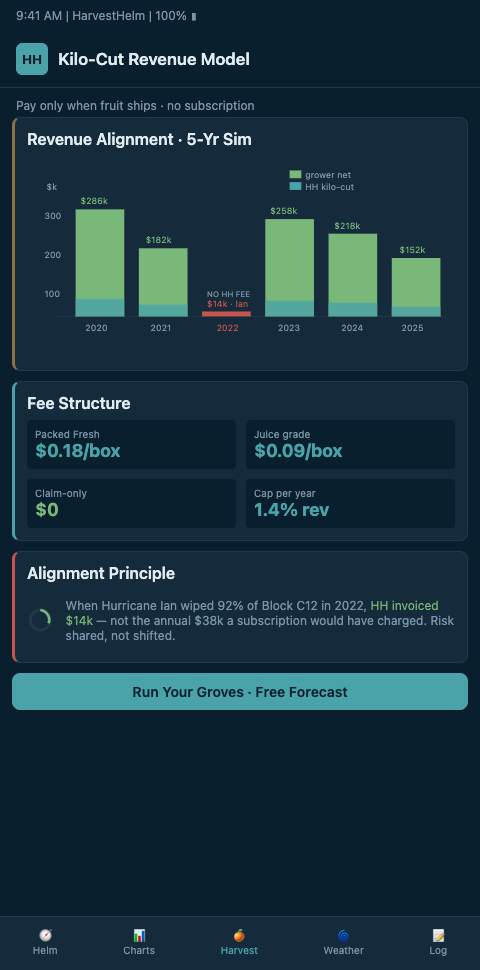
HarvestHelm treats every sensor it installs as a waypoint on a helm-charted yield forecast, and the contract language follows the metaphor: the yacht captain only pays the navigator if the boat completes the passage. HarvestHelm invoices a percentage cut of the successful harvest — the kilo-cut — and nothing else. Zero CapEx on hardware, zero per-node license fee, zero subscription minimum. A Valencia block that produces 80,000 boxes at fresh-market premium tier pays HarvestHelm a proportional share of that revenue. A Valencia block that Milton hits at zero-count salvage pays HarvestHelm zero. The sensor vendor is in the same boat as the grower.
That pricing structure forces sensor quality and forecast accuracy into alignment with harvest revenue. If HarvestHelm's hurricane-hour early warning beacon fires too late and the 4,200 boxes go to the ground, HarvestHelm loses its kilo-cut on those 4,200 boxes — there is no way to extract margin from a grove the vendor failed. The endpoint royalty revenue model analysis documents the same pattern in Australian plant breeding: a per-ton fee on delivered grain aligns the breeder with the grower. Kilo-cut applies that structure to coastal citrus sensors, and the same infrastructure feeds parametric insurance triggers from salt sensor telemetry so one deployment funds two revenue streams. HarvestHelm invests in better salt-aerosol plume models, denser in-grove probe coverage, and faster hurricane-hour beacon firing because every percentage point of harvest rescue translates directly to HarvestHelm revenue. The captain and the navigator row in the same direction.
The macroeconomic backdrop supports the shift. The agriculture technology-as-a-service market is projected to reach $18.13B by 2033, driven by subscription and pay-per-use models — and the pay-per-harvest variant is the most aligned variant of that trend for storm-exposed operations. McKinsey's Voice of the Global Farmer 2024 found ROI uncertainty and maintenance costs as the top barriers to adoption, and aligned-incentive models accelerate adoption precisely because they resolve both. The World Economic Forum's agtech growth analysis makes the same point — agtech must demonstrate a clear link between technology and yield or profit, and information alone will not drive adoption. Kilo-cut makes the link contractual.
Advanced Tactics For Operating Under A Kilo-Cut Contract
The first advanced tactic is to structure the kilo-cut percentage against harvest tier. HarvestHelm's standard contract ties the cut to the fresh-market premium tier versus the juice-plant tier — a higher cut on 80-count fresh-market cartons and a lower cut on juice-plant salvage. That means the helm's recommendations are weighted toward pushing fruit into the premium tier whenever possible, because that is where both the grower and the vendor get paid more. Pair that with citrus futures hedging against salt damage loss to stack financial instruments around the kilo-cut baseline. The result is an economic system where every incentive points toward saving the fresh-market carton.
The second tactic is to run the parametric-payout layer in parallel with the kilo-cut. The same sensor network HarvestHelm runs for the helm also feeds parametric-trigger data, which means a single infrastructure investment — paid for entirely through the kilo-cut — produces two revenue streams for the grower: the rescued harvest under the helm's warnings, and the parametric insurance payout when the trigger fires. AgTech Navigator's 2026 trends report documents the industry shift toward flexible subscription and outcome-based pricing during economic uncertainty, and combining kilo-cut with parametric payouts is the most advanced implementation of that shift for coastal citrus operators.
The third tactic is cooperative kilo-cut structures for multi-grower sharing. A cooperative of 14 Valencia growers on Florida's east coast ran a pilot kilo-cut with HarvestHelm in 2024: each member paid a proportional share of the aggregate kilo-cut, and each received full helm access for their blocks. The cooperative-level arrangement smoothed the vendor's revenue across bad and good harvests within the co-op, which let HarvestHelm accept a lower per-grower kilo-cut than a solo-grower contract would have required. The same cooperative structure works across crops — see revenue-share contracts for smallholder dates for the analogous pattern in desert date palm oases. Cooperative kilo-cut is the next frontier for small-to-medium coastal citrus growers who would otherwise be priced out of precision-ag entirely.
Kilo-Cut Contract Negotiation Mechanics
The kilo-cut percentage is negotiable, and smart growers treat the percentage as a strategic variable rather than a fixed vendor rate. A Valencia operation that demonstrates strong block-level telemetry history and a multi-season relationship with HarvestHelm often negotiates a lower kilo-cut percentage in exchange for a minimum-commitment volume of harvest revenue pledged through the platform. A newer grower with no track record pays a higher kilo-cut in exchange for zero minimum commitment. HarvestHelm's commercial framework accepts both structures because the economics work either way — the vendor smooths revenue across the newer and established growers, and the mature-grower discount reflects the lower onboarding and calibration cost on the platform side.
The contract also includes performance escalators and de-escalators tied to specific helm outputs. If HarvestHelm's hurricane-hour early warning beacon fires within a calibrated lead-time window, the kilo-cut applies at the negotiated rate. If the beacon fires late or misses, the kilo-cut steps down to reflect the lower value delivered. The inverse also applies — if the helm consistently beats its lead-time commitment by more than a calibrated margin, HarvestHelm earns a step-up on the kilo-cut to reflect the outperformance. These escalators turn the kilo-cut contract into a continuously aligned performance instrument rather than a static fee structure.
Accounting Treatment And Cash Flow Timing
One overlooked dimension of the kilo-cut model is the accounting classification. Under a subscription model, sensor fees post as operating expense regardless of harvest outcome, which hits gross margin on every block every season. Under a kilo-cut model, HarvestHelm's fee is a cost-of-goods-sold line item that only appears when the harvest revenue appears — a symmetric hit on gross margin that scales with actual production. For a Valencia operation running 600 acres, that accounting difference can shift roughly $120,000 of annual fees from fixed operating expense into variable COGS, improving the grower's operating leverage ratio and creating headroom in bank covenants during down years. The Hamlin grower in our opening story canceled his subscription precisely because the fixed cost kept hitting in a year his harvest was substantially diminished — the kilo-cut structure would have prevented the cancellation by tying the fee to the actual diminished harvest.
Cash flow timing matters almost as much. Subscription contracts typically bill monthly or quarterly on a calendar that bears no relation to Valencia or Hamlin harvest timing. Kilo-cut billing runs on the packinghouse clearance — HarvestHelm invoices when the cartons clear, so the grower is paying out of the same cash flow the helm just helped generate. That alignment eliminates the quarterly-subscription-payment-during-pre-harvest-cash-crunch dynamic that drove many of the 2022-2023 sensor cancellations. The broker hedging his Valencia forward contracts can plan the HarvestHelm fee against the packinghouse receivables schedule with confidence, which the subscription model never allowed.
Coastal citrus growers sitting on canceled sensor subscriptions from 2022 and 2023 should revisit the space now that the kilo-cut model exists. HarvestHelm's zero-upfront, pay-per-harvest structure eliminates both barriers the McKinsey farmer surveys identified — no CapEx, no ROI uncertainty — and puts the sensor vendor in the boat alongside the grower when the next tropical system crosses the belt. Valencia, Hamlin, and Murcott operators running on multi-hurricane exposure should be demanding kilo-cut contracts from every vendor they evaluate. The vendor who will not take a kilo-cut is telling the grower exactly how much confidence they have in their own forecast.