How Revenue-Share Sensor Contracts Fit Smallholder Date Economics
Why the Up-Front Sensor Math Doesn't Pencil
Walk into a trade show for date palm cultivation and you will see a dozen IoT vendors offering sensor kits between $1,800 and $6,400 per orchard. Their pitch — understandable, from a vendor's perspective — is that the kit pays back in two seasons through improved pollination timing, better fruit set, and reduced water waste. The pitch is honest at the unit-economics layer. It's also unworkable for the specific audience that most needs the telemetry: smallholder date growers working 100-400 palms across leased parcels, often on credit from the prior harvest.
A Tunisian oasis farm comparative analysis published in JNSciences documents that gross margin and total factor productivity are inversely related to farm size in Tunisian oases — smallholders carry the thinnest margins in the value chain. The same paper's dataset shows typical net margins in the $8-14 per palm range for Deglet Noor smallholders, meaning a 180-palm operation sits somewhere between $1,440 and $2,520 of annual net income in a normal season. A $3,800 up-front sensor investment represents more than a year's entire net income. Even amortized across five years, the cash-flow timing simply doesn't work — the grower pays cash in March before the sensors return their first useful data, and the notional payback in improved fruit set shows up in November's crop 8-20 months later.
The market already knows this. CGAP's analysis of pay-as-you-go solar documents how PAYG financing transferred solar ownership through harvest-aligned installments across sub-Saharan Africa after the traditional sale model failed to reach low-margin farmers. And AICCRA's Mali case study shows farmers paying for solar-powered irrigation after selling harvest via mobile money — a working precedent for paying for agritech after the harvest, not before. The question for date cultivation is: what does that model look like when the crop is Medjool or Deglet Noor rather than millet, and when the annual harvest is a single pulse rather than a continuous revenue stream?
The Helm-Charted Yield Forecast Under Kilo-Cut Pricing
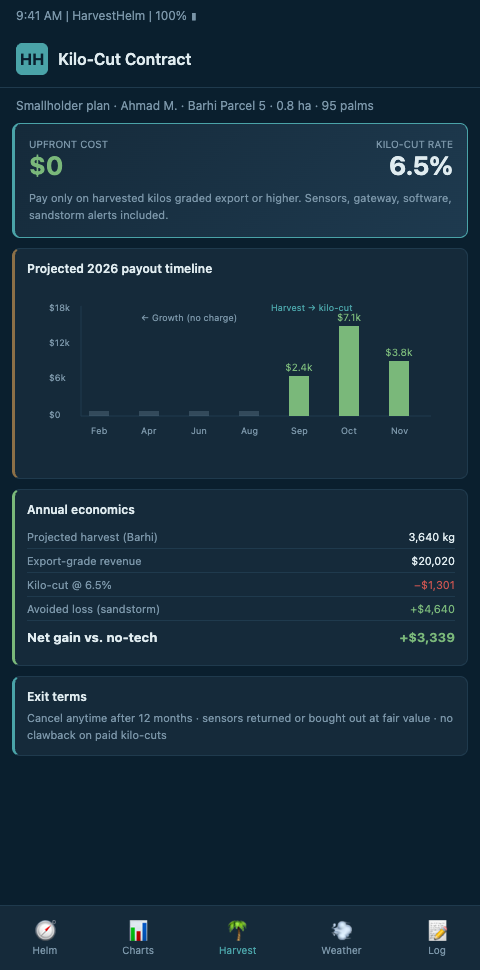
HarvestHelm's kilo-cut pricing structure takes nothing up front and earns only a defined share of the successful harvest tonnage. Our helm-charted yield forecast is financed by the same harvest it's predicting — meaning every alignment incentive that matters in agritech is pointing the right direction. If the pollination forecast is wrong, we eat the loss. If the sandstorm alert fires late, we eat the loss. If the diurnal swing compensation nudges the ladder crew toward the wrong cultivar, we eat the loss. That symmetry matters because a smallholder Deglet Noor grower cannot afford to pay for a sensor kit that guesses.
The contract structure mirrors precedent. The PNAS review of smallholder contract farming catalogs revenue-sharing designs that reduce smallholder risk and enable input access. The World Bank outgrower schemes brief documents revenue-sharing price formulas in successful outgrower schemes. UC Davis BASIS research on contract farming for smallholders documents farmer/processor splits of 65-80% / 20-35% as common in commodity crop contracts. HarvestHelm's kilo-cut sits toward the lighter end of that range on the processor side — we take a cut measured in kilos of packed dates delivered, and only after the grower has cleared their variable harvest costs.
What this looks like in practice on a 180-palm Tozeur operation: the grower signs nothing up front, accepts gateway and node installation at no charge, runs telemetry through the bloom and harvest season, and at pack-house reconciliation contributes the kilo-cut from export-grade tonnage. A weak season with 42% fruit set produces very little kilo-cut and no cash strain. A strong season with 68% fruit set produces a larger share — but also a much larger absolute harvest, so the grower's net income rises materially more than the cut extracts. The underlying climate-risk math that drives how we calibrate the floor and cap levels for each oasis is detailed in our post on the climate-drift fruit-set model.
The PMC study on contract farming field experiments in Benin found that contract farming lifts smallholder incomes when revenue-share designs include technical support — not just financial structure. Our kilo-cut deals include the technical support as a matter of course: every contracted grower gets pollination window countdown timers, sandstorm spathe protection alerts, diurnal swing compensation tuned for their cultivar mix, and cultivar reassignment advisories based on their orchard's specific diurnal history. The technical support is not a premium add-on; it's the product.
Advanced Tactics: Structuring the Kilo-Cut to Actually Work
The first advanced move is tiered kilo-cut by grade. A flat percentage cut creates perverse incentives: the grower has a reason to prioritize rutab-stage early drops to minimize the cut on export-grade tonnage. We avoid that by applying the cut only to export-grade Medjool, Deglet Noor, Barhi, or Zahidi shipments that clear pack-house specs — meaning every kilo we earn is a kilo that passed quality gates. The grower's and our incentives both point toward export-grade production, not volume inflation. This structural clarity matters as much as the percentage itself.
The second tactic is seasonal floors and caps. A catastrophic khamsin season might produce 22% fruit set and a $400 harvest from a 180-palm operation; extracting a percentage cut from that is morally wrong and operationally pointless. Our contracts include a zero-cut floor: below a defined yield threshold, the grower pays nothing, period. On the upside, a caps-and-collars structure prevents windfall years from creating grower resentment — there's a maximum cut per palm above which the grower keeps 100% of the incremental upside. That upside protection is what makes the contract a partnership rather than a debt instrument.
The third tactic is parametric linkage to insurance markets. When a sandstorm triggers a yield loss, a parametric insurance payout can offset the revenue-share reduction for the grower while the underlying telemetry keeps running. We work with reinsurers to align the parametric triggers to the same sensor stack that feeds the helm dashboard, so a single corroborated storm event feeds both the insurance payout and the yield recalibration. We cover the insurance-market pricing gap in depth in oasis insurance mispricing, where we walk through why current underwriting misses sandstorm risk by a wide margin.
The fourth tactic is cooperative aggregation. A single 180-palm operation may struggle to justify a dedicated gateway installation, but three neighboring operations sharing 540 palms across one wadi corridor amortizes the infrastructure across a larger harvest. We structure contracts at the cooperative level when geography permits — each grower retains their own kilo-cut arrangement on their own palms, but the underlying telemetry mesh is shared. This follows the same logic we applied in pay-per-harvest contracts for mountain apple orchards, where cash-flow timing drove similar aggregation patterns. The smallholder audience for date palm cultivation is served by aggregation more than by individual-scale contracts, and the kilo-cut accommodates that.
The fifth tactic is transparent post-season reconciliation. At harvest close, HarvestHelm publishes a reconciliation statement showing every storm event the dashboard flagged, every pollination recommendation issued, every estimated fruit-set outcome, and how those aligned with the grower's actual harvest. The kilo-cut calculation itself is displayed against the underlying pack-house tonnage line-by-line. Growers who have experienced opaque agritech vendor statements appreciate the transparency, and the transparency is part of how we earn renewal. A smallholder who doesn't trust the math at reconciliation time will not renew, no matter how good the technology was during the season.
The sixth tactic is technical-support inclusion at no additional charge. Smallholders often cannot afford separate agronomy consultants, so our kilo-cut contract explicitly includes weekly check-ins during bloom and harvest seasons, emergency storm-response coordination, and post-season strategy review. These support services are part of the product — not add-on SKUs. The UC Davis BASIS research on contract farming specifically identifies bundled technical support as a key differentiator for successful revenue-share contracts versus failed ones. HarvestHelm's model treats support as integral, not optional.
The seventh tactic is flexible exit and portability. Smallholders are wary of contracts that lock them into long-term commitments with uncertain counterparties. Our kilo-cut contracts include a defined exit provision — if the grower wants to leave after year two with full equipment purchase at a depreciated price, that path is documented in the original contract rather than negotiated under duress. This exit clarity reduces the perceived risk of signing in the first place, which is what gets smallholders over the initial trust hurdle. A contract no one signs is not a contract — design matters as much as economics.
Keep Your Cash. We Eat the Sensor Risk.
If you run 80-400 palms on leased parcels and you've ever stared at a sensor quote wondering where the money comes from in March, HarvestHelm is built for you. Our kilo-cut pricing puts nothing up front, installs the telemetry mesh on our dime, and earns a defined share only on the export-grade tonnage that clears your pack-house. Catastrophic storm season? You pay nothing. Record harvest? You keep most of the upside and we share in the win. Because we only earn when you earn, every pollination countdown timer, sandstorm alert, and cultivar reassignment advisory in our dashboard points toward actual yield, not subscription-revenue theater.
If you're a smallholder Medjool, Deglet Noor, Barhi, or Zahidi grower — or a cooperative of them — let us walk your parcels and put numbers on the specific kilo-cut that would apply to your orchard. No contract, no obligation, no up-front cost. Join the smallholder contract waitlist before your next khalal pick cycle and on day one you will see transparent reconciliation previews with zero-cut floor levels calibrated to your specific cultivar mix. Waitlisted Tozeur and Biskra smallholders who signed on ahead of last harvest carried the full kilo-cut technical support bundle into the bunch-thinning window without paying a dinar until tamar crates cleared the packhouse scale.