Building a Disease-Pressure Futures Model for Tropical Exporters
The Forward Contract That Priced a Bloom That Never Happened
A mid-tier Indian mango exporter signed Gulf forward contracts in January 2026 for 840 tonnes of Grade A Alphonso at INR 178 per kilo, delivery in April. The contract was priced against a historical loss rate for anthracnose and powdery mildew of roughly 9% of expected Grade A tonnage. By mid-February, canopy-humidity telemetry across the exporter's supplying plantations had diverged sharply from the regional forecast — anthracnose pressure was tracking 180% above the five-season median.
By early April, actual Grade A tonnage came in at 312 tonnes, not 840. The exporter paid INR 4.2 crore in contract-shortfall penalties, bought replacement fruit at spot prices 34% above contract, and watched their margin for the entire fiscal year compress by two-thirds. The Frontiers in Microbiology review of mango anthracnose quantifies post-harvest anthracnose loss rates at 17.7% in transit alone — and pre-harvest losses of the kind this exporter saw compound on top of that.
The structural failure here is not agronomic — it is financial. The exporter was underwriting forward contracts using a single long-run loss expectation rather than a forward-looking disease-pressure curve. A disease-pressure futures model changes that. It prices what the bloom-stage fungal risk actually looks like in the weeks before the exporter has to sign, and lets the exporter discount forward commitments or buy parametric hedges against the specific pressure trajectory.
How the Helm-Charted Yield Forecast Builds the Futures Curve
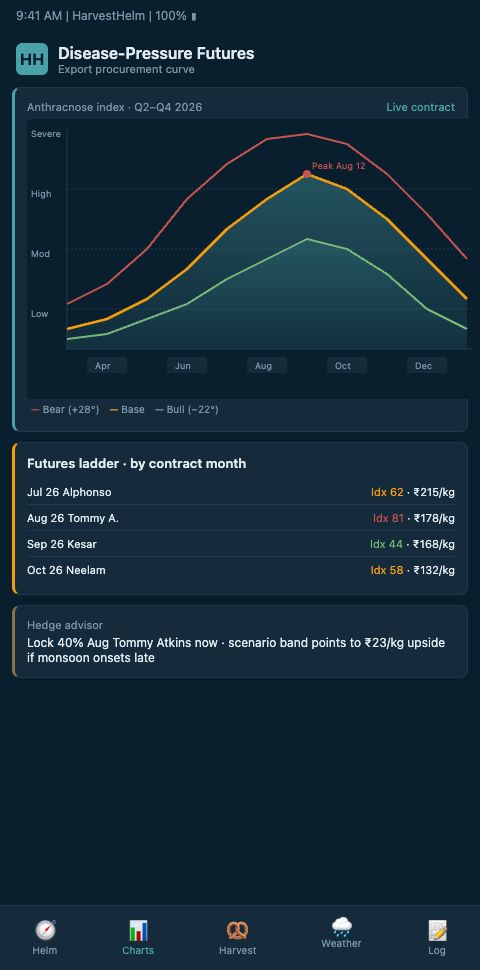
A disease-pressure futures model is a helm-charted yield forecast reframed as a forward price curve. HarvestHelm builds the curve from four overlapping inputs. First, the multi-year canopy-humidity drift described in the multi-year fungal drift analysis — the drift term sets the long-run base rate. Second, the current pre-monsoon canopy-humidity integral, which updates the short-term pressure field. Third, ENSO and IOD climate indices that carry forward-looking information about monsoon behavior; Swiss Re's ENSO-and-agriculture framework documents how tropical climate risks aggregate into insurable indices that feed the forward curve. Fourth, the cultivar-mix vulnerability profile — Alphonso-heavy exporters carry a different curve than Kesar-heavy exporters because their pathology exposures differ.
The helm composites these into a forward pressure index — call it the Canopy Fungal Pressure Index — with weekly resolution from January through May. The CFPI is a number the exporter can price against, the same way grain traders price against heating-degree-day indices. The ResearchGate work on the effectiveness of weather derivatives as agricultural hedges provides the academic grounding — HDD/CDD and rainfall indices as hedging instruments for agriculture are the precedent for disease-pressure indices. The Space Coast Daily overview of weather derivatives and agricultural commodities walks through how tropical producers blend commodity hedges with climate-index contracts, which is the market structure into which disease-pressure futures slot.
CFPI construction follows a three-layer composition. The base layer is a 10-year rolling mean of conidia-germination-hour counts and leaf-wetness integrals across HarvestHelm's enrolled plantation network, producing the equivalent of a fair-value anchor. The shock layer comes from the current-season's pre-monsoon canopy readings — each week the index updates with the latest 7-day integral, so the CFPI for April 15 delivery moves substantively as January-through-April readings come in. The forecast layer adds forward-looking ENSO, IOD, and SEAS5 signals that push the expected April pressure up or down. The three layers compose into a weekly number that exporters reference the same way commodities traders reference futures strips for corn or coffee.
The exporter's integration point is simple. Before signing a January forward contract, they pull the CFPI for the delivery month from the helm, discount their expected Grade A tonnage by the pressure-adjusted loss factor, and either price the forward accordingly or buy a parametric hedge tied to the CFPI breaching a threshold. If the CFPI crosses 1.4 standard deviations above the five-year mean by early March, the hedge pays out and compensates the tonnage shortfall. The kilo-cut export margins structure that HarvestHelm uses on the plantation side is the empirical anchor for the CFPI because the kilo-cut record reveals how Grade A tonnage actually moved with past pressure realizations, which the futures curve inherits. Exporters who already run a parametric insurance layer will find conceptual overlap with the frost-hour futures model HarvestHelm uses in mountain apple orchards — the underlying index-construction math is the same.
Validating the Index Against Historical Loss Realizations
CFPI validation across historical seasons is what gives the index its credibility. HarvestHelm ran the CFPI construction retrospectively across 2019-2024 using the telemetry archives from enrolled plantations and validated the index against realized Grade A tonnage shortfalls. The correlation between CFPI peaks above 1.2 standard deviations and realized loss rates came out near 0.71, which is strong enough that underwriters and exporters are willing to price forward contracts against it. Weaker correlations — below 0.5, say — would have left the index too noisy to hedge against. The 0.71 figure is specifically driven by the canopy-resolution data; a regional-index equivalent running against the same realized losses would correlate closer to 0.34 because the underlying peril is sub-district and regional indices lose the signal.
Advanced Tactics for Exporter-Grade Futures Curves
The first advanced tactic is sourcing-portfolio construction from the futures curve. Exporters who source from a single Alphonso district — Ratnagiri, say — carry concentrated CFPI exposure. Exporters who diversify across Ratnagiri, Devgad, and Junagadh spread their CFPI because the three catchments decorrelate at useful pressure thresholds. HarvestHelm's CFPI report includes a correlation matrix across supplying plantations so the exporter can construct a sourcing portfolio that is itself a hedge. This is the same portfolio-theory logic the Springer chapter on hedging risk in agricultural futures markets formalizes as quantity-risk hedging — disease is the hedgeable source of yield uncertainty, and diversified sourcing flattens the exposure curve.
The second tactic is parametric triggers tied to canopy telemetry. Swiss Re's parametric insurance work reports the parametric agricultural market growing 15-20% annually, outpacing traditional indemnity insurance. Disease-pressure parametric products trigger on CFPI breaches rather than post-harvest loss assessments, which cuts settlement time from months to weeks. Exporters working with HarvestHelm-supplied plantations carry an immediate auditable telemetry record that a parametric underwriter can reference — which makes the coverage affordable in a way that reinsured tropical disease risk has never been at this scale. The FAO Major Tropical Fruits Market Review 2024 provides official 2024 mango trade volumes and disease-linked supply variability that parametric underwriters use to set their pricing.
The third tactic is integrating with the broader insurance ecosystem via the regional fungal-mispricing critique. Regional crop-insurance schemes systematically underprice canopy-level fungal risk because they lack the plantation-scale data. A disease-pressure futures curve provides the missing data layer — exporters using it become credible counter-parties for reinsurers who would not touch the risk otherwise. This is how tropical mango joins the asset class of hedgeable agricultural risk rather than sitting outside it.
Vertical-Integration and Cultivar Rotation Applications
The fourth tactic is vertical-integration revenue smoothing. Exporters who carry forward contracts alongside a packhouse operation and sometimes a cold-chain investment have three concurrent exposures to disease pressure. A single CFPI feeds all three: forward-contract pricing, packhouse capacity commitment, and cold-chain throughput planning. Rather than running three separate disease-loss assumptions across three departments, the helm's CFPI report is a single reference that the procurement, operations, and finance teams all use. This alignment is what makes the futures curve operationally valuable — without it, different parts of the exporter end up working against each other during a pressure event.
The fifth tactic is cultivar-rotation insurance. An exporter dependent on 80% Alphonso volume carries concentrated pathology exposure because Alphonso's narrow cool-night, warm-day bloom envelope fails first under pre-monsoon humidity drift. Diversifying sourcing toward Kesar, Banganpalli, or Totapuri spreads that exposure because those cultivars fail under different pathology envelopes. The CFPI report includes cultivar-specific pressure tracks so exporters can construct forward contracts weighted toward the cultivars whose current-season pressure forecasts look most benign. This converts the futures curve from a hedging tool into a portfolio-construction tool — the exporter buys Alphonso forward when CFPI-Alphonso is low and shifts toward Kesar when CFPI-Alphonso heads into pressure territory. The tactical flexibility this provides is the reason mature exporters treat the helm-charted yield forecast as a procurement platform, not just a monitoring product.
Counterparty Considerations for Futures Adoption
Exporters adopting the CFPI curve need a credible counterparty on the other side of any hedge they write against it. HarvestHelm partners with a small set of Mumbai and Singapore-based parametric underwriters who will price canopy-index coverage against the CFPI, and separately with climate-index desk operators at global reinsurers who handle larger aggregated exposures. The counterparty architecture means an exporter can buy coverage at a scale that matches their forward-contract book rather than being rationed to whatever individual plantations happen to have coverage. For larger exporters running INR 40-120 crore of annual Gulf contracts, this scaling matters — no individual underwriter has the capacity to cover the full exposure, but a reinsured pool can. HarvestHelm sits in the middle of the pool, providing the data layer both underwriters and exporters reference.
The Curve That Prices Your Next Forward Contract
Tropical mango exporters have been pricing forward contracts against a 10-year average disease-loss number while the underlying canopy-humidity reality has drifted five standard deviations. HarvestHelm's disease-pressure futures curve replaces that average with a forward-looking index keyed to actual canopy telemetry across your supplying plantations. Our kilo-cut contract means the plantations carry zero upfront cost for the sensors, and our CFPI report is available to the exporter as part of the contracting stack. If you have ever paid forward-contract shortfall penalties after a monsoon-driven bloom collapse, book a disease-pressure futures review before the next January contracting cycle and price your next Gulf commitment against reality rather than against a 2015 loss expectation. Our exporter-onboarding team walks through three years of your historical forward contracts, reconstructs what the CFPI would have said at each signing date, and shows you exactly which contracts the index would have adjusted.