The Future of Precision Pollination in Desert Date Cultivation
Where Precision Pollination Is Actually Going
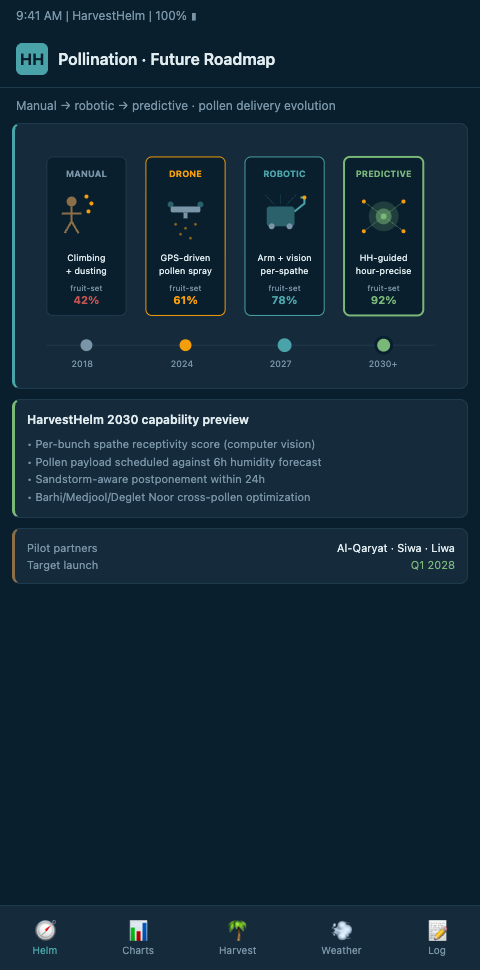
Date palm pollination has remained a labor-intensive manual operation longer than most perennial crops because the combination of 12-20 meter palm height, 72-hour receptivity windows, and cultivar-specific pollen matching resisted automation for decades. That is ending. Three research streams — autonomous drone pollinators, liquid-suspension spray systems, and sensor-directed dispatch — are converging fast enough that growers planning 2028 pollination capacity should be planning around tools that will be commercially deployable in the next 2-4 seasons.
The Nature Scientific Reports paper on AI-enabled drones for date palm pollination documents YOLO-based inflorescence detection combined with autonomous pollen-spraying achieving 80% labor reduction and 97% pollen reduction relative to manual application. Those numbers are not incremental — they represent an order-of-magnitude shift in unit economics. The Springer AI Review of robot-based pollinators surveys air-jet, water-jet, ultrasonic, and spray robotic pollinators including date palm applications, confirming multiple engineering paths toward automation.
ICARDA's cost-effective liquid pollination technology for date palm demonstrates hose-based liquid pollen spray delivering equivalent fruit set at a fraction of manual labor. The EJFA study on liquid-suspension pollination on Mejhoul cv in Mexicali valley achieved 68% fruit set on liquid-suspension treatment versus 54% on control, using only 4 g/L pollen ratio — quantifying both efficacy and pollen economy.
The operational context makes these advances matter. Ladder-crew labor for palm pollination is becoming scarcer and more expensive across MENA, and the 72-hour Medjool stigma receptivity window means a crew shortage during peak bloom is a yield event, not an inconvenience. The Avary Drone analysis of drone spraying economics documents drone-applied pollen reducing labor by 80% in tall crops, with the agricultural drone market growing at 25% CAGR through 2030. The ICARDA-IDC MoU on date palm sustainability signals institutional commitment across Gulf research programs to scale precision pollination tech.
The Helm-Charted Yield Forecast as the Director of Autonomous Pollination
HarvestHelm's helm-charted yield forecast is the coordinating layer that makes autonomous pollination operationally coherent. The yacht dashboard does not fly the drone or drive the liquid-suspension rig — but it tells the autonomous system which palms to visit, in what sequence, at what pollen concentration, and against what arrival deadline. A drone pollinator without a sensor-fed dispatch layer is a tool looking for a job; paired with a helm-charted yield forecast, it becomes a surgical instrument matched to the 72-hour Medjool window or the 7-day Deglet Noor window.
The ScienceDirect review of autonomous flower pollination techniques surveys progress and future directions, underlining that the bottleneck in deployment is not the pollinator hardware but the orchestration layer — knowing which flowers to pollinate when, with what pollen, at what rate. The helm dashboard is that orchestration layer for date palm. Our dispatch architecture ingests real-time spathe-emergence data from parcel-level telemetry, tracks cultivar-specific receptivity phases, and issues drone or liquid-rig dispatch orders with palm-level precision.
The Nature Scientific Reports paper on optimizing drone-based pollination using target detection and path planning in complex orchards demonstrates vision-guided path planning in orchards that transfers directly to scattered male-female palm dispatch. We integrate this path-planning layer with our sensor mesh: a drone flight plan for a 340-palm Medjool block is not a standing pattern, it's a morning-specific plan driven by overnight telemetry showing which palms crossed into receptivity since the previous flight. The yacht dashboard shows the flight plan overlay before departure, and the captain metaphor holds — the grower steers, the autonomous system executes.
The kilo-cut economics make autonomous pollination accessible at a scale that capex-driven models cannot. A drone pollinator fleet is out of reach for a smallholder running 180 palms, but a HarvestHelm deployment with autonomous dispatch shared across a cooperative of 30 smallholders becomes feasible — and the kilo-cut pays for the shared infrastructure only when harvests actually land. The revenue-share model financing pattern scales naturally; adding autonomous pollination as a fleet-shared service fits the same economic architecture. We couple the forecast-side modeling from our climate-drift fruit-set model directly into autonomous dispatch — the drift forecast conditions the drone flight plan on expected receptivity shifts, so next season's pollination calendar auto-adjusts for drift without a separate planning exercise.
Advanced Tactics: What to Plan For in the Next Five Seasons
The first advanced move is staged autonomous adoption. A full autonomous pollination stack is premature for most oases today — the regulatory frameworks for agricultural drone operation vary by country, and the liquid-suspension systems require cultivar-specific pollen-concentration calibration. We recommend a three-stage transition: stage one adds sensor-directed manual pollination (improving crew efficiency by 20-30% without any autonomous hardware); stage two introduces liquid-suspension on accessible blocks where ladder labor is most expensive; stage three adds drone pollination on the remaining 40-60% of blocks where manual access is most constrained.
The second tactic is pollen genetics integration. Autonomous systems unlock the ability to apply custom pollen mixes at per-palm precision — a capability manual pollination cannot match economically. Research is active on pollen-genotype optimization for specific cultivar-parthenocarpy suppression and fruit-size targeting. The helm dashboard will surface pollen-mix recommendations at the palm level as these research outputs mature, and the autonomous dispatch will execute against them. Growers who invest in telemetry infrastructure now will be positioned to act on these recommendations when they land; growers who wait will be playing catch-up.
The third tactic is cross-crop engineering transfer. Precision pollination in desert dates shares engineering DNA with precision disease management in tropical mango and precision spray in mountain apple. Our work on precision disease future applies the same autonomous-dispatch-directed-by-sensor-mesh pattern to anthracnose suppression rather than pollen application. The shared architecture means our engineering investment compounds across crops, and specific optimizations — vision-based detection, path-planning, dispatch scheduling — benefit all deployments as they mature.
The fourth tactic is monitoring-first deployment. The single most important decision a grower can make today for 2028 autonomous pollination is to start collecting parcel-level spathe-emergence and receptivity telemetry now. The autonomous systems depend on that historical record for dispatch calibration. A grower with four seasons of parcel-level bloom data on HarvestHelm will have materially better autonomous pollination performance in year one of drone deployment than a grower starting from scratch. This is why the pollination 12 seasons back-testing discipline matters for autonomous futures — the telemetry record built today becomes the training data for the autonomous systems of 2028-2030.
The fifth tactic is labor-force co-evolution. Autonomous pollination does not replace ladder crews overnight; it changes what the crews do. Instead of applying pollen, crews increasingly perform inspection, maintenance of the autonomous equipment, cultivar verification, and targeted manual pollination on palms the drones cannot access (inversely-oriented spathes, dense-canopy blocks, physical access constraints). The transition is gradual and collaborative, and the helm dashboard supports it by issuing role-specific task lists — drone dispatch for flight-plan blocks, crew dispatch for inspection-and-manual-pollination blocks, and combined runs where both approaches layer on the same parcel.
The sixth tactic is transparent performance reconciliation. Every season the helm runs a post-season reconciliation: what fruit set each pollination method achieved on comparable palm cohorts, with attribution to cultivar, timing, pollen concentration, and environmental conditions. Growers see which of their blocks benefited most from autonomous vs manual pollination, and the decision allocation for next season is data-driven rather than driven by vendor marketing. This discipline — transparent reconciliation, not vendor promises — is what makes autonomous pollination a permanent shift rather than a hype cycle.
The seventh tactic is insurance and regulatory pre-positioning. Autonomous agricultural drone operation falls under different regulatory frameworks across MENA countries, the Coachella Valley, and Tunisian oases — and those frameworks are evolving rapidly. Growers who establish telemetry compliance and operational logging now will have smoother paths to autonomous pollination permitting when regulations stabilize. The helm's event-log architecture produces the documentation patterns that regulators typically require: flight-path logs, pollen batch traceability, chemical-applicator certification (for liquid suspension), and incident response records. Being ready for the regulatory framework before it crystallizes is operational leverage.
The eighth tactic is pollen-supply-chain digitization. Precision pollination requires confidence in the pollen supply chain — provenance, genotype, viability testing, storage history. The helm tracks pollen inventory at batch level from male flower harvest through cold storage through deployment, producing chain-of-custody documentation for every pollination event. This matters both for fruit-set attribution (knowing whether a poor result came from pollen quality or environmental stress) and for export-grade compliance (some specialty date markets require documented pollen provenance). Growers adopting autonomous pollination without parallel supply-chain digitization get the dispatch benefits but lose the attribution discipline; the helm couples both.
The ninth tactic is cooperative precision-pollination fleet design. A single smallholder cannot justify a dedicated drone fleet; thirty cooperating smallholders sharing a fleet can. The helm's multi-grower dispatch architecture supports shared-fleet precision pollination by scheduling drone flights across cooperative blocks with attribution back to each grower's kilo-cut. This shared-fleet model is what makes autonomous pollination economically viable at smallholder scale, and the helm's operational architecture is designed for it from the ground up. Without a multi-grower dispatch layer, shared fleets collapse into scheduling disputes; with one, they operate as efficient shared infrastructure.
The tenth tactic is research-partnership integration. Institutions like ICARDA, CGIAR Gulf programs, and MENA agricultural universities are actively researching precision pollination techniques with cultivar-specific protocols. The helm's telemetry architecture produces research-grade datasets as a byproduct of routine operation — meaning growers running HarvestHelm can contribute to ongoing precision-pollination research and benefit from research findings faster than operations outside the network. This knowledge feedback loop accelerates both individual adoption and the underlying research, and it's only possible when the telemetry layer produces data at research standards.
Steer Your Palms Into the Next Decade of Date Cultivation
The ladder crew that pollinated your 2020 bloom is not the same system that will pollinate your 2028 bloom. Drone-directed pollen dispatch, liquid-suspension systems, and sensor-fed flight plans are already working in peer-reviewed trials — the only question is whether your oasis has the telemetry record and the operational discipline to benefit from those tools when they commercialize. HarvestHelm installs the sensor mesh, builds the multi-season bloom record, and runs the orchestration layer that makes autonomous pollination a surgical instrument rather than a shotgun.
Because our kilo-cut pricing takes only a share of the export-grade tonnage you harvest, we pay the infrastructure cost of the transition ourselves and share only in the yield gains. If you're a Medjool, Deglet Noor, Barhi, or Zahidi cultivator planning 2028-2030 capacity — alone or as part of a smallholder cooperative — let us walk your oasis and scope what precision pollination will look like on your specific palms when the autonomous tools go mainstream.
Join the precision-pollination waitlist before the next spathe-emergence season, and on day one you will see staged-adoption roadmaps tuned to your specific cultivar mix with per-block autonomous access scores, liquid-suspension feasibility indices, and pollen-supply-chain digitization checklists ready to run. Waitlisted Gulf and MENA cooperatives who onboarded ahead of last Barhi bloom began building the four-season receptivity telemetry record now needed for drone-dispatch calibration when autonomous equipment goes mainstream in 2028. The pollen-batch chain-of-custody workflow runs from day one regardless of which pollination method you use today, meaning the attribution data accrues even while you pollinate Medjool by ladder and Deglet Noor by mechanical duster.