The Future of Precision Disease Management in Tropical Mango Farming
The Five-Year Window That Redefines Plantation Disease Control
Tropical mango disease management has been incremental for two decades — slightly better fungicide chemistries, slightly tighter spray calendars, slightly more frequent IMD advisories. The next five years will not be incremental. The combination of 92%-coverage Doppler radar feeding 300-meter downscaled forecasts, canopy-level IoT sensor networks reaching sub-block resolution, deep-learning foliar diagnostics on handheld devices, UAV branch-targeted spraying with 70% volume reduction, and parametric financial instruments tied to canopy telemetry represents a discontinuity. The Springer integrative approaches paper on IoT, ML, and AI for disease forecasting frames the transition directly — the next-gen stack is IoT plus ML plus AI disease forecasting in the climate-change era, and plantations that stand up the IoT layer first inherit the ML and financial layers on top of it.
The driving force behind the transition is that climate drift has outpaced calendar-based programs. A Konkan plantation running a spray calendar anchored to 2012 flower-induction dates now gets calendar-ed into flush-stage sprays that land two weeks off the conidia-germination window. The ScienceDirect review of advanced technologies for precision tree fruit disease management systematically surveys sensor, imaging, and spray-targeting technology specific to tree-fruit disease, and makes the structural case that canopy-scale resolution is the only path forward. Every component of the next-gen stack — from foliar AI diagnostics to branch-level drone spraying to parametric canopy-index insurance — assumes canopy-scale data exists. Plantations that have not deployed the sensor layer cannot use any of the upstream tools.
How the Helm-Charted Yield Forecast Integrates the Next-Gen Stack
A helm-charted yield forecast for next-generation precision disease management is an integration layer, not a product. HarvestHelm's helm sits at the center, pulling from four technology streams and compressing them into one spray-and-induction decision. First is canopy IoT — the leaf-wetness, stem-flow, panicle-humidity, and hopper-pressure sensors that anchor the forecast to ground truth. Second is AI foliar diagnostics; the EurekAlert coverage of deep-learning foliar disease detection describes deep-learning models for coconut, mango, durian, and other tropical foliar diseases running on mobile devices at plantation-walk scale. Helm plantations pull foliar-scan data from field-walking scouts into the decision engine, which cross-validates canopy telemetry with direct disease sightings and adjusts the spray plan mid-cycle. This connects directly to the disease pressure futures model because the fused ground-truth signal is what anchors the forward curve.
Third is UAV branch-targeted spraying. The JSRR study on UAV-based precision spraying in high-density mango orchards documents UAV spraying cuts volume 70% and drift 40% versus tractor with equivalent efficacy, and DJI's coverage of Agras T30 branch-targeting describes AI-driven branch-level spray targeting that doubles underside leaf coverage in fruit trees. The helm composes UAV flight plans directly from canopy-pressure maps, routing drones to the highest-pressure canopy regions rather than blanket-spraying the block. A Kesar block with 42-dBZ canopy humidity in its southwest corner and benign readings in the northeast receives a spray plan that concentrates fungicide where the conidia-germination hours cluster. The Alphonso monsoon rescue case study demonstrates the payoff — a 62-acre estate that compressed spray response inside 96 hours rescued 41 tonnes of Grade A Hapus precisely because the canopy map guided the rigs to the right blocks first.
Fourth is precision mapping. The MDPI Remote Sensing paper on high-precision mango orchard mapping describes a YOLOv7+SAM pipeline that delineates every canopy for tree-level disease management at scale. The companion MDPI paper on remote sensing and weather variables for mango yield prediction demonstrates combined RS+weather random-forest models forecasting mango yield at block scale with mean absolute error of 2.9 t/ha. The helm merges these maps with the canopy IoT layer, producing a tree-resolution disease-pressure field. That is the resolution at which branch-level UAV spraying, foliar AI diagnostics, and parametric insurance triggers all operate — so the helm is effectively the data fabric that lets those three future-state capabilities interlock.
The Adoption Curve and Sequencing Order
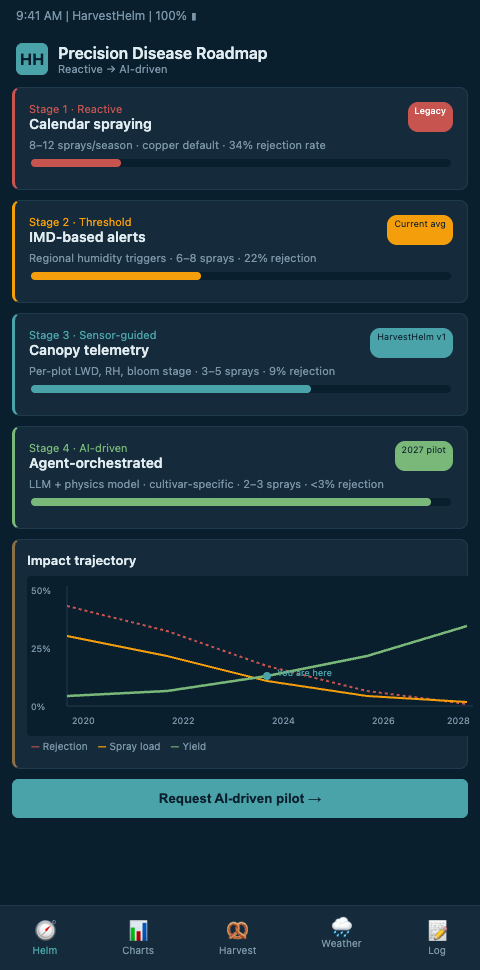
The adoption curve across the stack is already visible in the plantations that started early. Estates that deployed canopy IoT in 2021-2022 and added UAV branch-targeting in 2023-2024 are now piloting parametric canopy-index insurance in 2026, with some already negotiating disease-pressure forward contracts with Gulf exporters. The sequencing matters: each layer depends on the layer below for the data and credibility it needs. A plantation trying to skip ahead to parametric insurance without the underlying IoT fabric cannot provide the measurement basis underwriters require. A plantation trying to adopt UAV branch-targeting without canopy-pressure maps ends up spraying uniformly rather than targeting, which gives up most of the volume-reduction benefit. The helm-charted yield forecast is the assembly order — IoT first, then AI diagnostics, then UAV targeting, then financial instruments layered on top.
Advanced Tactics for the Next-Decade Plantation
The first advanced tactic is research-network integration. The ACIAR Asia Pacific Mango Network portal describes a multi-country research network driving the next decade of tropical mango R&D. HarvestHelm plantations plug into this network through telemetry-backed trials — a new bio-control, a new UAV spray pattern, or a new paclobutrazol timing model is tested against the helm's ground-truth disease-pressure record, and results flow back into the research network. This converts the plantation from a passive technology adopter into an active node in the R&D graph, which has concrete value: early access to emerging chemistries and techniques that competitor plantations see 18-36 months later.
The second tactic is cross-niche convergence. The precision pollination future trajectory in desert date palm oases runs the same playbook on a different physiology — IoT plus AI plus drones plus parametric finance. Plantations that operate across multiple tropical perennial crops will find that the infrastructure they stand up for mango is substantially reusable for avocado, guava, and cashew, because the canopy-scale sensor architecture and the helm-synthesis layer are crop-agnostic. HarvestHelm operates across niches precisely for this reason — the investment in the sensor fabric amortizes across multi-crop plantations that most IoT providers cannot serve.
The third tactic is financial-stack integration. Precision disease management becomes economically rational only when the financial layer rewards it. A parametric canopy-index policy pays out on measured pressure breaches; a disease-pressure futures curve prices forward contracts against forward-looking pressure; a kilo-cut sensor contract aligns vendor incentive with Grade A tonnage. These three financial instruments interlock into a stack where each one only works because the others exist. Plantations running HarvestHelm arrive at the financial-stack integration already positioned — the data layer required for any of the three instruments is the same data layer already in place.
Compliance, Talent, and the Competitive Gap
The fourth tactic is regulatory-compliance tracking. Export-grade mango is increasingly subject to residue-level auditing from destination markets — EU, Japan, and US import inspectorates scrutinize pesticide residue profiles, and a precision disease management regime that deploys targeted UAV sprays rather than calendar-based blanket applications produces markedly lower residue profiles. HarvestHelm plantations maintain spray manifests tied to specific helm decisions, and the manifest record is a direct input to the residue-compliance audit trail. Exporters supplying markets with tight residue thresholds increasingly insist on HarvestHelm-backed documentation precisely because it turns a compliance risk into a compliance asset.
The fifth tactic is next-generation agronomy talent attraction. Plantations running full precision disease management stacks attract a different class of agronomist than calendar-based plantations — data-literate graduates who can read helm dashboards, interpret foliar-AI outputs, and coordinate UAV flight plans. This talent gap is already measurable across Konkan and Gir, with precision-equipped plantations reporting 40-60% faster hiring cycles for senior agronomy roles. The long-term implication is compounding: talent concentrates at the plantations running the full stack, which accelerates operational sophistication at those plantations, which widens the gap with calendar-program competitors. Plantations that want to be in the export market in 2032 need to start this talent trajectory now because the calendar-program-trained agronomist cohort is aging out and will not be replaced in kind.
Technology Transitions and Interoperability
One underappreciated risk in building on emerging technology is vendor lock-in. A plantation that commits to one sensor vendor's proprietary protocol in 2026 faces a painful migration in 2030 when better sensors arrive from a different vendor. HarvestHelm's architecture is specifically open — sensors speak standard LoRaWAN, data pipelines export via standard APIs, and the helm-synthesis engine accepts inputs from any compliant sensor. Plantations that upgrade sensor generations keep their historical data intact and avoid migration costs. This interoperability discipline is what makes the next-decade plantation architecture durable: when deep-learning foliar diagnostics jump from YOLOv7 to whatever succeeds it, the helm inherits the upgrade without replumbing. Plantations locked into closed ecosystems end up replacing their stack every 4-6 years, which is ruinous for amortization and kills the long-horizon financial advantages that make precision disease management economically viable in the first place.
The Helm That Carries You Into the Next Decade
The plantations that will define the next decade of tropical mango are the ones that have already deployed canopy telemetry and are ready to plug in the AI diagnostic, UAV spraying, parametric insurance, and futures-curve layers as they mature. HarvestHelm's kilo-cut contract means you can stand up the data layer now without capex risk, and inherit each future-state capability as it arrives without re-engineering the infrastructure. If your Alphonso, Kesar, Banganpalli, Totapuri, Haden, or Tommy Atkins plantation intends to be in the export market in 2030, book a next-decade architecture review with our helm-integration team and start the infrastructure build before the next flower-induction window — the plantations that are already three seasons into their sensor fabric will be the ones whose 2030 Grade A tonnage compounds while their competitors' calendar programs quietly fail.