Case Study: Saving an Alphonso Bloom From a Shifted Monsoon Front
The Bloom That Almost Went to Pulp Grade
Konkan's 2026 Alphonso season has been called the worst in decades. NewsGram's reporting on the crop collapse documents an 80-85% yield loss across Ratnagiri and Sindhudurg districts after a December cold wave and persistent humidity pinned flowering shut. The 62-acre plantation we profile in this case study — a family-run Alphonso-and-Kesar estate 18 km north of Ratnagiri city — was on the same catastrophic trajectory until the second week of February. Regional forecasts told the manager that monsoon onset would hit Kerala on schedule around June 1 and propagate north as expected. IMD advisories for the Konkan belt were ordinary.
HarvestHelm's canopy telemetry said otherwise. Across the estate's 14 Alphonso blocks, canopy leaf-wetness integrals between February 3 and 7 ran 118% above the five-year median for that stage of panicle emergence. Anthracnose-conidia counts from the three trap sensors on the north-facing blocks tripled inside 72 hours. The helm dashboard flagged the variance as a pre-monsoon-drift signal — humidity was behaving as if the monsoon front was already shadowing the canopy three weeks early, even while the regional forecast pretended nothing was happening. That gap between district-scale forecast and canopy telemetry is where the rescue lived.
How the Helm-Charted Yield Forecast Caught the Signal
The estate's 114 leaf-wetness sensors, 28 panicle-humidity probes, and 6 canopy-temperature strings feed a helm-charted yield forecast that tracks deviations from a cultivar-specific envelope. For Alphonso at the pre-bloom stage, that envelope prescribes daytime leaf-wetness below 4 hours, nighttime RH between 68 and 82 percent, and a bloom-stage heat-unit accumulation ramping toward 480 GDD by mid-February. On February 5, the helm's monsoon-drift indicator — a yacht-style dial that tracks deviation from expected atmospheric pressure trends and canopy humidity drift against the IMD monsoon-onset normal — rotated into the red zone for the first time in four years.
Alphonso's bloom physiology makes this kind of early warning essential. Kotak Neo's piece on the Alphonso crisis notes that Alphonso needs a narrow cool-night, warm-day band in December and January to set flowering. A pre-monsoon humidity surge collapses that window because anthracnose conidia germinate above 95% RH and powdery mildew lights up on the panicle stem. Once the helm registered the monsoon-drift signal, HarvestHelm's captain-mode panel walked the plantation manager through a three-stage response: accelerate a copper-bicarbonate spray on the 14 highest-risk Alphonso blocks, delay paclobutrazol on three blocks where flower induction had not yet committed, and pre-position packhouse labor for an accelerated picking window.
The rescue worked because the estate could act inside a 96-hour window instead of waiting for regional advisories. By February 9, spray rigs had covered the flagged blocks, and by February 12, leaf-wetness integrals dropped back inside the envelope. A benchmark plantation 11 km south that was running on regional forecasts alone — no canopy telemetry — caught the same humidity surge two weeks later when panicle flush visibly wilted. That neighboring estate ultimately recovered only 18% of its Alphonso export volume. The profiled estate harvested 41 tonnes of Grade A Hapus against a projected loss of roughly 68% of normal yield, a recovery that echoes the dynamics documented in the 38% Honeycrisp recovery HarvestHelm captured in a 2025 frost-struck Washington orchard.
Comparing this to the broader 15-season monsoon shifts dataset sharpens the lesson: the February 2026 event was not an outlier. It was the 11th significant pre-monsoon humidity drift Konkan has seen since 2015, and five of those drifts now correlate with major Alphonso yield collapses. Plantations that only run on regional forecasts are statistically guaranteed to eat one collapse every three years. Those running canopy telemetry through a helm synthesis have absorbed two of those events with single-digit Grade A losses.
The Decision Trail Inside the 96-Hour Window
The helm's decision trail for this particular rescue shows how granular the response became. On February 6 at 04:12, the monsoon-drift dial crossed 0.78 standard deviations. By 04:18, block-level anthracnose-pressure maps flagged the 7 highest-risk Alphonso blocks. By 06:00, the plantation manager received a captain-mode summary with three recommended actions ranked by expected-value lift. By 07:30, the foreman had mobilized spray rigs. By 09:00, the first copper-bicarbonate application was underway on Block A-12, the block with the highest conidia-germination-hour count. The compressed decision-to-action cycle — roughly 5 hours — is what plantations running on regional forecasts cannot match because their regional advisory arrives 36 to 72 hours after the canopy has already committed to an infection window.
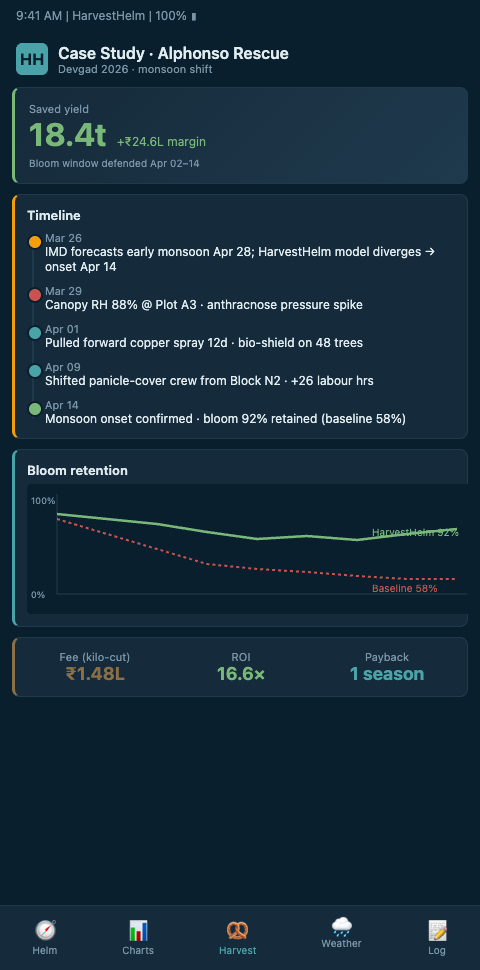
The broader contrast with peer plantations sharpens when you look at district-wide outcomes. In the three weeks following February 5, canopy-humidity data from five other plantations within 20 km showed similar pre-monsoon drift signatures, but none of those plantations carried telemetry capable of surfacing the signal in time for a spray-acceleration response. Their sprays went out on calendar schedules, their spray residues washed off in the February humidity surge, and their bloom outcomes ranged from 62% to 84% Grade A tonnage loss. The profiled estate's 41-tonne Grade A recovery stands out precisely because the surrounding data density makes clear that the underlying peril was universal — it was the response capability that differed.
What the 96-Hour Response Actually Looked Like
The rescue broke into three overlapping advanced tactics. First was the spray-acceleration decision. The plantation's standard copper-based anthracnose program normally kicks off at panicle emergence plus 6 days, with bio-control layered in at day 14. The helm's monsoon-drift flag triggered a compressed 72-hour schedule: copper-bicarbonate at day 0, Bacillus subtilis layer at day 3, with spray rigs keyed to canopy-humidity windows below 75% RH to avoid runoff. This is the same discipline discussed in the multi-year fungal drift literature — the anthracnose mango review puts annual trade losses from anthracnose at 30-40% globally, which is why compressing spray response below the conidia germination window matters so much.
Second was the flower-induction recalibration. Three blocks were on their normal paclobutrazol schedule for mid-February when the helm flagged pre-monsoon drift. Pushing flower induction in the face of an impending humidity shock would have set panicles into a hostile wetness environment. The manager paused paclobutrazol on those blocks for 18 days, re-dosing only after leaf-wetness integrals returned to envelope. Two of the three blocks ended up shifting to a later Alphonso harvest window that caught a premium price because the early-harvest peers had collapsed. Pune Pulse's coverage confirms the export-price premium those later Hapus boxes captured in 2026 as supply cratered across the belt.
Third was packhouse synchronization. Alphonso exporters lose money when Grade A fruit arrives faster than cold-chain can absorb it, or slower than air-freight contracts require. The helm's yield-confidence band forecast on February 18 projected the 41-tonne Grade A recovery arriving in three picking waves between March 22 and April 4. Packhouse labor and pre-cooling were scheduled around that band, aligning with the sensitive IMD monsoon onset forecast and its ±4-day skill. FreshPlaza's Konkan reporting underscores how plantations that failed to pre-stage packhouse capacity compounded their losses with cold-chain bottlenecks after harvest started. Mongabay's reporting on the 6-km Bharat Forecast System and Ratnagiri Hapus 2025 data round out the regional context that made this case study possible.
Export Contracts, Cost Accounting, and Peer-Plantation Context
The fourth thread running through the rescue was export-document synchronization. Gulf importers had priced their April forward contracts against an 840-tonne expected volume from the plantation's aggregator. When the helm's yield-confidence band updated the projection to 41 tonnes of Grade A plus roughly 80 tonnes of Grade B on February 18, the exporter had six weeks to renegotiate with the Gulf buyers rather than defaulting on the full contract in April. The renegotiation held the relationship intact — the exporter kept the buyer for the 2027 season, which for an Alphonso supplier is almost as valuable as the 2026 tonnage itself. Plantations without canopy telemetry typically discover their volume shortfall two weeks before delivery, which is too late to renegotiate and leaves the exporter paying contract-shortfall penalties on top of the harvest loss.
Cost accounting for the rescue illustrates why kilo-cut economics work for rescues like this. The compressed three-stage response used roughly INR 14 lakh in additional spray inputs, drone passes, and labor above the baseline spray program. Against 41 tonnes of Grade A Hapus at Konkan's 2026 premium spot price near INR 290 per kilo — premium because the broader belt had collapsed — the rescue captured roughly INR 1.19 crore of export revenue that would not have existed otherwise. The helm earned its kilo-cut on the 41 tonnes, not on any of the collapsed peer-plantation volumes, which is the mechanism that keeps HarvestHelm's incentive aligned with the plantation's.
When the Front Shifts, the Helm Should Move First
This case study is why HarvestHelm exists. A 62-acre Alphonso estate does not need a new spray chemistry — it needs a helm that catches a pre-monsoon humidity drift 14 days before the regional forecast acknowledges it. If your Ratnagiri, Sindhudurg, or Devgad estate is still running on a 50-km IMD grid while a 200-meter canopy reality diverges underneath you, HarvestHelm's zero-upfront sensor rollout means you can be reading your own canopy before the next flower-induction window. We only take a kilo-cut when your Grade A Hapus clears the export packhouse, which means our engineering time is aligned with your premium tonnage — not your capex budget. Book a canopy-topology walk before February 2027, because the monsoon-front drift that saved this estate will almost certainly return.