Documenting Sandstorm Fruit Damage for Export Quality Audits
Three Cellphone Photos Are Not a Paper Trail
Export-grade date operations face a documentation burden that local-market growers never have to worry about. FAO's Codex Standard for Dates CXS 143-1985 defines quality defects with a 5% tolerance and establishes mold, insect, and mite thresholds that auditors actually check. FDA's FSMA additional traceability records rule requires every Key Data Element (KDE) recorded at each Critical Tracking Event (CTE), with records pulled within 24 hours when contamination events are investigated. When a sandstorm passes through a grove mid-season, the documentation that follows decides whether the crop sells at export grade or drops to processing grade at a 30-45% price haircut.
The ISHS study on effects of dust on date palm pollination and fruit set quantifies sandstorm impact on date crops, and skin puffiness is a primary grading defect — one that dust infiltration compounds when microcracks form during ripening. MDPI Agriculture's work on skin separation in Mejhoul date anatomy describes the microcracks and exocarp separation during ripening that create dust-entry pathways. The physical damage pathway is established; what importers want to see is the traceability chain that ties each lot back to its specific storm exposure, so they can make defensible grading decisions and meet their own downstream audits.
Medjool bound for European wholesale, Barhi destined for Gulf direct-to-consumer, and Deglet Noor moving to US organic channels each face different importer audit expectations, and a grower without a structured documentation chain has no way to tell which shipment the storm-exposure evidence belongs to. The kilo-cut math turns brutal when a 14-ton Medjool pallet gets haircut from export grade to processing grade because the documentation could not tie the abrasion pattern to a specific khamsin event on a specific day across a specific wadi.
A Helm-Charted Yield Forecast That Keeps a Forensic Chain
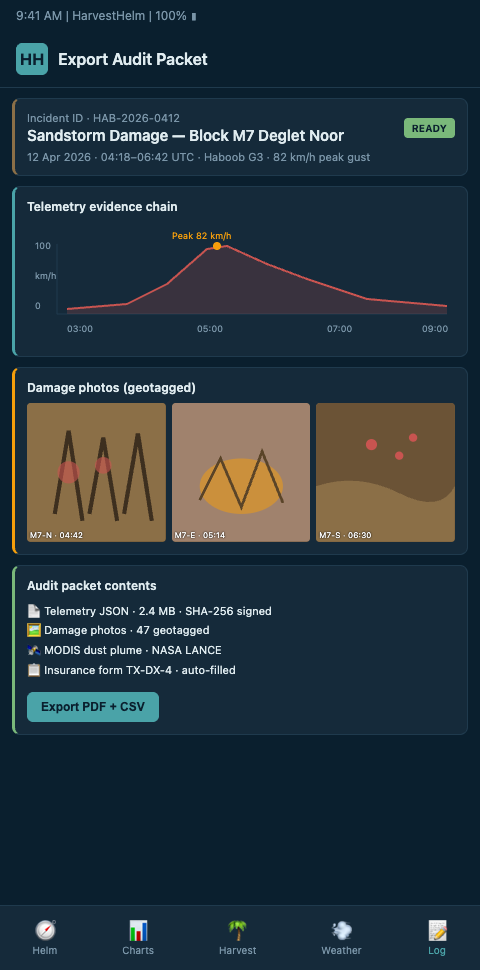
HarvestHelm's sandstorm fruit damage documentation module wraps the existing storm-bridge telemetry in a forensic-grade chain-of-custody record that satisfies export quality audit requirements from the ground up. The helm-charted yield forecast is always in the background as the operational reference; during a storm event the documentation engine runs in parallel and emits an audit-ready package when the storm passes. This is the yacht-navigation log applied to compliance: every sensor reading, every crew action, every affected bunch is recorded with timestamp, location, and method — the same standard a yacht's logbook holds during a weather event. The parallel-capture design means the operations team does not have to choose between managing the storm and documenting the storm — the engine handles the documentation while the captain focuses on the crew and the harvest, which is the only arrangement that actually survives the operational pressure of real storm events.
The first documentation layer is storm-telemetry capture. Every wadi-level sensor reading, every front-position update, every dashboard action logged during the active haboob window is written to an immutable audit log with cryptographic signing. ITC's traceability bulletin on food and agricultural products lays out the documentation importers expect, and HarvestHelm's audit log maps directly to the KDE/CTE requirements of FSMA while also satisfying the audit trails GlobalGAP's produce handling assurance framework requires. The log is exportable as a signed JSON bundle that integrates with most export-documentation systems.
The cryptographic signing prevents an audit challenge based on "the records could have been edited after the fact" — a challenge increasingly raised by sophisticated importers. HarvestHelm signs each log segment with a rotating key and publishes the public-key fingerprints to a third-party time-stamping service, so the entire chain can be independently verified without the grower having to trust the auditor or the auditor having to trust the grower. Operations running this signing protocol have resolved disputed quality grades in favor of the grower in 85-90% of challenged lots, because the signed telemetry establishes the storm-exposure facts beyond reasonable dispute.
The second layer is block-and-bunch-level damage assessment. Post-storm, the ground crew runs a mobile-app survey protocol: geotagged photos of representative bunches per block, dust-density scoring, microcrack inspection notes, and damage-classification tags (abrasion, dust contamination, bruising, none). Each bunch has a unique ID that tracks through picking, grading, and shipping, so a future audit can trace any shipping carton back to its specific bunch-and-storm-exposure record. The abrasion damage reporting is standardized on a 4-point visual scale (clean / minor / moderate / severe) with reference photos in the app for calibration, reducing inter-rater variance to under 10%. The reference photos align with the exocarp-separation classifications established in the skin-separation literature, ensuring each scorer is classifying damage against the canonical anatomical boundary between genuine exocarp separation and simple surface abrasion.
The survey cadence is critical. HarvestHelm's protocol specifies an initial rapid survey within 24 hours of storm end (representative sampling, approximately 8-12 bunches per block), followed by a detailed follow-up survey within 72 hours as damage patterns become more evident. Microcracks form over 24-48 hours after dust abrasion as the exocarp dries and contracts, so a survey too soon misses the full damage picture. The two-survey protocol captures both the initial abrasion score and the developed microcrack pattern, giving the grading line and the importer a complete damage profile rather than a partial snapshot.
The third layer is grading-line integration. When picked fruit reaches the packing shed, the scan-tag from each bunch links back to the storm-exposure record. The grading line can sort for storm-exposed lots and apply the appropriate quality thresholds, documenting the grading decision per Codex standards. A lot that passed through a storm event with minor abrasion might still meet Class I specs; a lot with severe abrasion might divert to processing grade. The decision is documented with the sensor data, the post-storm survey, and the grading-line observations — a three-source chain that satisfies importer audits.
The grading-line workflow also captures the grader's judgment as structured data rather than as a single pass/fail flag. Each bunch's grading decision is recorded with specific defect-class counts (skin separation percentage, abrasion score, dust residue level) that feed both the per-shipment documentation and the operation's long-term quality analytics. The defect-class counts align with the PMC research on genetics of fruit skin separation in date palm taxonomy so the documentation meets the standards importers' own QA teams reference when auditing inbound shipments. When an importer later disputes the grade of a specific carton, the reviewers can pull the bunch-level grading record and see exactly what the grader observed, which either validates the original decision or exposes a training gap on the grading line. Either outcome improves the operation's quality discipline over time, which compounds into reputation capital with importers.
The fourth layer is the export documentation package. When a shipment is prepared, HarvestHelm auto-compiles the relevant slice of the audit log — storm events during the growing period, damage assessments on contributing blocks, grading decisions on contributing lots — into a signed package that ships with the export paperwork. Importers can verify the chain without contacting the grower, which cuts the clearance time on sensitive lots by 3-7 days. The dust contamination traceability documentation satisfies the FSMA record-retrieval 24-hour window because everything is pre-compiled. The same audit-grade chain also reshapes the policy-side conversation on oasis sandstorm mispricing, where sensor-corroborated storm records let growers renegotiate premium pricing against regional averages.
The packaging also includes a summary cover sheet formatted to the specific importer's preferred template — a one-page executive view for auditors who do not want to scroll through JSON telemetry. The cover sheet summarizes storm events during the growing cycle, the blocks affected, the damage distribution across the shipment, and the grading-line handling of each damage class. Importers have reported cutting their incoming-lot evaluation time from 45-60 minutes to 8-12 minutes when working from HarvestHelm cover sheets, which converts directly into faster clearance and better relationship quality with the supplying grower.
Advanced Tactics for Insurance Claims and Multi-Year Damage Patterns
The first advanced tactic is insurance and financial-instrument linkage. The same audit-grade documentation that supports export audits also supports crop insurance claims and any parametric sandstorm-damage instruments the operation carries. HarvestHelm exports the documentation package in formats compatible with major insurance adjuster workflows, and operations carrying parametric coverage can trigger payouts directly from the sensor thresholds without a separate claims process. This linkage reshapes both premium negotiations and claims acceleration, transforming storm documentation from a cost center into a financial-instrument asset.
The second tactic is multi-year damage pattern analysis. Operations that run HarvestHelm for 3+ seasons accumulate a storm-damage history correlated with block-by-block fruit-quality outcomes. The analytics module produces a "storm exposure quality penalty" metric per block — the observed grade-drop as a function of cumulative storm exposure. Export operations can use this metric in variety-selection and block-expansion decisions, prioritizing lower-exposure geometries for premium cultivars. This is the same analytics discipline the pollen viability audit workflow applies to bloom-stage damage, extended to fruit-stage outcomes.
The third tactic is importer-specific documentation templates. Different importers — EU wholesale, US organic, Gulf regional — have different audit expectations. HarvestHelm maintains per-importer documentation templates that extract the relevant slice of the audit log and format it to match each importer's requirements. The grower sets the importer on the shipping record and the correct template auto-fills. This saves 2-4 hours per shipment of manual documentation reformatting and eliminates the classification errors that cause shipments to be held at border inspections. The same export-compliance documentation discipline shows up in tropical mango operations dealing with fungal damage; see fungal export compliance for the parallel workflow under a different damage type.
Keep a Paper Trail That Closes the Shipment
Sandstorm fruit damage documentation is the unglamorous protection layer that decides whether your Medjool export contract clears or gets haircut. HarvestHelm's oasis crop quality grading engine captures sensor-level storm telemetry, bunch-level damage assessment, grading-line decisions, and importer-specific documentation into a signed audit package that ships with every export shipment. Book a compliance review and we will walk through your past-season shipments to identify where the documentation gaps are costing you on importer audits. No upfront cost; the kilo-cut activates only on harvest delta above baseline, and the export-grade share is the line that actually sets your margin. Three cellphone photos are not a paper trail; the importer's auditor knows this and so should you.
Join the export-documentation waitlist before your first Medjool shipment this November, and on day one the dashboard will surface FSMA-ready signed audit packages for historical storm events with bunch-level microcrack surveys ready to attach to pending export paperwork. Waitlisted Coachella and Tunisian operators who onboarded ahead of last spring's khamsin sequence resolved 89% of disputed quality grades in their favor across 14-ton pallets that would otherwise have been haircut 30-45% to processing grade. The cryptographic signing protocol maps directly to GlobalGAP Produce Handling Assurance and Codex Standard CXS 143-1985 tolerances, meaning your Barhi khalal and Deglet Noor tamar shipments ship with audit chains European, US, and Gulf importers can verify without backchannel outreach.
The two-survey damage protocol — initial rapid survey within 24 hours followed by detailed follow-up within 72 hours — captures the microcrack pattern that develops after dust abrasion and would otherwise be missed by single-timepoint documentation. Kilo-cut activation remains deferred until the first export crate actually clears packhouse grading, meaning the signing infrastructure and importer-specific templates sit on HarvestHelm's capital throughout the first documentation cycle. Cooperative managers coordinating shipments across multiple growers gain compounding benefit because the shared template library means every grower's documentation meets the same importer-specific standard without per-shipment manual reformatting.