Documenting Fungal Crop Loss for Export Compliance Rejections
Why Export Rejections Reveal the Gaps in Plantation Documentation
Export-grade mango inspections have tightened across major import markets. EU buyers under CBI guidance enforce phytosanitary documentation requirements with increasing precision — the CBI European market for mangoes research documents the specific documentation buyers require including fungal attack classifications. GCC markets including UAE have issued formal warnings to Indian mango exporters, as captured by Business Standard reporting on UAE warnings. US markets under FSMA have added traceability requirements documented in the FDA FSMA 204 Food Traceability Rule, mandating Key Data Elements and Critical Tracking Events. Each regime demands a documentation standard that goes well beyond the traditional spray log and packhouse invoice.
The structural gap in Indian mango export documentation is not the absence of records — it is the fragmentation of records. A typical plantation maintains a spray log in the agronomist's notebook, a harvest record at the packhouse gate, a packhouse grading sheet on a separate form, a transport manifest with the logistics provider, and a buyer-certificate packet at dispatch. When a container gets flagged for anthracnose at the port, reconstructing the full chain of custody requires pulling five separate record streams that do not share keys, timestamps, or environmental context. The APS Plant Disease review on postharvest disease management challenges documents the regulatory rejection frameworks that require integrated documentation rather than fragmented paper trails.
The insurance and claims side amplifies the problem. A plantation trying to claim against a parametric policy or a crop insurance product needs to demonstrate that fungal loss occurred under conditions consistent with policy triggers, that management responses were timely and appropriate, and that the loss falls within covered categories. Fragmented records make that demonstration extremely difficult, which means claim payouts get delayed, reduced, or denied. The APEDA Packhouse Scheme recognition documentation specifies packhouse recognition procedures that require documentation continuity from plantation through to dispatch, and plantations without that continuity face both regulatory and commercial risk.
Integrated Documentation on the Helm-Charted Yield Forecast
HarvestHelm treats fungal crop loss documentation the way a yacht captain maintains a logbook — every entry timestamped, every decision recorded with context, every environmental condition captured alongside the actions taken. The helm-charted yield forecast architecture produces documentation as a byproduct of normal operations rather than as a separate compliance exercise. Every spray trigger event, every humidity threshold crossing, every harvest pull-forward decision, every packhouse processing step gets logged with the environmental readings and the decision rationale that drove it. A captain does not write the logbook at the end of the passage from memory — the logbook gets written in real time as the passage unfolds.
The documentation architecture runs five integrated layers. Layer one is environmental capture. Canopy RH, temperature, leaf wetness, precipitation, and PAR get logged continuously across the season with block-level resolution. When an export inspector flags a container for anthracnose, the plantation can pull the complete environmental history for the originating block across the 60 days preceding harvest, showing whether infection pressure was present and whether it was detected by the monitoring system. This environmental capture integrates with APEDA HortiNet traceability which provides APEDA's official electronic traceability platform for Indian horticulture exporters including mangoes — the environmental data enriches the traceability record with the epidemiological context.
Layer two is intervention logging. Every spray pass, every bio-control application, every chemistry selection decision gets logged with the sensor readings that triggered it, the chemistry selected, the volume applied, the coverage area, the crew identifier, and the re-entry timing. The ICAR-CISH integrated pest management documentation provides the regulatory framework for substantiating IPM decisions during audit, and HarvestHelm's intervention log produces the data those substantiations require. When a container rejection triggers a dispute, the intervention log demonstrates the decision process that produced the shipped fruit.
Layer three is harvest and handling tracking. Each bin gets a block identifier, a harvest timestamp, a maturity index, a transit time to packhouse, a pre-cooling window, and a grading line outcome. These data elements align directly with the FSMA 204 Key Data Elements requirements for traceability records, which means a plantation documenting with HarvestHelm can satisfy US market requirements without a separate compliance exercise. This integrates with spray timing audit logic because the harvest tracking closes the loop on the spray decisions, demonstrating whether the intervention timing actually protected the fruit that eventually shipped.
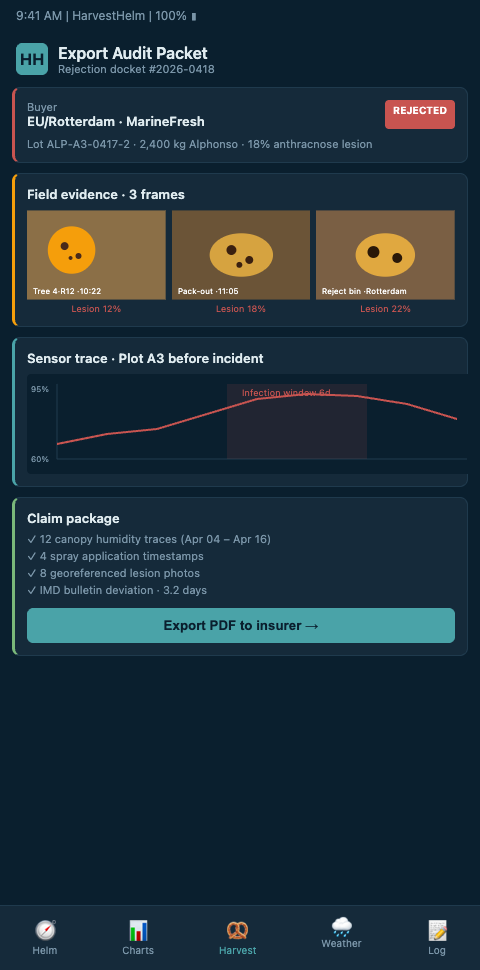
Layer four is rejection reconstruction. When a container is flagged at port inspection, the dashboard assembles a full rejection reconstruction packet automatically: environmental conditions for each block contributing to the container, intervention history, harvest and handling chain, packhouse grading outcomes, pre-cooling duration, and transit conditions. The plantation can transmit this packet to the buyer, insurer, or regulator within hours rather than reconstructing the documentation over weeks. The Frontiers review of mango supply chain management postharvest quality confirms that mango postharvest anthracnose lowers fruit quality and shelf life, directly affecting export quality standards — which makes rapid rejection reconstruction critical for disputing contested rejections.
Layer five is insurance-grade evidence packaging. For parametric crop insurance claims, the dashboard packages the environmental data, intervention log, harvest records, and loss documentation into the specific format that insurance carriers require. This is also where regional fungal mispricing analysis becomes actionable — insurance products mispriced against regional averages can be contested with plantation-specific historical evidence showing actual risk profiles.
Advanced Tactics for Audit-Grade Documentation
The advanced layer of documentation tactics separates plantations that successfully contest 60 percent of rejections from those that successfully contest 10 percent. The first tactic is pre-emptive documentation packaging. Rather than assembling rejection reconstruction packets only when rejections happen, leading plantations pre-package documentation for every export shipment before dispatch. That means the buyer receives the environmental history, intervention log, and handling chain alongside the commercial invoice — the compliance evidence is part of the shipment rather than a defensive response to flags. Pre-emptive packaging also accelerates phytosanitary inspection at the origin port because inspectors see the documentation up-front.
The second advanced tactic is cross-shipment pattern analysis. When a specific buyer rejects shipments with patterns inconsistent with the plantation's own documentation, the dashboard identifies the pattern divergence. For example, if Dubai consistently flags Alphonso containers for anthracnose at rates 3x higher than Rotterdam despite identical plantation-source documentation, the divergence indicates either transit handling issues, receiver inspection variance, or buyer-specific quality interpretation — each of which requires a different operational response. Desert date palm growers facing similar export documentation challenges use sandstorm export audit patterns that transfer directly to mango plantation cross-shipment analysis.
The third advanced tactic is multi-regulator documentation alignment. EU CBI requirements, US FSMA traceability, GCC phytosanitary, and domestic APEDA requirements have overlapping but not identical data element specifications. HarvestHelm's dashboard maps internal documentation to each regulatory framework and flags the specific data elements that each market requires, so a plantation shipping to five markets maintains one consistent data model that satisfies all five regulatory frames. This is the audit equivalent of what insurance-grade evidence packaging does for claims — the same underlying data supports multiple downstream compliance requirements.
Implementation Steps for Documentation-First Plantations
Plantations transitioning from fragmented paper records to integrated documentation typically start with environmental data capture because it runs automatically once sensors are deployed. Month one of the transition focuses on confirming sensor coverage meets the block-level resolution needed for traceability records — most plantations find gaps they did not know about once they look at documentation from the inspector's perspective rather than the agronomist's. Month two shifts intervention logging from paper or spreadsheet to the dashboard, which typically requires field crew training on mobile entry workflows. Month three brings harvest and packhouse tracking into the integrated system, completing the chain from block to container.
The cultural shift matters as much as the technical implementation. Plantation teams accustomed to completing compliance paperwork as an afterthought at end-of-shift need to adjust to capturing data as a routine part of each operation. HarvestHelm's dashboard reduces friction by pre-populating 70 to 80 percent of each documentation event from sensor and system data — the crew enters only the fields that human judgement actually contributes — but the residual 20 to 30 percent of manual entry still requires the habit of real-time logging. Plantations that make the habit stick typically do so by tying documentation completion to payroll release for piece-rate crews, creating a direct economic incentive for field-level data quality.
The payback on documentation investment shows up in the first major rejection dispute. A plantation that successfully contests a 30-lakh-rupee rejection with automated environmental and intervention records recovers roughly 10x what the full documentation system cost to implement, in a single case. After that first successful dispute, the documentation infrastructure becomes non-negotiable operational baseline rather than an optional overhead. Plantations still running fragmented records after their first major rejection dispute typically lose both the disputed shipment value and the ongoing commercial relationship with the flagging buyer, compounding the direct loss.
Documentation Is the Difference Between Contesting and Conceding
Export rejections happen — the question is whether your plantation has the documentation to contest them successfully or the data gaps that force concession. HarvestHelm's kilo-cut monetization model means the platform earns only when fruit clears customs at the destination, which aligns the dashboard's documentation capture directly with export success. A plantation that captures documentation as a byproduct of normal operations treats rejections as contestable commercial events rather than as accepted losses. Ratnagiri, Valsad, and Krishnagiri export specialists who have moved to integrated documentation platforms report recovering 40 to 60 percent of rejected shipment value through successful contestation, and completing insurance claims in weeks rather than months.
The inspector at the port will find what the inspector finds. Your logbook determines whether you win the dispute that follows. Day one of the dashboard links every Alphonso and Kesar bin to the block-level anthracnose pressure hours logged during flowering, packhouse brix readings at grading, and the spray chemistry selected against each monsoon humidity spike. Waitlist priority goes to exporters who have faced at least one Jebel Ali or Rotterdam rejection in the last two pre-monsoon seasons, where integrated documentation reshapes the next dispute outcome.