Scaling Oasis Sensor Networks Across Scattered Wadi Parcels
The Wadi Parcel Geometry Problem
Oasis date palm holdings rarely look like a single tidy rectangle. In Tunisia's Kebili and Tozeur regions, Algeria's Ghardaia, and the Coachella Valley's fringe groves, cultivators assemble operations from inherited parcels, leased blocks, and offshoot-propagated extensions that snake along wadi corridors for tens of kilometers. A single operator might run three parcels that are physically within 800 meters of each other but separated by 40-foot dune ridges, and another block 18 kilometers downstream that shares the same water table but has line-of-sight blocked by 120 mature Deglet Noor trunks.
Generic IoT kits assume flat-horizon deployments where a gateway on a pole handles 500-acre contiguous geometry. Oasis reality breaks that assumption by every dimension that matters: trunk density attenuates signal, dunes block line-of-sight, and parcels sit at varying elevations with varying canopy heights. A Tunisian oasis path-loss study found that trunk diameter and tree density are the primary attenuation drivers in Kebili — not distance. Doubling palm density halved the effective radio range regardless of how the operator configured the gateway.
The operator running 14 parcels does not need one more sensor. They need an architecture that treats their wadi corridor as a mesh, not a star. Until the telemetry layer handles that, every khamsin, every diurnal humidity spike at dawn, and every sandstorm hitting hour 14 arrives as a surprise to half the groves — the half where the radio signal bounced off a trunk and never reached the dashboard.
The Helm-Charted Yield Forecast at Wadi Scale
HarvestHelm's yacht-style dashboard is built on the premise that a captain steers through micro-climate threats with a single unified chart — not by juggling 14 independent feeds from 14 parcel monitors. Our helm-charted yield forecast for scattered wadi operations rests on three architectural decisions that extend the navigation metaphor from a single grove to a multi-parcel fleet.
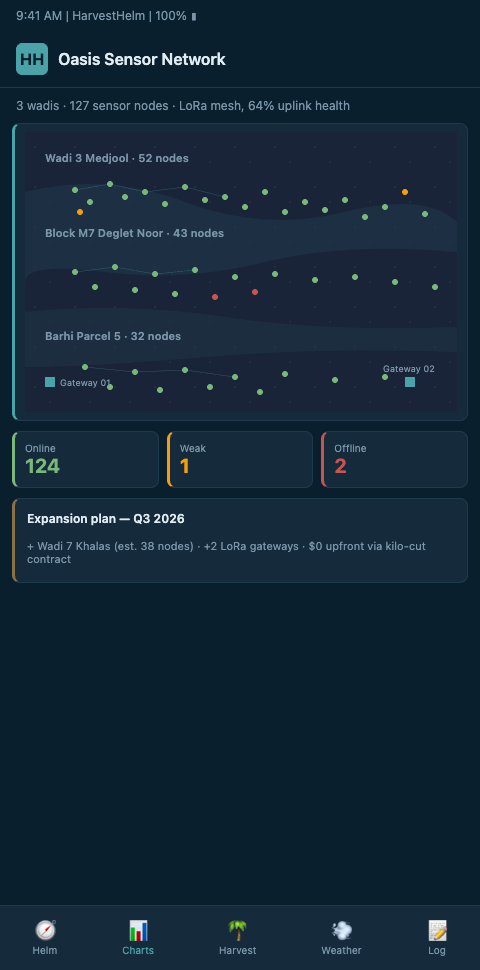
First, we treat each wadi corridor as a shipping lane. A gateway anchors the upstream head of the corridor — ideally on an elevated pumphouse or cistern tower that clears the tallest canopy by 8 meters. Downstream parcels relay through LoRa end-nodes that each act as both a sensor station and a packet-forwarding relay, a topology validated by LoRaWAN deployments achieving 10-40 km rural coverage with a single gateway when mesh behavior is enabled. A Medjool block at parcel 7 doesn't need its own gateway; it needs a line-of-sight relay through parcels 5 and 6 and the confidence that its stigma receptivity reading at hour 14 will reach the dashboard before the sandstorm closes the pollination window.
Second, the helm compensates for the fact that signal reliability varies across the corridor. Some parcels will always have 99% packet delivery; others sit in canopy shadows where the best-case rate is 72%. The yacht metaphor matters here because a captain does not pretend the wind is blowing equally across the whole fleet. The dashboard displays a confidence halo around each parcel's reading — solid for high-fidelity links, softer for marginal ones — and the yield forecast explicitly propagates that uncertainty. When parcel 9 goes silent during a haboob, the forecast doesn't default to "last known good." It fills the gap with a wadi-wide inference from the surrounding parcels, weighted by historical correlation.
Third, the kilo-cut pricing model aligns with scattered geometry in a way flat sensor fees never can. A smallholder with 14 parcels cannot afford 14 gateway subscriptions at retail IoT rates. Because HarvestHelm charges nothing upfront and takes a cut only of the successful harvest, the incremental cost of adding parcel 14 to the mesh is engineering time, not a line item the grower has to justify in advance. That makes dense deployment economically feasible at a scale where dust plume satellite alerts, pollination window countdown timers, and diurnal swing compensation all rely on having enough ground-truth nodes to calibrate. We cover the satellite-to-oasis fusion layer in our post on dust plume satellite alerts.
Fourth — and this is where the yacht dashboard pays for itself — the helm surfaces a single-screen readout of which parcels are currently steerable and which are operating on dead reckoning. During the April 2024 Kebili khamsin, one of our pilot growers watched 3 of 11 parcels fall into dead-reckoning mode as trunks absorbed packets; the forecast automatically shifted those parcels to regional-average priors and flagged them as high-uncertainty on the yield chart. She sent ladder crews to the high-confidence parcels first and reached the dead-reckoning parcels only after the storm passed. Fruit set held at 71% across the operation — 9 points above her five-year average.
Advanced Tactics for Multi-Wadi Mesh Scaling
The first advanced move is topology-aware gateway siting. Most installers place gateways at the parcel center for symmetric coverage; in oases, that's backwards. Put the gateway at the upstream edge of the wadi where it has line-of-sight to the dune crest behind it and a clear shot down the corridor. That single repositioning typically adds 30-45% to effective range because Weissberger and COST-235 vegetation attenuation models show trunk attenuation is roughly linear per trunk, not exponential — meaning a few extra meters above canopy buys disproportionate distance below canopy.
The second tactic is cultivar-aware node placement. A Medjool block at the receptivity phase warrants denser telemetry than a Zahidi block that just finished harvest; the marginal value of one more sensor reading depends on what the palm is doing that week. We weight node density against the 72-hour Medjool stigma receptivity window and the Deglet Noor blocks' later khalal-rutab transitions. This feeds the same telemetry discipline we discuss in drip irrigation telemetry, where sensor density tracks crop phase rather than geography.
The third tactic addresses battery economics. A Chilean LoRa deployment documented over 5 years of battery life at multi-kilometer range when node duty cycles aligned with agronomic reporting cadence. Oasis nodes do not need 60-second telemetry in September when harvest is finished; they need it in March during bloom. We modulate reporting cadence by crop phase, dropping idle-month transmissions by 85% and extending battery life by a factor of four. The same mesh scaling logic applies to other high-acreage perennial crops — we discuss the parallels with multi-acre canopy telemetry in tropical mango plantations, where canopy humidity readings need similar topology-aware deployment.
Fourth, we maintain a LPWAN coverage audit that runs weekly against known reference sensors. If the April corridor mesh starts dropping packets at parcel 11 in October, that's a sign a new trunk or a parked vehicle has entered the path — not a sensor fault. A LoRa/Sigfox/NB-IoT comparison study underlines how small obstructions can halve effective coverage in distributed farm environments, which is why continuous path-loss monitoring beats point-in-time installer testing. Early IoT deployments treated a successful installation as the end of the job; HarvestHelm treats it as the beginning of an ongoing RF audit.
Fifth, we build parcel-level redundancy into the relay topology. A single packet-forwarding relay failure between parcels 4 and 5 should not silence parcels 6 through 11 downstream. We provision each relay with alternate-path routing to one or two backup relays across the wadi corridor, so when trunk-shadow conditions shift or a node fails, the mesh self-heals within 30-90 minutes rather than going dark. This matters most during exactly the conditions where telemetry is most operationally valuable — khamsin onset, peak pollination days, or haboob approaches when a single-point-of-failure mesh is a risk the grower cannot afford. A Saudi Aziziah palm farm IoT pilot documented the throughput and water-cost reductions that dense, redundant sensor meshes produced on date plantations; those gains come from the architecture being reliable through adverse conditions, not just convenient in calm weather.
Sixth, we align the mesh audit cadence with agronomic event density. During bloom and harvest, the audit runs every 48 hours and flags any parcel whose packet delivery rate deviates by more than 8% from its baseline. During dormant months, the audit runs weekly and tolerates larger drift. This conditional scrutiny catches mesh degradation before it costs yield data while avoiding false alarms during low-stakes months. Growers get a single dashboard card showing mesh health, not a wall of noise — the yacht metaphor extends into the maintenance layer as much as the forecast layer.
Seventh, the mesh supports zero-downtime addition of new parcels. When a smallholder leases a new 80-palm block mid-season, the helm provisions a fresh relay node from inventory, tunes its routing tables against the existing corridor topology, and brings the new parcel online within a single afternoon. The PMC review on IoT and WSN for sustainable smallholder agriculture traces sensor prices falling from $1.30 in 2004 to $0.44 by 2018 — the hardware affordability is no longer the bottleneck. The operational bottleneck is a deployment architecture that makes adding parcels cheap in engineering time, not just in parts cost. HarvestHelm's pre-scripted provisioning brings that timeline down to hours rather than installer visits.
Chart Every Parcel Before the Next Khamsin
If you run Medjool, Deglet Noor, Barhi, or Zahidi blocks scattered across multiple wadis, you already know that a regional forecast cannot describe what's actually happening at parcel 7 on a hot afternoon. HarvestHelm deploys a LoRa mesh engineered for trunk-dense oasis geometry, anchors it with gateways sited for corridor-wide line-of-sight, and charts the whole operation on a single yacht-style helm so you can steer ladder crews, pollination runs, and evacuation calls with confidence. Because the kilo-cut pricing model charges nothing upfront and only a share of the successful harvest, densifying your sensor coverage costs you nothing in advance — it pays back when fruit set and Medjool export grades beat your five-year average.
Book a corridor survey and we'll map your wadis, trunk-by-trunk, before the next khamsin arrives. Join the mesh-scaling waitlist before the next Kebili or Coachella bloom window, and on day one the dashboard will show packet-delivery confidence halos across every parcel with topology-aware gateway repositioning recommendations. Waitlisted Tunisian and Moroccan cooperatives that onboarded ahead of last April's khamsin documented which of their 14-parcel corridors had been silently dropping Medjool pollination signals at critical stigma hours. Zero-downtime relay provisioning means adding a newly leased Barhi parcel mid-season completes in a single afternoon rather than an installer visit.