How to Audit Sensor Coverage After a Late-Spring Freeze Event
The Dead Zone That Cost 14 Tons of Honeycrisp
A New York grower completed a sensor coverage audit three weeks after a May 11 advective freeze and discovered a 2.3-acre coverage gap in the northwest corner of Block 22 Honeycrisp. The block had four probes on the expected grid pattern, but a fence line obstruction and a small east-west swale had created a localized cold pocket where no probe was placed. Bud-section analysis showed 68% king-bloom kill in the gap zone versus 12% kill in the probe-covered zones of the same block — roughly 14 tons of expected packhouse yield lost, none of it caught by the monitoring system. A Rutgers guidance on frost protection monitoring emphasizes that drift in bud-stage and canopy-temp readings exposes sensor dead zones — and the audit is how you find them.
The audit discipline is well-established in research. An Environmental Evidence Journal systematic review of spring frost management strategies concluded that sensor placement and redeployment efficacy depends on spatial sampling density — which is exactly what the post-event audit measures. And NC State Extension's guidance on assessing apple bud damage after an advective freeze specifies stage-by-stage sampling across the orchard as the representative-data foundation that the audit then compares against probe logs. The coverage-gap framing ties back to how pickup-truck crop surveys miss mountain orchard risk — the same coverage discipline that justifies replacing truck surveys with probes is what the audit quantifies after every freeze.
The timing of the audit matters as much as the methodology. Bud-section analysis performed within 72 hours of the freeze event reveals kill percentages clearly — brown pistils indicate dead buds. Performed 10 days later, natural bloom drop obscures the signal because some surviving buds have dropped for unrelated reasons and some dead buds remain on the tree. HarvestHelm's audit workflow targets the 24-72 hour window for maximum evidentiary clarity, and the helm dashboard surfaces the audit as a time-sensitive task immediately after any threshold-crossing freeze event.
Audit Protocol on the Helm-Charted Yield Forecast
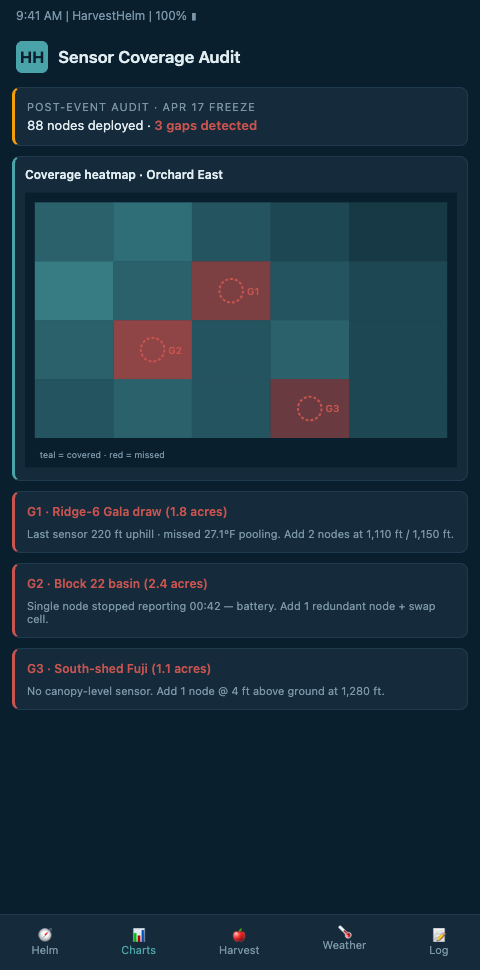
HarvestHelm's audit runs as a structured three-phase workflow on the helm-charted yield forecast. Phase one is the freeze-event reconstruction: every probe log for the event is aggregated, the cold-pool footprint is mapped from interpolated sensor data, and the orchard's elevation model is overlaid to identify where cold air would have pooled in zones that lack probe coverage. This produces a "suspected dead zone" heatmap directly on the helm display.
Phase two is the ground-truth sampling pass. Following MSU Extension's methodology for assessing frost and freeze damage to flowers and buds, trained staff section buds across a stratified sample that includes both probe-covered zones and suspected-dead-zone areas. Kill percentages from each sample point are entered into HarvestHelm's audit module against GPS coordinates, and the system overlays the damage data onto the cold-pool heatmap. Where damage exceeds sensor-predicted kill by more than 15 percentage points, a coverage gap is confirmed.
Phase three is the redeployment plan. For each confirmed gap, HarvestHelm generates a proposed probe siting with recommended cable or wireless routing, estimated cost impact against the kilo-cut revenue model, and a priority rating based on expected future frost exposure. The yacht metaphor carries through — after a hull breach, you do not just patch the visible hole; you inspect the whole hull and re-rate the vessel's seaworthiness. The sensor audit is the orchard's hull inspection.
Redeployment sequencing reflects the next season's risk window. Gaps that sit inside blocks scheduled to bloom first in the coming year receive the highest redeployment priority, because those blocks will encounter the next frost exposure window first. Gaps in late-blooming Fuji or Pink Lady blocks can wait until mid-winter for redeployment without exposing the grower to additional loss. HarvestHelm's redeployment timeline panel shows the ordering and the cumulative risk reduction each installation delivers, so growers can make informed trade-offs when budget constraints force them to stage installations across weeks rather than days.
Research benchmarks inform the density targets. An IEEE Xplore paper on the PEACH IoT frost event prediction system demonstrates wireless mesh networks with 100% reliability and under 2-second latency, 3+ year battery life — that is the benchmark HarvestHelm uses for post-audit coverage upgrades. And Onset Comp's documentation on data loggers in microclimate monitoring describes the standard pattern: loggers in a grid across rolling topography expose frost-pressure zones and GDD variance. The audit formalizes when the existing grid is insufficient and how dense the replacement grid needs to be.
Grid density recommendations adjust by terrain complexity. On rolling topography with distinct sub-basins, the audit typically recommends 25-35 meter spacing with additional probes at known cold-sink points. On more uniform terrain, 50-60 meter spacing suffices with strategic cold-sink coverage. HarvestHelm's recommendation engine models the cold-pool reconstruction error at each candidate density and chooses the density that minimizes expected miss rate at the minimum probe count — so the grower is neither under-sensoring critical zones nor over-sensoring zones that do not need it.
Multi-sensor approaches raise the ceiling. An MDPI Atmosphere paper on a multi-sensor frost observation system describes combining infrared cameras, leaf wetness sensors, and RGB imagery to replace naked-eye post-event assessments — HarvestHelm integrates these as optional premium upgrades for orchards where repeat frost losses justify the additional instrumentation.
Advanced Tactics for Multi-Parcel Audits
Large operations running multiple parcels face a scale problem. A 500-acre orchard across three non-contiguous parcels can generate 50+ suspected-dead-zone heatmaps after a severe freeze, and the grower needs to prioritize redeployment investment. HarvestHelm's audit module ranks gaps by expected annual yield exposure — a 2-acre gap at the basin bottom of a Honeycrisp block ranks higher than a 4-acre gap on a south-facing ridge, because the frost-frequency expectation is higher. Growers can allocate limited redeployment budget to the gaps that matter most.
Sensor technology upgrades are worth evaluating during the audit. A Penn State University study on cyber-physical heating systems for apple blossoms documented that sensor-driven heating systems more than doubled canopy protection time — but only when sensor coverage was dense enough to drive reliable triggering. The audit is the moment to decide whether the existing hardware can support upgraded protection schemes or whether new hardware is required.
Battery and communication health is a silent failure mode the audit catches. A probe that reported normally on Tuesday but went silent at 2am on the frost night looks like coverage from the overview but contributed nothing during the actual event. HarvestHelm's audit module specifically checks each probe's continuous-reporting record through the event window and flags probes that dropped out. A 3-year-old wireless network will typically have 3-5% of probes dropping out during peak cold events; after the audit identifies the affected units, battery replacement and antenna inspection restore coverage before the next event.
Comparison to baseline survey methods reveals why the audit matters on an ongoing basis. The probe network's coverage claim is only as strong as the data that validates it after each event — and the audit is the formal proof that the probe network is actually doing what manual surveys cannot. Without the audit, there is no way to show that the switch from truck surveys to probes delivered the expected coverage, and growers who skip this validation often find their renewed confidence in sensors undercut the first time a dead zone quietly costs bins.
Scaling audits across fragmented parcels is its own discipline. HarvestHelm's multi-parcel audit view rolls up dead zones across all the grower's parcels into a single prioritization list, which ties into scaling microclimate monitoring across fragmented parcels — the scaling patterns and the audit patterns reinforce each other. Growers who run parcels across multiple counties face an especially acute version of this problem, and the audit view surfaces the long-tail gaps they might otherwise miss.
Coastal citrus operations run an analogous audit after hurricanes. hurricane sensor survival audit documents the same post-event pattern against a different weather threat — probes knocked out by wind and salt rather than cold-pool miscoverage, but the same three-phase audit skeleton.
The failure mode to avoid is treating the audit as optional. Growers who skip the audit after a "small" freeze event often find that the same dead zone costs them yield again two years later — the pattern repeats because the gap was never addressed. HarvestHelm schedules the audit automatically after any freeze event that exceeds bud-stage kill thresholds on any block, so the review happens regardless of whether the grower remembers to request it.
End-of-season audit reconciliation is the closing layer. At the end of the bloom-to-harvest cycle, HarvestHelm runs a cumulative audit that combines all within-season events into a single coverage review. Patterns that were not obvious from any single event — a mid-block drop-off in probe reliability, a consistent 2F bias between two neighboring probes, or a sub-basin that appeared in imagery but had never been captured in the probe grid — surface in the cumulative view. Growers use the end-of-season audit as the planning anchor for next year's sensor deployment, so every installed probe reflects a specific observed need rather than a generic grid-density default.
Ready to Audit Sensor Coverage After Your Next Freeze?
Mountain orchardists who discover sensor dead zones only during the next frost event are carrying avoidable risk. HarvestHelm's audit module reconstructs the freeze footprint, overlays bud-section damage data, identifies coverage gaps, and generates a ranked redeployment plan — all tied to the helm-charted yield forecast that drives fan triggers and pick schedules. Zero cash upfront, kilo-cut at packhouse scale. Join the waitlist with your parcel boundaries and any known cold-pocket locations from last spring, and we will return a coverage map showing where your current probes cover and where the likely dead zones sit before the next freeze window opens. Pilots signing before the next May advective-freeze window get the 24-to-72-hour bud-section sampling protocol pre-scheduled with trained staff so kill percentages land in the audit module with the evidentiary clarity that post-week-one sampling loses.
Day-one dashboard views show the cold-pool heatmap overlaid on probe coverage with suspected dead zones marked in red and expected annual yield exposure drawn per gap. Onboarding includes a battery and communication health check that flags probes which went silent during the last frost event, since a dropped-out wireless unit looks like coverage from the overview but contributed nothing during the actual event. The kilo-cut contract settles only on Honeycrisp, Gala, and Enterprise tonnage that cleared through audit-validated probe coverage, so a 2.3-acre dead zone in a Block 22 Honeycrisp corner that drops 14 tons of packhouse yield costs us before it costs your fruit broker's contract commitment. End-of-season cumulative audits surface patterns that no single event reveals — a mid-block reliability drop-off or a 2F bias between neighboring probes — and become the planning anchor for next season's redeployment.