Predicting Cultivar Rotation Timing From 5-Year Bloom Variance Data
The Replant Decision Mountain Growers Keep Getting Wrong
A Washington State apple grower tracks 25 years of variety mix and sees the numbers: WSU Extension documents Red Delicious falling from a 70% share of Washington production to around 30% over two decades. That transition cost growers who held on too long. Honeycrisp, Gala, Fuji, and newer Cosmic Crisp plantings captured the margin. The replant discipline was the competitive edge.
For mountain orchardists, the next wave of cultivar rotation decisions will be driven less by consumer preference and more by climate drift. A block that has been a reliable Honeycrisp producer at 1,950 feet for 15 years may be drifting toward chill-hour insufficiency. The question is not whether to rotate — the question is when, and the answer lives in five years of bloom variance data that most orchards are not systematically tracking.
The cost of mistiming the rotation is asymmetric. Replanting too early means tearing out a block that still had 3-5 productive years, losing roughly $24,000-$60,000 per acre in foregone revenue during its remaining productive life. Replanting too late means operating a block at declining yield for 5-8 years, losing roughly $18,000-$40,000 per acre in yield shortfall. Both errors are expensive, but the late-replant error compounds with worse fruit quality and more difficult labor management. Data-driven timing splits the difference by identifying the inflection point before yield has visibly degraded.
The Frontiers Agronomy study on flowering variation in apple maturity documents that within-orchard flowering variability between trees and individual flowers drives harvest variability — and that signal is the canary for whether a variety is still matched to its site. Growers who plant decisions on first-year bloom performance miss the year-over-year variance that reveals the actual stability of the match.
The Helm-Charted Yield Forecast View of Bloom Variance
Think of cultivar rotation timing the way a yacht captain thinks about when to refit a sail plan: a sail that performed well for five years but has shown increasing luff and shape variance over the last two seasons is telling you it is nearing end of life, even if it has not failed outright. The helm-charted yield forecast reads apple variety performance the same way — not just mean yield, but bloom-window variance over rolling 5-year windows. A cultivar whose bloom-window variance is widening is signaling site-mismatch before the yield numbers confirm it.
HarvestHelm's bloom variance module ingests daily phenology observations per block across the full bloom window (pink bud through petal fall), computes bloom center-of-mass and bloom-window width, and tracks the 5-year trend in both metrics as a rolling baseline. A stable variety on a matched site will show center-of-mass drifting consistently with climate (1-2 days earlier per decade, per the MDPI Horticulturae 60-year pome fruit phenology dataset showing 11-14 days of advance across six decades) and bloom-window width staying roughly constant.
A mismatched variety shows a different signature: bloom-window width expanding year-over-year, indicating that the cultivar is struggling to coordinate bud break across the block under increasingly variable chill accumulation. This is the early signal that the variety should be on the replant watchlist.
The expanding bloom-window is functionally equivalent to a check-engine light on a vehicle. By itself, it does not mean the block has to be replanted immediately — but it requires attention because the cost of ignoring it compounds each season. A 5-day bloom window in year 1 expanding to 11 days by year 5 indicates the cultivar is operating near its chill-requirement edge, and additional warming will push it across the threshold into unreliable bud break. The helm surfaces this expansion trend alongside the chill-drift forecast, giving the grower a coherent forward view rather than two disconnected signals.
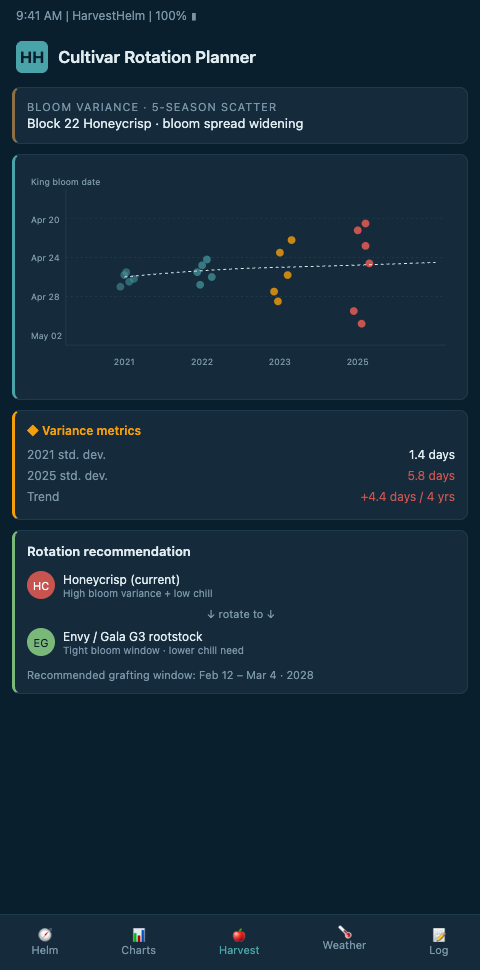
The ScienceDirect global evaluation of apple flowering phenology models supports multi-year variance analysis as a valid basis for planting decisions. The ScienceDirect study on flowering models across 26 apple cultivars in England provides multi-cultivar parameterization baselines for variance-based rotation scoring. For Honeycrisp specifically, Agriculture Journals' 4-year data on Honeycrisp bloom/yield across 8 rootstocks supports variety-phase-out modeling at the rootstock level — not all Honeycrisp behaves identically, and the rootstock choice moderates the bloom stability signal.
Data-collection discipline matters. Daily phenology observations during bloom require either a dedicated crew member walking the blocks or automated imaging. HarvestHelm uses camera nodes with leaf-scale imaging that automatically count bloom-stage progression 3 times per day, feeding the results into the variance module. Manual observations are also accepted — the helm has a simple mobile-app interface for the grower to tap bloom-stage codes during a standard block walk. Either input stream works; what matters is consistency across seasons so the year-over-year variance calculation is comparing like to like.
The helm produces a rotation score per block per variety on a 0-100 scale. Below 40, the variety is on immediate rotation priority. 40-70, monitor and plan within 3 years. Above 70, stable for current planning horizon. The score is updated each May after bloom completion, so growers have the full winter to plan replant decisions rather than reacting at nursery order time. Rotation planning is a multi-year process that involves nursery stock ordering (typically 2-3 years ahead), financing arrangement, and labor scheduling — the score gives enough lead time to sequence these without compression.
Advanced Tactics for Variety Rotation Economics
Three moves separate disciplined variety-rotation planning from panic-driven replants. First, integrate bloom variance data with replant economics. Good Fruit Grower's analysis of replant economics shows that multi-decade replant decisions weigh variety performance, royalty structure, and bloom-window economics. A block showing increasing bloom variance but only three years from peak productive age may still deserve rotation planning now, with the replant window scheduled after harvest of the pre-existing tree's final full-bearing season.
Second, do not replant like-for-like on a site that is showing variance signals. A Honeycrisp block showing increasing bloom-window width in a low-chill elevation band should not be replanted to Honeycrisp. Evaluate lower-chill cultivars (Gala, Fuji, Cosmic Crisp) or explicitly warmer-climate stock. Replanting the failing variety just restarts the clock on the same problem.
Third, sequence rotations across the orchard so that no more than 15-20% of total acreage is in establishment at any one time. Establishment years are cash-negative; a rotation plan that puts 40% of the orchard into establishment simultaneously produces a 3-year revenue trough that few operations survive. This requires a 10-year rotation master plan informed by bloom-variance data from every block. It connects directly to cultivar sensor strategy choices at planting time and to multi-year chill drift forecasting that provides the forward-looking context for variety choice. Tropical mango plantations run a parallel analysis on monsoon-shifted bloom windows; the monsoon bloom windows framework applies the same variance discipline to tropical cultivars.
A fourth tactic is trialing candidate replacements in buffer rows before committing to full-block rotation. Plant 6-10 trees of the candidate cultivar on the edges of the target block and track their bloom variance alongside the main cultivar for 2-3 years. If the candidate shows stable bloom coordination while the main cultivar's variance is expanding, the data supports the full rotation. This de-risks the rotation decision at the cost of delaying full-block replacement by 2-3 years — a worthwhile trade when the full rotation represents $50,000+ per acre of committed capital.
A common pitfall is reading a single unusually late or cold spring as evidence of cultivar mismatch when it is really just weather variability. The 5-year variance window specifically filters out single-season anomalies — one warm winter followed by a late frost is not enough signal to change planting decisions. The trend has to hold across the rolling window before the helm flags the block for rotation planning. This discipline prevents reactive replants that the grower later regrets when the following year's bloom comes back to baseline.
Pollination and cross-cultivar dependency also shape rotation timing. If Block 22 Honeycrisp is partially pollinated by Block 14 Gala across a fence line, replanting Block 22 to a different variety can reduce Block 14's yield if the bloom overlap is lost. The helm flags these dependencies so the rotation plan can either preserve cross-pollination (by choosing a new cultivar with overlapping bloom window) or phase in pollinator-rows within the new block. Either way, rotation planning is never a single-block decision — it is a block-and-neighbor analysis.
Make Replant Decisions on Five Years of Data, Not a Gut Call
Mountain orchardists planning the next decade of variety mix need bloom variance data per block per cultivar, not regional averages or nursery recommendations. HarvestHelm tracks phenology daily across every block and produces 5-year variance trajectories and rotation scores that drive replant sequencing. Zero upfront cost, kilo-cut only on cleared harvest. Mountain Apple Orchards waitlist growers get access to the 2026 variance analytics package, so your next replant decision is navigated on data instead of guessed on tradition. Join the HarvestHelm waitlist today to start logging the phenology data your replant decisions will depend on in 2031. Pilots signing before this spring's bloom window get camera nodes with leaf-scale imaging that automatically count bloom-stage progression 3 times per day, so the daily phenology record begins on calibrated automation rather than manual spot checks.
Day-one dashboard views show bloom-window width and center-of-mass per block per cultivar with rotation scores between 0 and 100, flagging every Honeycrisp block drifting toward chill-hour insufficiency at 1,950 feet before yield visibly degrades. Onboarding includes buffer-row trial planting of 6-to-10 candidate-replacement trees at target-block edges so the rotation decision can be validated against 2-to-3 seasons of side-by-side variance data before $50,000-per-acre of committed capital goes into the ground. The kilo-cut contract settles only on cleared Honeycrisp, Gala, Enterprise, and Fuji tonnage from blocks where rotation scores informed the planting decision, so a mismatched replant-like-for-like mistake on a low-chill elevation band costs us before the 5-to-8-year declining-yield tail drags your cash flow. Pollination-dependency mapping surfaces cross-fence-line cultivar overlap so a Block 22 Honeycrisp rotation does not silently drop Block 14 Gala's fruit set by losing the bloom-window overlap that held the two blocks together.