Predicting Bloom Windows From Five-Year Monsoon Arrival Shifts
When Alphonso Bloomed Two Weeks Early and Nobody Was Ready
The 2025 Alphonso season in Konkan surprised half the plantations in the region. Flowering began around January 12 across multiple Ratnagiri and Sindhudurg blocks — 16 days earlier than the five-year mean. Paclobutrazol schedules had been written for a normal late-January flower induction, and most of them were still uncompleted when panicle emergence began. Spray crews scrambled, packhouse labor schedules misaligned with the earlier picking window, and a significant fraction of the early-bloom fruit ran into a pre-monsoon humidity shock in March that it would have escaped under the later bloom. Mongabay's reporting on heatwaves threatening the king of mangoes documents the broader pattern — Uttar Pradesh's 34% share of national mango output is now exposed to bloom-timing volatility that a five-year monsoon record could have flagged ahead of time.
This is the bloom-window prediction problem. Mango flowering is driven by a combination of winter minimum temperatures, dry-period duration, and monsoon-withdrawal timing in the preceding season. All three variables carry year-over-year autocorrelation that makes a five-year record predictive rather than descriptive. Plantations that ignore it are scheduling spray rigs, labor, and packhouse capacity against a phantom historical mean that the actual distribution no longer matches.
How the Helm-Charted Yield Forecast Converts Monsoon History Into Bloom Windows
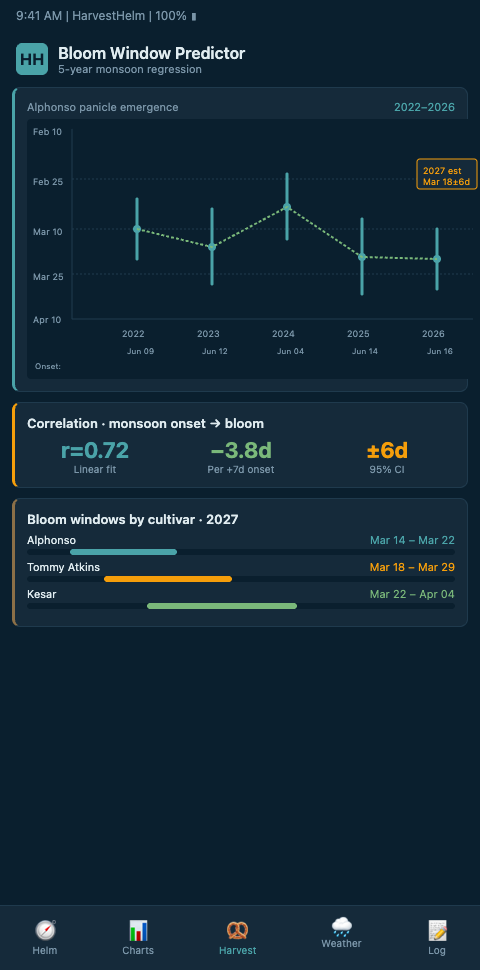
A helm-charted yield forecast for bloom windows runs a five-year monsoon arrival record through three physiological layers. First is the chilling-unit accumulation from the preceding November-December period, which the Springer work on weather impacts on mango phenostages documents as the trigger for bud-swell across four cultivars — bud swell persists at 15-23°C, and monsoon-linked temperatures shift bloom by weeks. Second is the dry-period duration between monsoon withdrawal and flower induction, which determines whether the plantation gets a clean flower-induction signal or a muddled one. Third is the cultivar-specific sensitivity curve — Alphonso, Kesar, Banganpalli, and Totapuri each respond differently to the same monsoon signal. The Preprints.org work on shifting phenostages in mango documents exactly this: higher minimum temperatures cut days-to-inflorescence-emergence in Alphonso, Banganpalli, and Totapuri by measurable margins.
The helm composites these layers into a bloom-window forecast with a confidence band, not a point estimate. For a given plantation, the helm draws from the five-year monsoon record — arrival date, withdrawal date, withdrawal temperature trajectory — and produces a three-panel bloom forecast: earliest expected panicle emergence, modal expected panicle emergence, and latest expected panicle emergence, each at 80% confidence. The modal prediction is what the plantation schedules around; the confidence band is what the plantation plans contingency labor against. The ResearchGate phenological responses case study provides the direct mapping of rainfall and temperature variables to bloom timing that anchors the model.
Forward-looking skill comes from coupling this with seasonal climate predictions. The Springer work on ECMWF SEAS5 forecast skill for Indian monsoon onset shows SEAS5 predicts monsoon onset pentad one month ahead, enabling bloom-window forecasts that extend into the coming season rather than only reporting the historical record. HarvestHelm's helm ingests the SEAS5 product and merges it with the five-year plantation record — the SEAS5 forecast updates the prior, and the plantation-specific five-year record calibrates how much weight to put on the regional forecast. This connects to the 15-season monsoon analysis at the long-horizon end, and to the monsoon dashboard workflow at the operational end — the five-year record lives in between.
The five-year window is specifically useful because it is short enough to capture the current drift regime but long enough to average out single-season noise. A three-year window is still too noisy — a single anomalous season biases the forecast. A ten-year window averages across what are now likely to be two drift regimes, producing a forecast that fits neither the current climate nor the past one. Five years sits at the sweet spot, which is why the helm's cultivar-response coefficients are specifically calibrated against the five-year rolling record rather than the full historical archive. Each season, the oldest year drops off and the newest year enters, keeping the forecast current.
Mid-Season Refresh and Operational Cadence
Updating the forecast mid-season is what converts it from an annual planning artifact into a living operational tool. The helm refreshes the bloom-window forecast weekly through December, every three days through January, and daily through early February as panicle emergence approaches. Each refresh incorporates the latest canopy telemetry, updated SEAS5 monsoon-onset forecasts, and observed flower-induction progress across the plantation. A December forecast that had panicle emergence at February 12 with a 28-day band might tighten to February 14 with an 11-day band by early February as the signals converge. This week-over-week tightening is what gives foremen confidence to commit labor to specific picking windows rather than holding contingencies open indefinitely.
The refresh cadence is designed around operational decision points, not around statistical convenience. Paclobutrazol purchasing typically gets locked in by mid-December, so the weekly December refresh is what drives that decision. Picking-labor pre-contracting happens in mid-January, so the three-times-weekly January refresh is what feeds that commitment. Packhouse-capacity reservation peaks in early February, so the daily February refresh is what firms up that planning. By aligning refresh cadence with decision cadence, the helm ensures that each refresh lands in time to actually change a decision rather than arriving as background noise that the foreman ignores.
Advanced Tactics for Bloom-Window Scheduling
The first advanced tactic is paclobutrazol timing keyed to the modal bloom prediction. Paclobutrazol applied too early delays bloom into a hostile pre-monsoon humidity window; applied too late, it fails to induce flowering at all. HarvestHelm plantations schedule paclobutrazol based on the helm's modal forecast minus a cultivar-specific lag — Alphonso gets 35-42 days, Kesar gets 28-32 days, Banganpalli gets 30-36 days. The five-year record feeds into the cultivar-specific lag because the historical data reveals how each cultivar's lag has drifted with changing winter minimums. The Mongabay coverage of Indian plant phenology highlights that monsoon-tied plant phenology may fail to track increasingly variable onset dates, which is why the helm's lag parameters update annually.
The second tactic is labor and packhouse pre-staging against the confidence band. If the helm's bloom-window forecast gives a modal panicle emergence of February 12 with an 80% band of January 28 to February 24, the plantation pre-contracts picking labor for a two-week variable window rather than a single-week fixed window. Packhouse pre-cooling capacity is reserved for the full band. When the actual bloom lands — whether early, modal, or late — the operational machinery flexes without panic. This is the same cultivar rotation bloom logic HarvestHelm runs in mountain apple orchards, where cross-cultivar bloom variance drives staggered labor scheduling — the underlying math of variance-aware operational planning is cross-niche infrastructure.
The third tactic is a back-test against the plantation's own five-year record. HarvestHelm runs the bloom-window forecast retrospectively for each of the last five seasons, showing the plantation manager what the model would have predicted and what actually happened. The ResearchGate review of climate change impacts on mango production in India documents that elevated temperatures drive premature flowering and irregular fruit set — exactly the patterns the back-test reveals. Plantations running HarvestHelm for three or more seasons typically find the bloom-window forecast would have captured 4 of 5 historical blooms within its 80% confidence band, which is the credibility threshold managers need before they schedule labor against a model output.
Multi-Cultivar Staggering and Split-Commitment Paclobutrazol
The fourth tactic is cultivar-mix bloom staggering. A plantation with Alphonso, Kesar, and Tommy Atkins blocks sees three different bloom windows that rarely overlap completely. The helm's five-year-record forecast produces three cultivar-specific bloom-window bands, which the plantation manager can use to stagger labor and spray resources across the season. When the forecast shows an early Alphonso bloom overlapping with a modal Kesar bloom, the plantation can either pre-contract additional labor or accept some pressure on the overlap window and plan for it explicitly. This is the difference between a cultivar mix being a resource-conflict liability and a resource-staggering asset.
The fifth tactic is flower-induction contingency planning. When the helm's confidence band is unusually wide — say a 28-day early-to-late spread — the plantation should prepare both an early and a late paclobutrazol deployment rather than committing to a single schedule. HarvestHelm plantations use a split-commitment approach: 40% of the paclobutrazol budget goes out at the modal-minus-lag date, with the remaining 60% reserved pending the helm's week-of-bloom update. This preserves flexibility to respond to whichever side of the confidence band the actual bloom lands on. The trade-off is a slightly less efficient paclobutrazol deployment — you pay for flexibility with coordination overhead — but in high-variance seasons, the flexibility is worth the overhead by a wide margin.
Cultivar-Specific Coefficient Drift
The cultivar-response coefficients in the helm's bloom-window engine are not static — they drift season-by-season as climate conditions shift. Alphonso's response coefficient for winter minimum temperature, for instance, has trended upward since 2019 as bloom timing becomes more sensitive to smaller temperature deviations. HarvestHelm re-estimates these coefficients annually using the latest five-year window, which keeps the forecast aligned with current physiology rather than locked into 2015-era assumptions. Plantations that run the same bloom-window model for five consecutive years without coefficient refresh find their forecast accuracy degrading by roughly 8-12% per year. The annual refresh is what holds forecast skill steady across shifting climate regimes, and it is the reason HarvestHelm contracts build coefficient updates into the quarterly service cadence rather than treating them as one-off engineering projects.
The Helm That Schedules Your Next Flower-Induction Window
A plantation that books paclobutrazol crews, spray rigs, and packhouse labor against a 10-year mean bloom date while the actual distribution has drifted two weeks is burning margin every season. HarvestHelm's helm-charted yield forecast converts your five-year monsoon record plus the ECMWF SEAS5 prediction into a bloom-window confidence band you can schedule against — Alphonso, Kesar, Banganpalli, Totapuri each with their own cultivar-calibrated lag. Because our contract is kilo-cut on Grade A export fruit, the bloom-window forecast itself is zero-upfront. If your 2027 flower-induction schedule is still running on a pre-2020 bloom calendar, book a bloom-window diagnostic before your next paclobutrazol cycle and stop scheduling against a past that no longer exists. Our bloom-window onboarding includes a five-season back-test showing what the helm would have predicted for each of your last five blooms, so you can see the forecast credibility against your own records rather than taking it on faith.