When Canopy Humidity Contradicts Official Monsoon Withdrawal Dates
The Official Withdrawal Date Versus the Canopy Reality
Indian monsoon withdrawal is declared by IMD based on a specific set of atmospheric criteria: anticyclone formation over northwest India, dry continental air replacing monsoon circulation, and progressive cessation of rainfall across declared isochrones. That declaration triggers agricultural advisories to shift from monsoon protocols to post-monsoon protocols — fungicide programs wind down, irrigation schedules restart, and crews move from disease monitoring to pre-flowering preparation. But research from Wiley QJRMS on midlatitude dry air during monsoon withdrawal documents that the air behind the withdrawal isochrone is much drier than the air ahead of it, creating a sharp gradient in residual humidity — and plantations sitting ahead of the isochrone on declaration day experience meaningfully different conditions than those behind it.
The documented delay pattern makes this worse. Adda247 reporting documents 13 consecutive years of late monsoon retreat in India, with actual withdrawal lagging normal withdrawal dates by 5 to 18 days across different regions. Independent analysis from Down To Earth confirmed the 2023 pattern of delayed withdrawal extending well into October with direct agricultural implications. For mango plantations in coastal Maharashtra, Konkan, and parts of Karnataka, the late-season residual humidity lingers long enough to drive a post-monsoon anthracnose pressure wave that the official withdrawal declaration does not capture.
The cost shows up two seasons later. Mango plantations that shut down disease monitoring at the official withdrawal date miss the late-October and November humidity windows when young trees develop flush that later panicle-emerges. Anthracnose lesions on that flush carry inoculum across to the next season's bloom. ScienceDirect research on Indian monsoon onset and withdrawal variability highlights that regional disruption analysis reveals local monsoon-withdrawal divergence versus national-scale declarations — the national advisory says the season is over, but the local canopy microclimate says otherwise. A plantation that trusts the national advisory over its own canopy sensors ends up with compounding inoculum load across multiple seasons.
Resolving the Contradiction With a Helm-Charted Yield Forecast
HarvestHelm treats the withdrawal-versus-canopy contradiction the way a yacht navigator treats a weather forecast that contradicts the barometer. The helm-charted yield forecast keeps the plantation's decision logic anchored to canopy-level readings rather than to regional declarations, while still surfacing the contradiction explicitly so the grower understands the divergence. When IMD declares withdrawal but plantation sensors continue reading 90-plus percent RH for sustained windows, the dashboard flags the discrepancy, holds disease-monitoring protocols active, and re-weights the next several trigger windows with higher caution. The captain does not stop watching the glass because the forecast says the weather has cleared.
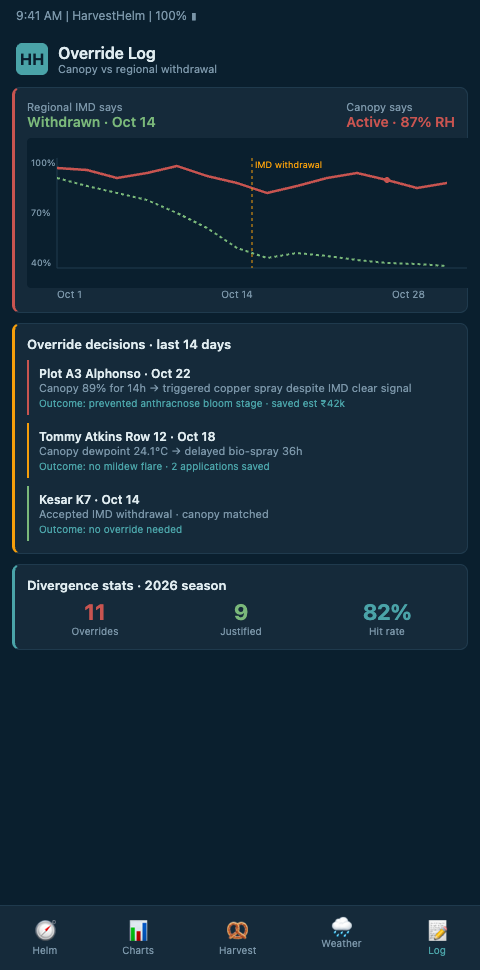
The dashboard architecture during the contradiction window runs four layers. Layer one is the official-versus-measured comparison. HarvestHelm pulls the IMD Monsoon Information withdrawal declarations automatically and overlays them on the plantation's canopy humidity time series, rendering the gap visually. The grower sees a single view showing "IMD declared withdrawal October 8" alongside "canopy RH average for last 72 hours: 92 percent, trend flat." That visual gap is the decision trigger for override behaviour.
Layer two is extended disease-pressure tracking. Normal plantation protocols during the monsoon season track anthracnose and powdery mildew pressure continuously. Post-withdrawal protocols in a non-contradictory year would scale back to weekly monitoring. In a contradiction year, HarvestHelm keeps the daily-pressure monitoring live for an additional 14 to 28 days (or until canopy humidity actually drops below the infection threshold for 7 consecutive days, whichever is later). Research from PMC on predicting leaf wetness duration provides the 86 percent RH / 3°C dewpoint reference that drives the leaf wetness proxy during this extended window, so even plantations without direct leaf wetness sensors can track the effective infection-hours accumulating post-withdrawal.
Layer three is cultivar and block-level risk differentiation. Not every block faces the same contradiction severity. A low-lying shaded Alphonso block holds residual moisture longer than an exposed slope Tommy Atkins block. HarvestHelm's dashboard renders the contradiction on the cultivar-aware microclimate heat-map, so the grower can see which blocks are most exposed and prioritize intervention accordingly. This integrates naturally with multi-year humidity drift analysis because repeated contradiction-years create systemic drift that changes the long-term risk profile of specific blocks.
Layer four is intervention recommendation. When the dashboard confirms the contradiction is real and sustained, it recommends extending the pre-monsoon fungicide program with bio-control passes on the extended-risk blocks, adjusting residue budgets accordingly, and scheduling additional leaf inspection for early anthracnose lesion detection. Research from Tropmet on determining monsoon onset and withdrawal documents large interannual variability in monsoon progression — the variability is not a bug in the forecasts, it is a feature of the system — which means intervention recommendations have to reflect the live sensor data rather than the declared date. This also connects to spray rig trigger logic because the contradiction window is exactly when trigger-based spray rigs add the most value — calendar-based programs have already shut down.
Advanced Tactics for Post-Withdrawal Risk Management
The advanced tactical layer addresses the plantations that experience monsoon-withdrawal contradictions as recurring operational problems rather than one-off anomalies. The first tactic is historical contradiction indexing. A plantation that has experienced contradiction years in 11 of the past 13 seasons (a common pattern for coastal Konkan operations) should treat post-withdrawal canopy monitoring as the default protocol rather than as an override. HarvestHelm's dashboard computes a local contradiction index from each plantation's own historical data, and plantations above the threshold get extended-monitoring protocols enabled automatically each season.
The second advanced tactic is panicle-emergence protection during the extended window. Late-season flush on young trees is particularly vulnerable because the panicle emergence on those trees happens during the post-withdrawal contradiction window rather than during the standard pre-monsoon protection period. HarvestHelm's dashboard tracks flush phase per block and flags young-tree blocks as high-priority during the contradiction window. Intervention on young-tree blocks is typically bio-control focused because the residue budget for those trees has to stretch across multiple future seasons, and the UF/IFAS mango management blog documents that protecting early tissue development reduces inoculum carryover into subsequent seasons. Mountain apple growers face a similar logic during late-season frost events where cold air drainage overrides NOAA alerts — the principle of trusting local sensor data over regional forecasts transfers cleanly across crops.
The third advanced tactic is multi-season carryover accounting. Anthracnose and powdery mildew inoculum persists in canopy debris and on latent tissue across seasons. A plantation that gets caught by three consecutive monsoon-withdrawal contradictions carries elevated inoculum into the following pre-monsoon season, which means that season's protection program has to start earlier and run heavier. HarvestHelm's dashboard computes an inoculum carryover index that feeds forward into next-season pressure forecasts, producing a multi-year view of the plantation's disease pressure trajectory that is essential for plantations planning cultivar rotation or long-term chemistry strategy shifts.
Handling Mixed Signals During Contradiction Windows
The operational challenge during a contradiction window is not just deciding whether the official withdrawal or the canopy reading is authoritative — it is handling the mixed signals that arise when the two diverge differently across blocks. A plantation might find its coastal-facing blocks holding high canopy RH for three weeks past withdrawal while its inland blocks align with the official declaration within 3 to 5 days. That split pattern means the plantation cannot run a single plantation-wide override; it has to run block-specific extended-monitoring on the contradiction-affected blocks while transitioning the aligned blocks to post-monsoon protocols.
HarvestHelm's dashboard handles this split explicitly. Each block gets its own withdrawal-alignment status (aligned, contradiction, severe contradiction) based on the canopy humidity signal against the official declaration. Aligned blocks move to post-monsoon protocols on schedule. Contradiction blocks stay on extended monitoring. Severe contradiction blocks (where canopy readings exceed 90 percent RH for more than 18 days post-declaration) trigger additional intervention protocols including bio-control passes and intensive panicle inspection. This granularity prevents the blanket-override response that treats every contradiction year as identical when they are not.
The second operational challenge is crew communication. Field crews trained to shift from monsoon-season protocols to post-monsoon protocols on the official declaration date need explicit re-briefing when the dashboard says "not yet for these blocks." Without that briefing, crews default to the date-based transition regardless of dashboard guidance, and the extended-monitoring program fails in execution even when it was correctly planned. HarvestHelm's dashboard generates crew-facing briefing cards during contradiction windows, specifying which blocks stay on monsoon protocols and which transition — removing ambiguity from the crew instruction layer.
The Withdrawal Date Is A Regional Declaration, Not a Plantation Decision
Official monsoon withdrawal dates are valuable regional context, but they are not plantation-level navigation instruments. A plantation that shuts down disease monitoring the day IMD declares withdrawal is navigating by the departure schedule rather than the actual weather. HarvestHelm's kilo-cut monetization model means the platform earns only when the plantation's export-grade fruit clears customs — which aligns the dashboard's contradiction-handling recommendations directly with the grower's outcome. The best plantations run the dashboard's canopy readings as the authoritative source during contradiction windows and treat the official declaration as a signal to re-check rather than a signal to stop. Ratnagiri, Sindhudurg, and Ratanpur plantations that have adopted canopy-override protocols during withdrawal contradictions report 8 to 15 percent reductions in next-season anthracnose pressure and measurably cleaner early-flush phenology. The monsoon will retreat when the monsoon retreats. Your canopy tells you when that actually happens on your plantation.