Why Rain-Gauge Data Fails Canopy-Internal Moisture Decisions
The 25-Percentage-Point Gap Between Your Rain Gauge and Your Canopy
A rain gauge mounted on a pole at the edge of a mango plantation measures open-air precipitation and ambient humidity. A mango canopy, dense with leaves and panicles during the flush-to-bloom transition, measures something completely different. Frontiers research on microclimatic variables within tree canopies quantified the gap: canopy temperature can run 2 to 5 degrees cooler than ambient, with relative humidity up to 25 percentage points higher.
Semios in-canopy climate monitoring documented that above-canopy and below-canopy humidity readings can differ by 25%, confirming the gap is not theoretical. Penn State Extension emphasized that canopy density itself drives moisture retention in ways external sensors cannot read, so quantified canopy density measurements are needed for precise per-tree spray control.
The consequence: plantations making fungal spray, irrigation, and harvest decisions from rain-gauge data are reacting to one weather system while their canopy is experiencing another, an issue compounded by regional canopy-fungal gaps that smooth out the very humidity spikes that matter most. PubMed research on spatial variability of leaf wetness duration showed leaf wetness duration varies significantly by canopy position, so external wetness estimates are poor proxies for inside-canopy conditions. APS Journals reconsidering leaf wetness duration determination confirmed that direct leaf wetness sensors outperform rain-gauge-derived models for disease warning systems.
The failure mode plays out every monsoon season. A rain gauge reports 3 mm overnight rainfall; manager concludes "no fungal spray needed today." Canopy-internal humidity sustained 96% for seven hours, leaf wetness integral crossed the anthracnose threshold, and an infection window opened and closed unnoticed. Two weeks later, lesions appear and the manager wonders what went wrong.
The reverse failure mode is equally costly. A rain gauge reports 15 mm rainfall; manager schedules a curative spray for the next day. Canopy is already dry by dawn thanks to wind exposure and open canopy density, the canopy humidity peak passed at 02:00 without infection-conducive conditions, and the spray is wasted. Multiple such over-sprays per season add up, both in direct chemical cost and in gradual resistance build-up that weakens the entire disease management program over years.
Helm-Charted Canopy Moisture: Reading the Moisture That Actually Matters
HarvestHelm deploys in-canopy moisture sensors and feeds the data into the helm-charted yield forecast dashboard, replacing rain-gauge-derived decisions with canopy-truth decisions. Like a yacht that reads wind speed at the masthead rather than at deck level, the helm reads moisture where the physiology is happening, not where it is convenient to mount a sensor.
The first layer is in-canopy leaf wetness sensors. These are placed at mid-canopy height, spaced at 200-meter intervals across the plantation. They measure direct leaf surface moisture rather than ambient humidity, which is the variable actually driving fungal germination, transpiration stress, and spray efficacy. A SciELO study on weather data input leaf wetness detailed methods for accurate leaf wetness duration inputs, confirming that measurement by single external sensors is unreliable for disease forecasting.
The second layer is paired external-internal sensors. For every in-canopy unit, a paired external sensor reads ambient humidity and rainfall. The helm computes a delta, which quantifies how "sealed" the canopy is. Sealed canopies (high delta) hold moisture long after external conditions dry out. Ventilated canopies drop moisture quickly. Your spray timing must account for this delta, and the helm does it automatically per block.
The third layer is canopy density context. Per Penn State Extension guidance, canopy density influences moisture retention. The helm ingests pre-season canopy density measurements (pruning intensity, leaf area index, row orientation) and uses them as multipliers on the moisture retention model. Dense canopies get longer spray windows; open canopies get shorter. This refinement turns coarse leaf wetness data into precise per-block decision support.
The fourth layer is moisture-linked action routing. Every canopy moisture threshold crossing triggers a proposed action: prevention spray if conditions are trending to conducive, stand-down if conditions remain sub-threshold, targeted irrigation if canopy is unusually dry relative to phenological stage. Sprayers 101 on spraying weather confirmed that a single rain gauge proves inadequate for spray decisions, and applicators need multi-sensor canopy monitoring.
The fifth layer is post-rain recovery tracking. After a rainfall event, the canopy dries at a rate that depends on canopy density, wind exposure, and ambient humidity. The helm tracks the drying trajectory and flags blocks that remain moisture-conducive longer than expected. These are the blocks that need the first spray rig visit the next morning. Blocks that dry quickly get lower priority. This post-rain triage saves rig time, fuel, and chemical inventory while protecting the canopies that are actually at risk.
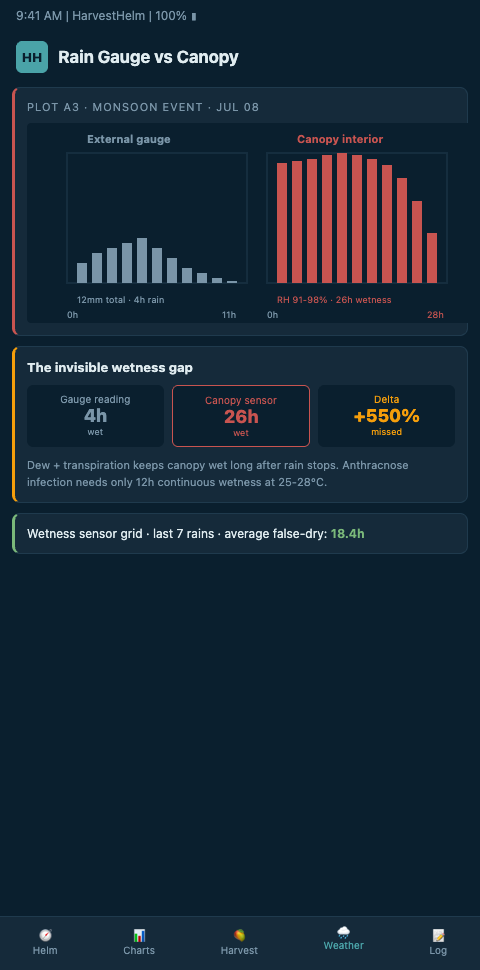
The output on the helm dashboard is a per-block moisture gauge alongside anthracnose pressure, powdery mildew risk, and phenological stage. Managers see at a glance which blocks are moisture-critical, which are moisture-safe, and where spray rig deployments earn the highest ROI. The captain and the spray crew share one chart, and the chart is measuring what the canopy actually feels, not what the rain gauge on the edge of the field guessed at.
The kilo-cut pricing remains the HarvestHelm trademark: zero upfront cost for sensors, installation, and dashboard, with a small share of export-grade tonnage earned only if the system helps the plantation ship more fruit. For plantations that have struggled with anthracnose or powdery mildew outbreaks despite appearing "within forecast" on rain-gauge data, the switch to canopy-truth sensors typically pays off in the first season. The captain finally has the right instrumentation to steer.
Advanced Tactics: Building a Multi-Layer Moisture View
Three advanced practices extract maximum value from canopy-internal moisture sensing.
First, layer rainfall splash dynamics on top of canopy moisture. Rainfall does not just wet leaves; it splashes fungal spores (conidia) from infected tissue to healthy panicles and fruit. The helm tracks rainfall intensity, canopy wetness, and conidia load together, so a 5-mm rain event onto a humid canopy triggers different alerts than the same rain onto a dry canopy. This splash-aware view is critical during heavy monsoon windows.
Second, contrast canopy-internal moisture data against whatever the regional forecast says. When canopy-internal moisture sensors show conditions crossing disease thresholds while regional forecasts remain "all clear," you have an early-warning window. Some of the highest-ROI spray decisions are made when the gap is largest, because competitors relying on regional data are not responding. Your helm-driven plantation gets the cleanest bloom, the highest export-grade proportion, and the best prices.
Third, integrate moisture data with multi-variety canopy map workflows to understand how different cultivars' canopies behave under the same rainfall. Alphonso's denser canopy holds moisture longer than Kesar's. Tommy Atkins sheds moisture faster than both. The helm accounts for these canopy-structure differences when converting external rain events into internal moisture projections.
Cross-crop parallel: apple orchards have long suffered analogous pickup-truck survey gaps where manager pickup-truck inspections miss microclimate risks that IoT probes catch. The mango plantation equivalent is relying on rain-gauge data when the canopy is the actual risk surface. Both cases share a pattern: the cheap, familiar instrument looks useful but misses the real signal.
Fourth, maintain a rainfall-to-canopy-moisture translation table per block. Over two or three seasons, the helm builds per-block curves that translate ambient rainfall events into probable canopy moisture trajectories. This means you can run "what-if" scenarios on incoming weather: "If we get 10 mm tomorrow, Block 4 Alphonso will sustain 94% RH for seven hours; intervene now." This predictive capacity is what elevates the helm from a passive sensor dashboard to an active forecast instrument.
Fifth, share moisture-and-spray decisions with neighboring plantations through an opt-in regional view. Canopy moisture signals correlate across adjacent blocks and plantations. When ten mango operators in a 20-kilometer radius share anonymized canopy moisture readings, the regional picture sharpens for everyone. HarvestHelm supports this cooperative layer, so your helm view benefits from regional signal while your decisions remain your own.
CTA: Replace Rain-Gauge-Driven Decisions With Canopy-Truth Moisture Sensing
If your mango plantation has made repeated spray or irrigation decisions off rain-gauge data and ended seasons wondering why fungal outbreaks landed despite "dry weather" readings, HarvestHelm can deploy in-canopy moisture sensors across your Alphonso, Kesar, or Tommy Atkins blocks before the next pre-monsoon window. We install at zero upfront cost, integrate the data into a helm dashboard that surfaces canopy-truth moisture alongside disease pressure and phenology, and earn only when export-grade tonnage actually ships. Plantations running 60-plus acres of mixed cultivars have the most to gain from replacing a single rain gauge with a canopy-level moisture lattice.
Reach out to size your in-canopy sensor placement before the next flush cycle. Day one of the dashboard shows the live canopy-to-external humidity delta per block, a post-rain drying curve that predicts spray-rig priority for the next morning, and an inoculum splash overlay for rainfall events above 5 mm. Waitlist priority goes to plantations that have lost anthracnose calls under rainfall events below the 3 mm rain-gauge sensitivity floor, where canopy-truth sensing catches hours the gauge cannot see.