Why Regional Weather Models Miss Canopy-Level Fungal Bloom Windows
The 50-Kilometer Grid That Hides 100% Crop Loss
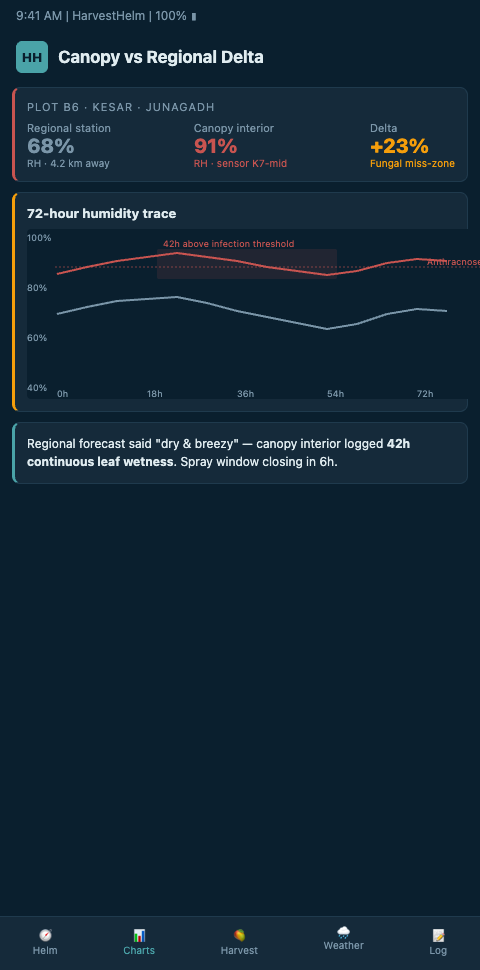
A regional weather model reporting "74% RH and scattered showers" across your district is telling the truth and lying to your mango canopy at the same time. Inside a well-leafed Alphonso block during late pre-monsoon flush, the canopy can hold 95% to 100% RH for hours while the district readout averages down to 74%. Frontiers research on microclimatic variables within tree canopies quantified this gap: canopy temperature can run 2 to 5 degrees cooler, with RH up to 25 percentage points higher than ambient. Your spray window opens and closes inside that gap.
Frontiers Microbiology documented that anthracnose causes 30 to 60% economic damage in standard years and reaches 100% loss during humid seasons. These outbreaks track canopy humidity, not district humidity. A ScienceDirect study on pruning intensity and canopy microclimate in mango found un-pruned mango canopies ran at 64.1% RH against 49.7% in severely pruned blocks, under identical district weather. Your canopy structure, not your county, determines your fungal risk.
The consequence: plantation managers who schedule sprays off Doppler or the nearest IMD station end up either spraying blindly when the canopy is dry, or waiting for an alert that never triggers while the canopy has already crossed infection threshold. Both failure modes waste money and cost tonnage.
Consider a three-day humid pressure front that appears in regional bulletins as "intermittent cloud, scattered showers, 70% RH likely." Inside half of the canopies in that district, actual leaf wetness integrals run above 10 hours on day two, and panicle emergence is advancing into the anthracnose canopy pressure zone where conidia germination becomes imminent. Plantations running on district forecasts defer sprays until the bulletin updates. Plantations running canopy sensors dispatch rig teams by day two, protecting the flush. The post-season export grading gap between those two groups is not small.
The Helm-Charted Yield Forecast: Closing the Grid-to-Canopy Gap
HarvestHelm replaces the district readout with a per-canopy instrument panel, the nautical yacht-style dashboard at the center of every block-level decision. Think of a ship's helm: rudder position, heading, wind direction, and depth are all read off dedicated gauges, not inferred from a regional chart. The helm-charted yield forecast gives your plantation the same treatment for canopy temperature, leaf wetness duration, dew point convergence, and fungal pressure indices.
The sensing layer uses in-canopy weather stations spaced at 200-meter intervals. Semios in-canopy weather stations illustrate the commercial category: per-acre temperature and humidity updates every 10 minutes, built to sit inside the foliage rather than above it. HarvestHelm integrates this class of hardware with plantation-specific cultivar logic for Alphonso, Kesar, Tommy Atkins, and Haden blocks. Each sensor reports the microclimate the trees are actually experiencing, not the microclimate the grid assumes.
The modeling layer applies canopy-calibrated fungal bloom windows. An AMS paper on the ongoing need for high-resolution regional climate models argued that even 1-to-10-kilometer resolution remains insufficient for precise orchard decisions that require meter-scale data. HarvestHelm fuses regional forecasts with your canopy telemetry using a Bayesian update so your bloom window confidence tightens every hour as the canopy trajectory comes in. You stop betting on a district average and start navigating your own canopy.
The output layer is the helm view. A glance tells you which blocks are approaching anthracnose conidia germination thresholds (95% RH with leaf wetness above 8 hours), which are in the safe zone, and which are trending into a 24-hour infection window. Every alert maps to a labor action: "Block 4 Alphonso enters anthracnose conducive range 14:00 today. Spray window: 05:30 to 08:30 tomorrow. Reroute crew Delta." The captain reads the chart and gives one order.
Crucially, the helm distinguishes three decision classes. Prevention sprays go out when the canopy is trending toward infection but has not crossed. Curative sprays deploy within the infection window, targeted only to blocks where sensors confirm exposure. Stand-down calls cancel sprays the calendar would have triggered but canopy data rules out. A Nature Scientific Reports study on deep learning for local microclimate forecasting confirmed that meteorological stations cannot capture spatial heterogeneity over large areas for hyperlocal decisions. The helm's value is replacing "spray everything" with "spray what the canopy requires."
The kilo-cut economics are what make this adoptable. HarvestHelm charges nothing to deploy sensors or run the dashboard. When export-grade tonnage lands because your anthracnose pressure calls were canopy-accurate, we take a small cut of that tonnage. If your season underperforms, you pay nothing. Plantation managers who have been burned by upfront-fee SaaS tools finally have an alignment they can trust: we only win when the export containers ship.
Advanced Tactics: Resolving the Canopy Variability Beneath One Grid Cell
Within a single 50-kilometer grid cell, a plantation can contain five or more distinct microclimates. The Springer study on spatial variability of leaf wetness duration found LWD varies significantly by canopy position, with external sensors making poor proxies for inside-canopy conditions. Three tactics resolve this variability without drowning in sensor cost.
First, deploy paired sensors: one external canopy-top reference, one internal mid-canopy, ideally both at 200-meter intervals. The delta between external and internal humidity tells you how "sealed" the canopy is. Sealed canopies (delta above 15 percentage points) hold fungal pressure longer after rain events. Ventilated canopies shed humidity within three hours. Your spray schedule should differentiate.
Second, run a pre-season canopy density baseline. Dense canopies with heavy un-pruned flush need more frequent anthracnose monitoring than openly pruned Kesar blocks. AEM Agricultural Weather Stations documented how hyperlocal data captures soil, microclimate, and pest prevalence invisible to regional models. HarvestHelm records this density delta as a per-block multiplier on the infection model. A single district alert becomes five different block-level actions: stand down for Block 2, prevention for Block 5, curative for Block 7, stand down for Block 9, urgent for Block 11.
Third, chain the canopy humidity data into a running 14-day pressure score per block, not just point-in-time alerts. This smooths sensor noise and surfaces the slow-motion outbreaks that catch plantations off guard when two weeks of 85% canopy RH quietly tees up a flush-cycle disaster.
Cross-crop validation strengthens the model. Date palm operators in the desert face an analogous problem with diurnal yield models where district forecasts smooth over the day-night temperature swings that drive fruit set. The pattern generalizes: physiology responds to the microclimate, not the average. And when rain-gauge canopy failures compound with grid-resolution limits, you get compounding blindness.
A fourth tactic is to time anti-fungal decisions against forecast uncertainty bands. Regional bulletins come with implicit error bars that the helm can surface. When the 24-hour forecast confidence is low (a front is stalled, a cyclone is tracking unpredictably), the helm tightens spray windows and relies more on canopy signal. When confidence is high, it widens the window and weights the forecast more. This dynamic weighting is how a plantation maintains calm under monsoon variability: you are always consuming the most reliable blend of canopy truth and regional prediction.
Finally, watch the spatial correlation between blocks. Plantations often assume adjacent blocks see similar humidity, but canopy-sealed blocks can hold 95% RH while open-canopy neighbors are at 72%. The helm maps the inter-block correlation matrix and flags when it breaks, which is almost always a leading sign of differential infection risk. If Block 3 and Block 5 typically move together on RH but today Block 3 is 18 points wetter, something structural has shifted: wind-shadow from a new fence line, a pruning gang that missed a row, an irrigation leak that pushed canopy humidity up. The helm surfaces the anomaly in minutes, not weeks.
A fifth practice worth adopting is a seasonal post-mortem built from the helm's event logs. At season end, you can replay every spray decision, every canopy threshold crossing, every regional forecast, and every actual outcome. This lets you quantify the exact economic value of closing the grid-to-canopy gap for your plantation. Most managers find that the first season pays for the sensor lattice multiple times over in avoided reactive sprays alone. The second season usually lifts export-grade tonnage in measurable percentages.
CTA: Close Your Grid-to-Canopy Gap Before the Next Bloom
If anthracnose or powdery mildew costs you tonnage you could not reconcile against the district weather readout, HarvestHelm can audit your existing sensor coverage and design a canopy-level instrumentation plan tuned to your Alphonso, Kesar, or Tommy Atkins blocks. We install at zero upfront cost, run the helm-charted yield forecast through your next bloom window, and only earn when export-grade fruit ships. Plantation managers running multi-block operations across Konkan, Ratnagiri, or South Karnataka have the most to gain from closing the grid-to-canopy gap. Book a block walk-through to map sensor placement before the next pre-monsoon flush stage opens.
On day one of your deployment the helm surfaces an inter-block humidity delta heatmap, showing which sealed canopies hold 90-plus percent RH longest and which are shedding moisture within three hours of rainfall. Waitlist slots prioritize plantations that have already suffered a single-block 40-percent loss event to anthracnose within the last three bloom cycles, since those operations see the steepest export-grade recovery during the first pre-monsoon flush under the helm. Reserve coverage at least six weeks before your earliest cultivar begins panicle emergence so we can capture a canopy sealing baseline and calibrate the grid-to-canopy delta model against your packhouse grading outcomes.