Protecting Competitive Advantage With Local Browser Indexing
The Value of Sourcing Intelligence -- And Its Vulnerability
The U.S. Small Business Administration warns that small businesses must protect proprietary information as a core cybersecurity practice, noting that employees and their access to business data represent a leading vulnerability. For salvage dealers, the data most worth protecting is not financial records or customer lists. It is sourcing intelligence: the accumulated knowledge of where to find materials, which suppliers carry what inventory, which demolition schedules create opportunities, and which competitors are active in which markets.
This sourcing intelligence lives in browsing history. Every time a dealer checks a demolition schedule, browses an auction catalog, evaluates a supplier's inventory, or researches a building's history, that browsing session contains competitive advantage in raw form. A competitor with access to those sessions could reconstruct the dealer's entire sourcing strategy: which neighborhoods she watches, which suppliers she prefers, which material types she prioritizes.
Cloud-based bookmarking tools, browser sync services, and web-based research platforms all store this data on remote servers. The Federal Trade Commission has published guidance emphasizing that businesses should limit data collection, secure what they keep, and dispose of what they no longer need. Yet most dealers store their sourcing history on platforms that aggregate data from thousands of users, creating exactly the kind of centralized target that the FTC warns against.
The architectural salvage market is relationship-driven and geographically concentrated. A dealer who identifies a demolition contractor disposing of high-value materials before competitors learn about the project captures that inventory at favorable prices. If that dealer's browsing history, showing which contractor websites she monitors and which demolition schedules she tracks, becomes accessible to competitors, the information asymmetry that drives her margins evaporates.
The risk is not hypothetical. Cloud-based tools aggregate user data in ways that create unintended exposure. A browser sync service that stores bookmarks on a remote server makes those bookmarks accessible to anyone who compromises the account. A bookmarking tool that shares "popular" saves reveals which resources other users, including competitors, find valuable. Even analytics data shared between the tool provider and third parties can leak patterns of sourcing activity to entities the dealer never intended to inform.
The Architect Magazine investigation into the world of architectural salvage revealed the competitive intensity of the market, where dealers race each other to secure materials from demolition sites. In this environment, the browsing activity that precedes a bid is itself competitive intelligence. Which demolition permits a dealer monitors, which auction houses she watches, which geographic areas she researches most heavily -- each of these patterns, if visible to competitors, erodes the sourcing advantage that years of relationship-building created.
Local-First Indexing as a Privacy Architecture
TabVault's approach to protecting salvage market research starts with a fundamental architectural decision: the index lives on the dealer's local machine. No browsing data is uploaded to a remote server. No session history is aggregated with other users' data. The archive that turns chaotic browser sessions into a searchable private database keeps the "private" part literal.
This local browser indexing approach means that the dealer's sourcing intelligence never leaves her control. The indexed archive of demolition schedules, supplier inventories, auction records, and building history research exists on hardware she owns, protected by whatever physical and digital security measures she applies to her own equipment.
The competitive advantage in salvage data becomes durable when it stays local. A dealer who has indexed three years of sourcing sessions possesses a competitive advantage that compounds over time. Each new session adds to the archive. Each archived session makes future searches more productive. That compounding effect works only as long as the archive remains private.
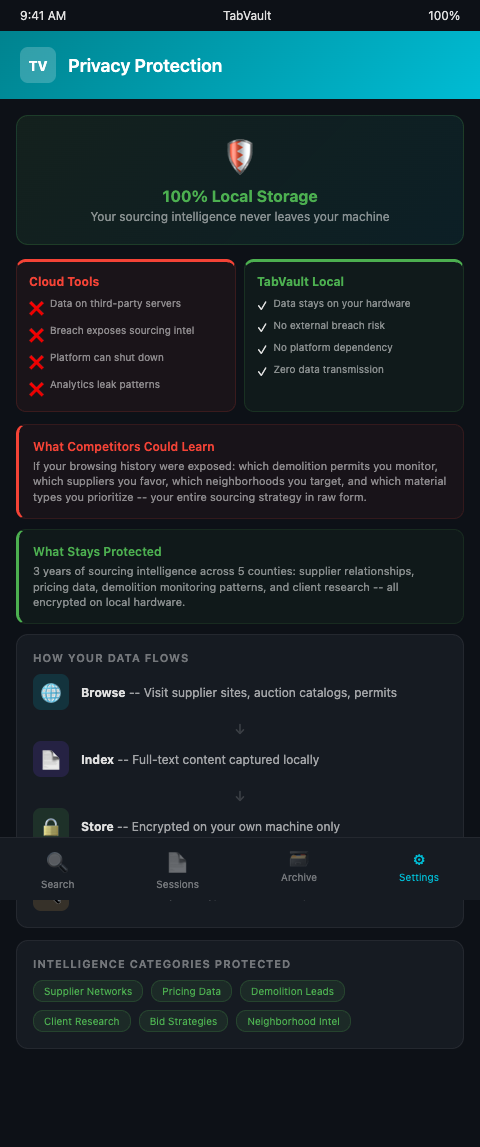
Private salvage sourcing intelligence also benefits from local indexing during the research phase itself. When a dealer researches a new demolition project, the browsing pattern itself reveals interest. A cloud-based tool that logs which pages the dealer visits creates a record on a third-party server showing that the dealer is actively investigating a specific property. Local indexing captures the same information without generating any external signal of the dealer's research activity.
The documentation integrity that professional salvage operations require also benefits from local storage. Provenance documentation, material testing records, and building history research stored locally cannot be altered by a third-party service provider's database changes. The dealer controls the archive, and the archive reflects exactly what was researched, when, and in what context.
Local indexing provides continuity that cloud-dependent tools cannot. The archive remains fully searchable whether the dealer has internet access or not. A buyer calls with an urgent question about a piece's provenance while the dealer is at a rural salvage yard with no cell service. If the archive is local, the answer is still accessible.
Local indexing also eliminates dependency on a third-party service's business continuity. Cloud-based tools shut down, pivot to different business models, or change their terms of service. When a bookmarking service the dealer relied on discontinues its product, years of organized sourcing research disappear with it. Local-only architectural salvage data stored on the dealer's own hardware persists regardless of what happens to any external service provider. The dealer's archive survives platform changes because it was never on the platform.
The privacy advantage extends to client relationships. A dealer sourcing materials for a high-profile restoration client may browse sensitive project details, budget information, and proprietary architectural plans shared through web portals. Storing those browsing sessions on a third-party server introduces a data custody risk that the client may not have consented to. Local indexing keeps client-related research within the same security perimeter as other confidential business information.
Advanced Privacy Practices for Salvage Dealers
Separate sourcing research from general business browsing. Use a dedicated browser profile for sourcing activity, with TabVault indexing only that profile. This ensures that the archive contains concentrated sourcing intelligence without the noise of email, social media, and other general browsing.
Implement local backup protocols for the indexed archive. The archive represents years of accumulated sourcing intelligence, and losing it to hardware failure would erase a competitive asset that cannot be reconstructed from memory. Regular backups to an encrypted external drive provide durability without sacrificing privacy by uploading to a cloud backup service.
When sharing sourcing intelligence with team members, share specific search results rather than granting access to the full archive. A buyer who needs information about a specific supplier can receive the relevant session data without gaining visibility into the dealer's complete sourcing history. This compartmentalization protects the business even in employee turnover situations.
For dealers whose sourcing involves offline audit-ready veterinary case research architecture repurposed for rural demolition sites or estate sales without reliable connectivity, the local archive remains fully searchable regardless of internet access.
Consider the privacy implications of browser extensions and plugins that may transmit browsing data to remote servers. Local-only architectural salvage data remains local only if the browsing environment itself does not leak data to third parties. Audit installed extensions periodically and remove any that transmit browsing history, page content, or usage patterns to external services.
For dealers operating in competitive markets where sourcing intelligence directly determines profitability, the privacy architecture of their research tools is not a technical detail. It is a business decision with direct revenue implications. The dealer who protects her sourcing data retains her edge. The dealer who stores it on shared infrastructure donates that edge to the platform operator and anyone who accesses the platform's data.
Establish a data retention policy for the local archive. The Institute for Local Self-Reliance's deconstruction update shows that more than two dozen municipalities are debating material reuse mandates, meaning archived sourcing data will become even more strategically valuable as regulations expand. Determine how long sourcing sessions should be retained based on their business value. Active sourcing intelligence from the past twelve months may warrant permanent retention. Older sessions may be archived to secondary storage or pruned. A retention policy ensures that the local archive remains performant as it grows while preserving the most valuable intelligence indefinitely.
Review your team's browsing tools annually for privacy compliance. Browser updates, extension changes, and platform policy modifications can introduce new data transmission pathways that were not present when the tools were first installed. An annual review ensures that the local-only architecture remains intact as the broader software ecosystem evolves. The privacy protection that the dealer relies on today is only as strong as the weakest data pathway in tomorrow's configuration.
Protect Your Sourcing Edge
Your browsing history is your sourcing strategy in raw form. TabVault keeps that strategy on your machine, under your control, with no data leaving your local environment. Join the waitlist to protect the competitive advantage you have spent years building.
Your competitor pricing research, demolition monitoring patterns, and supplier network data never leave your machine. No cloud service processes it. No breach can expose it. No platform shutdown can erase it. After three years of private, local indexing, your archive represents the most detailed map of your regional salvage market that exists anywhere -- visible only to you, searchable only by you, and growing more valuable with every session. Protecting that intelligence is not a technical preference. It is a business imperative.