From 200 Open Tabs to Defensible Research: A Genealogist's Playbook
The 200-Tab Problem
The Carnegie Mellon University study on browser tab behavior surveyed and interviewed 103 participants, finding that more than half felt they could not close their open tabs and that 25 percent had experienced browser or computer crashes from tab overload. The researchers identified fear of information loss as the primary driver: people kept tabs open because they believed that closing a tab meant losing access to whatever they had found there.
Genetic genealogists take this pattern to an extreme. A researcher working an unknown parentage case might have tabs open across AncestryDNA match profiles, FamilyTreeDNA chromosome browser results, GEDmatch one-to-many comparisons, Newspapers.com search results, FamilySearch record pages, FindAGrave memorials, and state vital records portals. Each tab represents a piece of evidence or a lead she has not yet fully processed. Closing any one of them means trusting that she can find it again, and browser history's bare URL listings do not inspire that trust.
The result is a research environment that actively works against the researcher. Browser performance degrades. Tabs become too small to read. The researcher spends more time scanning tab titles looking for the right one than she spends actually analyzing what is on the page. The National Genealogical Society teaches researchers to organize DNA matches into clusters for clarity, but the browser itself offers no organizational structure for the tabs where that clustering work happens.
The deeper problem is that tab hoarding and defensible genealogy research methodology are fundamentally incompatible. The Genealogical Proof Standard requires documented, exhaustive research with complete source citations. Two hundred open tabs are not documentation. They are a pile of unsorted evidence that becomes less useful with every additional tab added to the heap.
The irony is that the tabs represent real research effort. Each one was opened for a reason. Each one contains information the researcher considered potentially relevant. The problem is not the research itself but the container. Browser tabs were designed for short-term, lightweight page viewing. They were never meant to function as a research archive, a citation manager, or a project organization system. Asking them to serve all those purposes simultaneously is why they fail at all of them.
The Playbook: From Chaos to Searchable Archive
The genealogist tab overload solution is not better tab management. It is a different relationship with tabs entirely. Instead of using tabs as long-term storage for research leads, the researcher uses TabVault to turn every browser session into a permanent, searchable archive, then closes the tabs knowing that everything they contained is indexed, retrievable, and searchable by full text.
The playbook has four phases.
Phase 1: Capture. During any research session, TabVault indexes every page visited with full-text content, URL, timestamp, and session context. The researcher does not need to do anything different. She researches as she normally would, visiting match profiles, searching databases, and reading records. The indexing happens in the background, turning chaotic browser sessions into a searchable private database without interrupting the workflow.
Phase 2: Close. At the end of the session, the researcher closes her tabs. All of them. This is the behavioral shift that tab management genetic genealogy playbook advice usually cannot achieve through willpower alone. The researcher can close tabs because she knows that every page is now in an indexed archive. The fear of information loss, the primary driver of tab hoarding, is eliminated by the certainty that nothing is actually lost.
This phase is where most researchers experience the biggest psychological shift. The CMU study found that people felt invested in their open tabs, experiencing something akin to the sunk cost fallacy: "I spent time finding this page, so closing it feels like wasting that effort." The indexed archive reframes the equation. Closing a tab is not losing the work. It is filing the work in a searchable system that is more reliable than a browser window that could crash at any moment.
Phase 3: Search. When the researcher returns to the case, whether tomorrow or three months from now, she does not reopen old tabs or scroll through browser history. She searches. A surname, a location, a date range, or any phrase she remembers from the content. The search returns every session where that term appeared, with full context showing what else she examined during the same session.
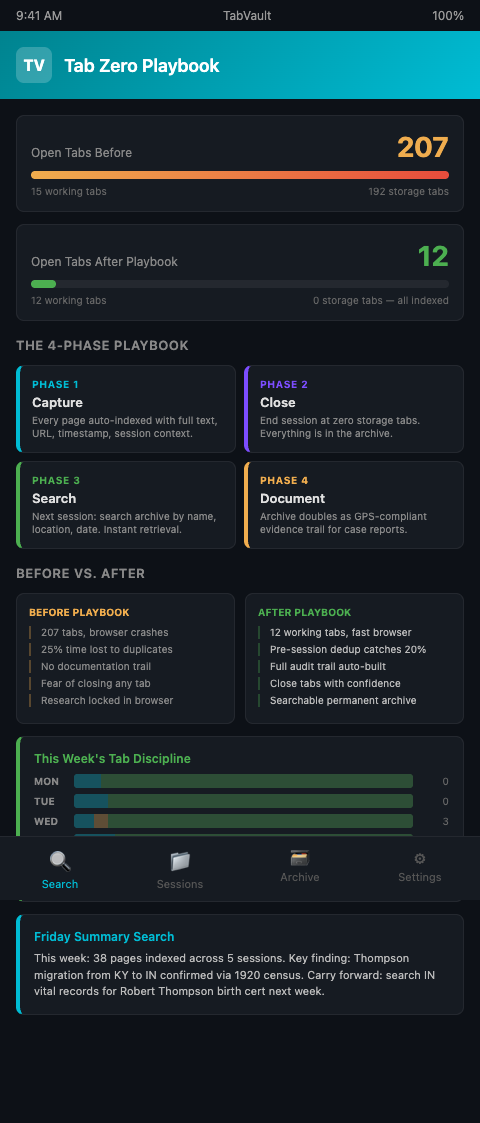
Phase 4: Document. The indexed archive serves double duty as research documentation. When the researcher needs to compile a case report, submit evidence for a forensic genealogy case, or demonstrate that her research meets the Genealogical Proof Standard, the session archive provides a chronological, searchable record of every page examined. Open tabs to organized research is not just a productivity improvement. It is the foundation for defensible methodology.
This four-phase approach mirrors the research-to-publication playbook used by investigative podcast producers, who face a similar challenge: enormous volumes of browser-based research that must eventually be distilled into a structured, defensible output. The underlying principle is the same across fields: capture everything, organize through search, and let the archive serve as documentation.
Advanced Playbook Tactics
The first advanced tactic is session tagging. Researchers who adopt a consistent naming convention for their research sessions, tagging by case, branch, and research objective, gain an additional layer of organization on top of full-text search. A search for "Henderson County" returns every session where that location appeared, but filtering by a case tag narrows the results to sessions from a specific investigation.
The second tactic is weekly archive review. Once a week, the researcher spends fifteen minutes searching her recent sessions for connections she may have missed in real time. This review catches patterns that are invisible during individual sessions but become apparent when a week's worth of research is viewed together. The practice aligns with the future tools for investigative genealogy trajectory: as archives grow, the insights available from reviewing them grow proportionally.
The third tactic is tab-zero discipline. Researchers who commit to ending every session at zero open tabs build the muscle memory that makes the playbook sustainable. The first week feels uncomfortable. By the third week, the researcher discovers that she works faster with fewer tabs because she spends less time managing the browser and more time analyzing evidence. The Board for Certification of Genealogists standards do not mention tab counts, but the exhaustive, documented research those standards require is much easier to achieve when the researcher's workspace is clean and her past work is searchable.
The fourth tactic addresses the common objection that some tabs need to stay open as active workspace for in-progress analysis. The playbook accommodates this by distinguishing between working tabs (actively being used right now) and storage tabs (kept open to avoid losing them). Working tabs stay open during the current session. Storage tabs are the hoarding problem, and they are the tabs that TabVault's indexing makes closable. Most researchers find that their 200-tab problem consists of 15 working tabs and 185 storage tabs. Closing the 185 storage tabs does not lose any information. It frees the browser to function as a research tool again rather than a struggling filing cabinet.
The fifth tactic involves creating a weekly research summary from the archive. Every Friday, the researcher spends ten minutes searching the week's sessions for key findings, unresolved questions, and leads to pursue the following week. This summary replaces the mental load of remembering where the week's research left off. On Monday morning, the researcher reads her summary rather than scrolling through tabs or browser history, and she starts the new week with clear direction.
Finally, the genealogy browser session management playbook should be shared across teams. Professional firms that standardize on the four-phase approach, and build the shared knowledge bases that result from it, create a research infrastructure that benefits every researcher and every client. A firm where every researcher follows the same capture-close-search-document cycle produces consistently documented research, regardless of which individual conducted it.
Scaling the Playbook Across Teams
A sixth tactic is using the archive as a training tool. New researchers joining a team can review archived sessions from experienced colleagues to learn research patterns, discover productive databases, and understand how experienced genealogists approach different case types. The archive provides a window into the research process that no training manual can replicate, because it shows the actual sequence of decisions, searches, and evaluations that produced results. This apprenticeship-through-archives approach accelerates onboarding and ensures that institutional knowledge transfers even when the senior researcher is not available to mentor directly.
The path from 200 open tabs to defensible research is not a single decision. It is a practice, built through consistent application of the four-phase cycle across every research session. The genealogist who adopts this playbook does not just manage her tabs better. She builds a cumulative research infrastructure that grows more valuable with every session, supporting both daily productivity and the long-term documentation that professional standards demand.
Close Your Tabs, Keep Your Research
Defensible genealogy research methodology starts with a workspace that supports organized, documented, retrievable research. TabVault turns your 200-tab chaos into a searchable archive that serves as both productivity tool and evidence trail. Join the waitlist to start the playbook that transforms how you research.
Closing two hundred tabs feels impossible until you have a system that makes it safe. TabVault indexes every page before you close it, so the capture-close-search-document cycle works from your very first session. Researchers who commit to ending each session at zero storage tabs report that the behavioral shift takes about a week, and the productivity gain is immediate: less time scanning tiny tab titles, less browser memory consumption, and faster access to past findings through search than through scrolling. The four-phase playbook outlined above turns your browser from an overloaded filing cabinet into a clean research instrument backed by an archive that meets Genealogical Proof Standard documentation requirements automatically.