The Future of Browser-Based Tools in Investigative Genealogy
Where Genealogy Technology Stands Today
A researcher at San Jose State University published a comprehensive review of emerging technologies for genealogists, documenting how the field has evolved from paper-based record searches to digitized archives, online databases, and DNA testing platforms. Each wave of technology changed what genealogists could access. But none fundamentally changed how they manage the research process itself.
Consider the current state. A genetic genealogist working a cold case opens her browser and begins a session that might span AncestryDNA, FamilyTreeDNA, GEDmatch, Newspapers.com, FamilySearch, FindAGrave, and three separate state vital records portals. Each platform has its own interface, its own search syntax, and its own way of presenting results. The researcher synthesizes information across all of them, holding connections in her head or in a separate spreadsheet. The browser is the common thread running through every platform, yet it contributes nothing to the research process beyond displaying pages.
The browser handles perhaps 95 percent of a genetic genealogist's active research time. DNA match analysis happens in the browser. Vital records searches happen in the browser. Newspaper archive lookups, cemetery index searches, census record examinations, and court record queries all happen in the browser. The remaining 5 percent happens in offline tools like desktop genealogy software and GEDCOM editors. Yet the tool where nearly all the work happens is the one that provides the least research support. It displays pages and maintains a rudimentary history of URLs visited. It offers no search across page content, no session organization, no connection between related visits, and no persistent archive of research activity.
This is the gap that investigative genealogy browser tools are beginning to fill. The browser is not just a viewport. It is the environment where research happens. Tools that operate within the browser, as extensions that capture, index, and organize research activity in real time, represent the next genealogy technology trend that matters. Unlike standalone software that requires manual data entry, browser-based tools observe the research as it unfolds and build a structured archive from the raw activity.
The Evidentia Software blog identifies AI-powered analysis and seamless integration across platforms as two of the defining trends in next-generation genealogy research software. Both of these trends depend on having structured, searchable research data to work with. You cannot run intelligent analysis on bookmarks and browser history. You need indexed, full-text content captured in context.
The technology stack that most genealogists rely on today consists of standalone tools connected by manual effort. The researcher copies information from a browser tab into a spreadsheet, transfers conclusions from the spreadsheet into genealogy software, exports a GEDCOM file for sharing, and maintains a separate research log documenting the process. Each transfer point loses context and introduces the possibility of transcription errors. A browser extension genealogy innovation that captures and indexes research activity at the source eliminates the first and most costly transfer point: from browser to documentation.
The Browser as Research Infrastructure
TabVault sits at the intersection of these trends by turning the browser from a passive display tool into active research infrastructure. Every page visited during a genealogy session is indexed with full-text content, timestamp, and session context, creating a searchable private database that grows with each research session. This is the foundation that next-generation features will build on.
The immediate benefit is retrieval. Researchers who have been integrating tab search into their genetic genealogy workflow already experience the productivity gain of being able to search across months of past sessions. But retrieval is just the starting point. The indexed archive creates a structured dataset that supports progressively more sophisticated analysis.
Pattern detection is the next layer. When a researcher's archive contains thousands of indexed pages from hundreds of sessions, patterns become computationally discoverable. Surname frequencies, geographic clusters, and temporal patterns in research activity all emerge from the data. The same principle that drives browser-based clinical decision support in veterinary toxicology applies to genealogy: when the browser captures structured research data, it can also surface insights from that data.
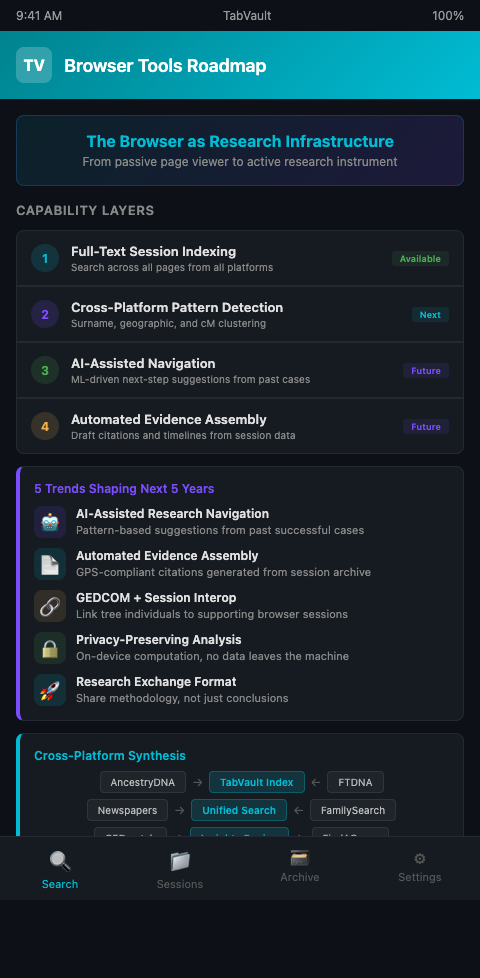
Cross-platform synthesis is another frontier. Genealogists currently move between platforms manually, holding connections in their heads. A browser extension genealogy innovation that indexes content from every platform visited can surface connections that span platforms: a surname from an AncestryDNA match profile that also appeared in a Newspapers.com obituary three sessions ago, or a geographic location from FamilySearch records that matches a FindAGrave entry investigated the previous month. These cross-platform connections are invisible in platform-native tools because each platform only sees its own data.
Collaboration features represent a third direction. Professional genealogy firms need to share research context across team members without sharing raw browser data. An indexed archive that supports selective export, where specific sessions or search results can be shared while the rest of the archive remains private, enables collaboration without compromising the privacy protections that local-first storage provides.
Research documentation automation represents a fourth important direction. The Genealogical Proof Standard requires documented research trails, and currently that documentation is assembled manually after the research is complete. A browser-based tool that automatically generates research timelines, session summaries, and source citation lists from the indexed archive would reduce the administrative overhead that discourages thorough documentation. The research itself becomes the documentation, rather than requiring a separate documentation step.
What the Next Five Years Will Bring
The first trend to watch is AI-assisted research navigation. As browser-based archives grow, machine learning models trained on the researcher's own data could suggest next steps based on patterns in past successful cases. If three previous parentage cases that involved matches in the 70-100 centimorgan range were solved by investigating shared matches in specific geographic regions, the system could flag similar patterns in a new case. This is speculative today but becomes feasible once the underlying data is structured and searchable.
The second trend is automated evidence assembly. The Genealogical Proof Standard requires complete source citations and written analysis. Future browser-based tools could generate draft citation lists and research timelines directly from the indexed archive, reducing the administrative burden of compliance with professional standards. The researcher would still perform the analysis and write the conclusions, but the documentation scaffolding would be built automatically from the session data.
The third trend is interoperability between browser-based research tools and traditional genealogy software. GEDCOM files, the standard for exchanging family tree data, currently carry no information about the research process that built the tree. Future integrations could link GEDCOM individuals to the specific browser sessions where the evidence supporting each relationship was found. The genealogist's research playbook of the future will treat the browser archive as a first-class component of the research output, not an afterthought.
The fourth trend is privacy-preserving analysis. As genetic genealogy tools become more powerful, the privacy stakes increase proportionally. Future browser-based tools will need to perform sophisticated analysis on sensitive genetic data without that data ever leaving the researcher's device. Local-first architectures that support on-device computation will become the expected standard rather than an unusual feature, particularly as regulatory frameworks around genetic data tighten globally.
The digital genealogy research evolution will not come from a single breakthrough platform. It will come from tools that work with the browser the researcher already uses, layering intelligence onto the research process without requiring the researcher to change where or how she works. That evolution has already started, and the researchers who adopt browser-based research infrastructure now will be best positioned to benefit as new capabilities expand over time.
Building on the Foundation Today
The fifth trend is standardized research exchange formats. Currently, genealogists share conclusions via GEDCOM files and research summaries via written reports. Neither format captures the actual research process. Future tools may develop a standardized format for exchanging indexed session data, allowing researchers to share not just their conclusions but their methodology in a structured, searchable form. This would transform peer review in genealogy from reading a narrative about what was done to independently verifying what was done by searching the underlying session data.
Each of these trends depends on a single foundational capability: structured, indexed, searchable research data captured from the browser where the work actually happens. Tools that build that foundation today are positioning their users for every advancement that comes next. The researchers and firms that invest in browser-based research infrastructure now will not need to retrofit their workflows when these capabilities arrive. Their archived sessions will already be ready for it.
The genealogy technology trends shaping the next five years favor practitioners who treat their browser activity as a data asset rather than a disposable byproduct. The browser session is the primary artifact of genetic genealogy research. Treating it with the same care applied to DNA results and documentary evidence is the defining shift of the current generation of investigative genealogy tools.
Be Part of the Next Generation
Investigative genealogy browser tools are moving from passive display to active research partnership. TabVault is building the indexed, searchable foundation that next-generation features depend on. Join the waitlist to get early access as these capabilities come online.
The browser handles ninety-five percent of your active research time, yet until now it has contributed nothing to organizing or preserving that research. TabVault changes that equation by layering a full-text search index directly onto your existing workflow, no platform switching required. Researchers who start building their indexed archive today are positioning themselves for every advancement in browser-based genealogy tools that arrives over the next five years, because the foundation those tools will depend on, structured and searchable session data, is exactly what TabVault captures from day one. The earlier you begin indexing, the richer the archive that future capabilities will have to work with.