Merging Research Archives Across Multiple Podcast Shows
The Silo Problem in Podcast Networks
Podcast networks typically operate each show as an independent production unit. A network with three investigative shows — one covering corporate fraud, one covering environmental violations, one covering political corruption — may have nine producers collectively generating thousands of research pages per month across county records, court filings, corporate registrations, and regulatory databases. Each show's research stays within its production team. The only cross-pollination happens when producers happen to talk.
The Structured Podcast Research Corpus project at Cornell documented the scale of the podcast ecosystem's fragmentation: despite millions of episodes containing investigative and documentary content, there has been "surprisingly little large-scale research into podcasts, in part due to a lack of data" (Cornell / arXiv). The data problem inside a podcast network mirrors this pattern. Each show generates rich research data — indexed public records, source documents, news archives — but that data is trapped in individual production workflows with no shared search layer.
The Global Investigative Journalism Network describes the investigative coordinator role as requiring "a thorough understanding of the investigation's material" combined with the ability to "communicate well across cultures" and organizational contexts (GIJN). In a podcast network, no single person holds that understanding across multiple shows. The network's collective research knowledge exceeds any individual's awareness of it.
The practical cost is missed connections. When Show B's environmental reporter pulls property records for a chemical plant's ownership chain and finds an LLC whose registered agent also appears in corporate filings that Show A's fraud team indexed three months earlier, that connection only becomes visible if someone on both teams happens to recognize the name. In a network producing dozens of episodes across multiple shows, the probability of that chance recognition decreases with every additional show and every additional month of research.
Lower Street's analysis of podcast network structures notes that each show in a network "lives in its own feed but benefits from shared production resources, cross-promotion, and a unified visual identity" (Lower Street). What most networks do not share is research infrastructure. The production resources are shared; the investigative knowledge is siloed. This is the structural gap that a cross-show search layer fills — applying the network model to research, not only production and distribution.
Building a Cross-Show Search Layer
Merging research archives across multiple podcast shows does not mean merging production workflows. Each show maintains its own editorial independence, its own sources, and its own publication schedule. The merger happens at the search layer — creating a unified index that lets any authorized producer query the combined research corpus.
TabVault's local indexing architecture makes this feasible without a centralized server, turning chaotic browser sessions into a searchable private database. Each show's production team runs TabVault on their own machines, building show-specific research archives. The cross-show research database is assembled by merging exported index files from each show into a shared query layer. A producer on Show C can search the merged index for a company name and see results from all three shows — complete with timestamps, source URLs, and indexed text — without accessing another show's raw research files.
The architecture preserves editorial boundaries. Show A's team controls what gets included in the merged index. They can exclude sensitive source-related research while sharing public-records research. The merged index contains only what each show chooses to contribute — a selective sharing model rather than a full-disclosure model. This granularity is critical for podcast networks where different shows may have different source protection requirements, different legal exposure profiles, and different editorial standards.
The multiple podcast research consolidation approach through TabVault also avoids the common failure mode of centralized research databases: adoption resistance. Producers are protective of their research workflows and resistant to tools that require them to change how they work. TabVault's model asks producers to change nothing about their browsing behavior — the indexing happens automatically. The only new behavior is the periodic export and merge, which is a network-level administrative task rather than a producer-level workflow change.
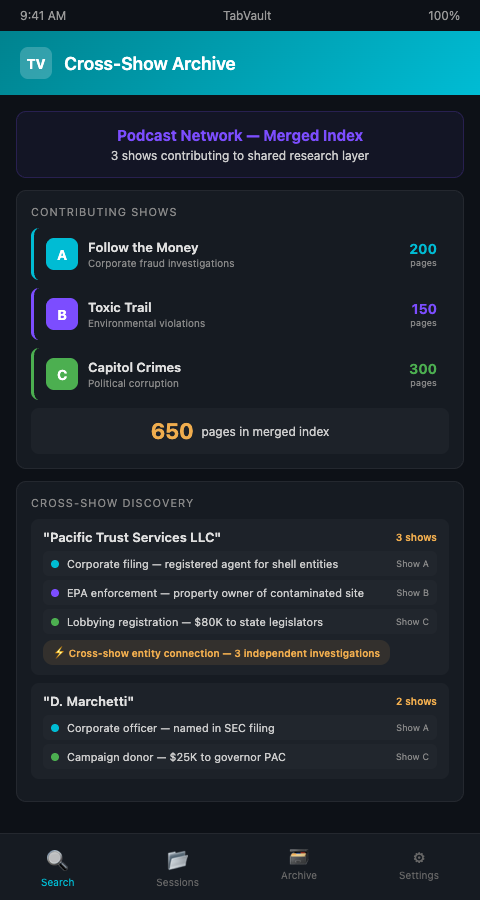
Consider the practical workflow. Show A's fraud team indexes 200 pages of corporate filings over two months. Show B's environmental team indexes 150 pages of EPA enforcement actions and property records over the same period. Show C's political corruption team indexes 300 pages of campaign finance disclosures and lobbying registrations. The merged archive contains 650 pages searchable as a single corpus. A search for a company name returns results from corporate filings, environmental enforcement, and campaign finance — three perspectives that no single show's archive would contain.
Cross-Show Connections and Network Efficiency
The cross-show value also runs in reverse. When Show A publishes an episode about a corporate fraud case, producers on Shows B and C can search the merged archive for every entity mentioned in Show A's episode. If any of those entities appear in their own indexed research, the connection might warrant a cross-show collaboration or a follow-up episode. The merged archive turns publication into a search prompt — every new episode generates new queries against the collective research corpus.
The merging investigation databases approach also addresses a common network inefficiency: duplicated database subscriptions. If Show A and Show C both pay for access to a corporate records database and both pull records for entities in the same geographic region, the merged archive reveals the overlap. The network can then coordinate database access — one show pulls records from one jurisdiction while another covers a different one — reducing subscription costs while increasing total coverage.
This cross-show research database model extends the team coordination approach from within a single show to across a network. The principles are the same — shared search, preserved autonomy, connection discovery through queries — but the scale and the potential for cross-domain insights increase substantially.
TabVault's merged index also supports the producer handoff scenario that occurs when a producer moves between shows within a network. Instead of losing months of institutional research knowledge, the departing producer's indexed sessions remain in the show's archive, searchable by their successor.
The same principle applies in other research-intensive team environments. Professional genealogy firms have built team knowledge bases using shared indexed archives, and the structural approach — local indexing, selective sharing, merged search — transfers directly to podcast network research sharing.
The podcast network research sharing model also creates institutional memory that survives individual show cancellations. If Show B is discontinued after two seasons, its indexed research archive remains available through the merged index. When Show A picks up a story thread that overlaps with Show B's prior research, the archived material is searchable and usable — preventing the loss of months or years of investigative groundwork.
Operational Considerations for Multi-Show Archives
Define sharing boundaries before merging. Each show's team should explicitly decide which research categories are shareable and which are restricted. Public records research is typically safe to share; source-related research and pre-publication findings may not be. Establish these boundaries in writing before the first index merge.
Assign a network research coordinator. Someone needs to manage the merged index — running periodic merges, resolving indexing conflicts, and communicating cross-show connections to the relevant teams. This role is the podcast network equivalent of the GIJN's investigative coordinator, operating at the network level rather than within a single investigation.
Run cross-show searches at investigation kickoff. Before a show starts a new investigation, search the merged archive for every key entity — company names, individual names, addresses, regulatory case numbers. This pre-research step surfaces any existing indexed material from other shows, preventing the new investigation from duplicating work already done. A thorough kickoff search against the cross-show research database can save weeks of redundant record-pulling and immediately contextualize the new investigation within the network's existing knowledge base.
Maintain show-level archive integrity. The merged index is a read-only query layer, not a replacement for show-specific archives. Each show should maintain its own complete TabVault archive independently. If the merged index becomes corrupted or outdated, each show's archive remains intact as the source of truth.
Schedule quarterly cross-show reviews. Professional genealogy firms have built team knowledge bases using the same shared indexed archive principle. Bring producers from all shows together quarterly to review cross-show search results and discuss potential connections. The merged archive surfaces the data; human editorial judgment decides what to do with it. These reviews produce the cross-domain story leads that justify the effort of merging archives in the first place. The Pew Research Center found that 56 percent of U.S. adults have at least some trust in information from national news organizations, and cross-show collaboration that produces more thorough, multi-angle investigations strengthens that trust.
Track cross-show contribution metrics. Monitor which shows contribute the most indexed pages and which shows generate the most cross-show search hits. This data informs network resource allocation decisions — shows that frequently surface in other shows' searches are producing high-value research that benefits the entire network, even if their own episode output is modest.
Your Network Already Has the Data
The research your podcast network needs for its next breakthrough story may already exist — indexed in another show's archive, waiting for a search query that nobody has run because the archives are not connected. TabVault gives podcast networks a private, searchable cross-show research database built from each show's browsing sessions. If your network is producing investigative content across multiple shows, join the waitlist and start connecting the research you have already done.
Three investigative shows in one network collectively index 650 pages per month across corporate filings, EPA enforcement actions, and campaign finance disclosures. When Show B's environmental reporter discovers an LLC whose registered agent also appears in corporate filings that Show A indexed three months earlier, the merged TabVault archive surfaces that cross-show connection in a single search. Without a merged index, that connection depends on a hallway conversation that may never happen. One podcast network identified four cross-show story leads in their first quarterly review after implementing a shared search layer. Join the waitlist and start connecting the research your network has already done.