Tab Indexing for Multi-Season Investigation Continuity
The Compounding Cost of Lost Research
Edison Research's Infinite Dial 2025 reports that 55 percent of Americans now listen to podcasts monthly, with long-form investigative series driving some of the strongest audience loyalty. Multi-season investigative podcasts like Serial, In the Dark, and Murdaugh Murders have demonstrated that audiences will follow a story across years of episodes. But the production challenge behind that listener experience is rarely discussed: maintaining investigation continuity across seasons when the underlying research sessions disappear with each browser restart.
A producer on a multi-season financial crime podcast described the problem in stark terms. Season one generated roughly 400 hours of browser research across eight months -- court records, corporate filings, news archives, FOIA documents, property records. Season two began fourteen months later with a new co-producer. The new producer spent the first three weeks re-researching leads that season one had already covered because there was no searchable record of what had been investigated. The original producer's bookmarks had been cleared. The browser history was gone. The notes were incomplete.
The GIJN recommends maintaining detailed research records throughout an investigation, but manual documentation invariably has gaps. A producer documents the sources they found significant but rarely records the searches that returned nothing. Those negative results -- the databases checked, the names searched, the jurisdictions cleared -- are exactly what a new season's production team needs to avoid duplicating prior work.
Building a Podcast Season Research Archive That Persists
The fundamental requirement for multi-season investigation continuity is that research from season one remains fully searchable during season three's production, without depending on any individual producer's memory, bookmarks, or personal note system.
TabVault addresses this by turning chaotic browser sessions into a searchable private database that persists across production gaps. Every browser page visited during season one's research -- every court docket, every news article, every FOIA document, every corporate filing -- remains indexed and searchable when season two begins. The fourteen-month gap between seasons does not erase the archive.
The long-running podcast research management workflow operates on a simple principle: research sessions accumulate rather than expire. Season one's indexed sessions form the foundation. Season two adds to that foundation. Season three builds further. By season four, the archive contains years of indexed research across hundreds of sessions, all queryable through the same search interface.
When a season three producer encounters a name in a FOIA document and needs to know whether that name appeared in prior research, they search the archive. Results from season one and season two appear alongside season three's own research. The multi-season case file research archive answers the question instantly, without requiring anyone from prior seasons to be consulted.
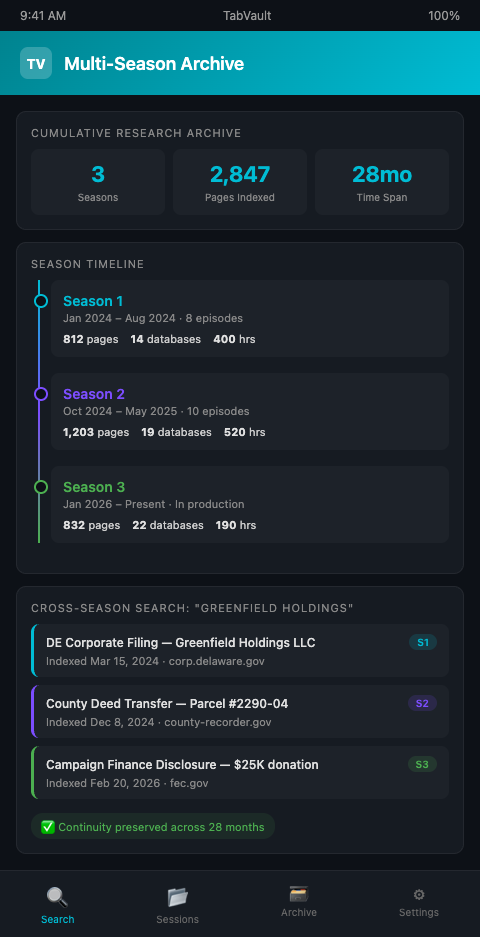
Producers already building episode timelines from indexed sessions will find that multi-season timelines emerge naturally when the indexed archive spans years rather than weeks.
Structuring Research for Season Transitions
Label sessions by season and episode. Every research session should carry metadata identifying which season and episode it supports. A session tagged "S01E04-court-records" is findable years later without requiring anyone to remember what was researched when. This labeling discipline pays its largest dividend during season transitions when new team members need to orient themselves.
Conduct a season-end research audit. Before a season wraps, search the archive for the investigation's key terms and document what was covered. This audit produces a summary of which databases were searched, which names were investigated, which jurisdictions were checked, and what was found or not found. The audit does not replace the indexed archive -- it provides an entry point for the next season's team.
Preserve the full archive, not just highlights. The temptation during season transitions is to curate -- to save only the most relevant indexed sessions and discard the rest. Resist this. The session that seemed irrelevant during season one may contain a name that becomes central to season three's investigation. Researchers who manage multi-generational family reconstruction research face the same temptation and learn the same lesson: preserve everything.
Onboard new producers through archive orientation. When new producers join for a new season, their first task should be searching the archive for the investigation's primary subjects. This gives them an immediate, concrete understanding of what has been investigated and what the prior team found. It is faster and more thorough than reading summary documents alone.
Advanced Tactics for Investigation Continuity Across Seasons
Cross-season pattern detection. Search the archive for a subject's name and review results chronologically across seasons. Research from season one may have covered events from 2018. Season two may have found records from 2019 through 2021. Season three can fill the gaps and extend the timeline forward. The multi-season archive makes the overall investigation's coverage map visible.
Source revalidation. Between seasons, sources change. Websites restructure. Databases update. Records get sealed or unsealed. At the start of a new season, take a sample of critical indexed pages from prior seasons and verify they are still accessible. If a source has changed, the indexed version preserves what the page contained when you originally viewed it.
Identify evolving leads. Some leads pursued in season one may have developed since the season ended. Search the archive for leads that were open or unresolved, then conduct fresh research to see whether new records have appeared. The podcast season research archive tells you exactly which leads were active, so you do not need to reconstruct the status from memory.
Budget for research continuity. Multi-season investigations have cumulative research costs. PACER fees, state court access fees, and database subscriptions add up across seasons. The indexed archive documents what was already accessed and paid for, preventing duplicate expenditures. Producers applying source pattern detection across long-running investigations across seasons can also track research costs across the same timeframe.
Use the archive for audience engagement between seasons. Long-running investigation research management extends beyond production. Between seasons, listeners email tips, post theories in online communities, and share documents they believe are relevant. When a listener tip mentions a name or entity, the production team can search the multi-season archive instantly to determine whether that lead was already investigated. The Pew Research Center found that 71 percent of Americans believe the news media should act as a watchdog over powerful people and organizations -- and responding to listener tips with evidence of thorough prior research demonstrates that the show takes its watchdog responsibility seriously.
Establish archive access protocols for departing team members. Producer turnover between seasons is common. When a producer who contributed indexed sessions during seasons one and two leaves before season three, their research must remain in the podcast season research archive. Establish written agreements at the start of each season confirming that all indexed research conducted for the show belongs to the production entity, not the individual producer. This prevents the institutional knowledge loss that occurs when a departing producer's personal research habits were the only connection between their indexed sessions and the investigation.
If your investigative podcast spans multiple seasons and each new season starts by re-researching what prior seasons already covered, the investigation is paying a compounding tax on lost research. TabVault preserves every session from every season in one searchable archive, so season three builds on season one's work instead of repeating it. Join the waitlist to give your long-running investigation the research continuity it needs.