Weaving Tab Search Into Podcast Pre-Production Workflows
The Research Phase That Makes or Breaks Episodes
The Global Investigative Journalism Network advises that the foundation of any investigative podcast is identifying your subject, the story you want to tell, and separating closed questions with definitive answers from open questions still being pursued. That identification phase happens almost entirely in the browser. Producers search court records, pull news archive results, review corporate filings, scan social media profiles, and read prior reporting on their subject -- all before a single interview is scheduled.
A McKinsey Global Institute analysis found that knowledge workers spend roughly 20 percent of their work week -- one full day -- searching for and gathering information. For investigative podcast producers, that number skews even higher during pre-production, when the entire job is research. The problem is not the time spent researching. The problem is that the research disappears the moment tabs close.
A typical pre-production cycle for one episode might involve fifty to a hundred unique web pages visited over two to three weeks. Court docket pages, FOIA portal results, archived news articles, corporate registry lookups, property records, social media profiles. Each page contains details that could become part of the episode script. But by the time the producer sits down to write, many of those tabs have been closed, the browser history has been cleared, and the specific details live only in whatever notes were manually transcribed.
Integrating Tab Search Into Every Pre-Production Stage
A podcast pre-production research workflow that includes tab search eliminates the gap between research and script. Instead of treating research as a phase that produces notes and then ends, the indexed browser sessions become a permanent reference that the producer queries throughout production.
TabVault turns chaotic browser sessions into a searchable private database that persists from the first background research through final fact-checking. The research workflow integration works across every pre-production stage.
Background research. The earliest phase involves broad searches to understand the landscape of your subject. You search news databases, read Wikipedia entries for context, review academic papers, scan government reports. With tab search active during pre-production, every page you visit becomes part of your searchable archive. Two weeks later, when you need to recall the specific statistic from a government report you skimmed, you search your own indexed sessions rather than trying to reconstruct which government website you were on.
Source identification. As you move from background to active investigation, you begin identifying potential interview subjects. You search court documents for witnesses, review corporate filings for officers, scan news articles for quoted experts. Each of these pages gets indexed. When you later need to compile a source list for your host or co-producer, you search your TabVault archive for the names you encountered rather than re-doing the original searches.
Document collection. Investigative podcast episode planning requires assembling the documents that will drive the narrative. FOIA responses, court filings, financial disclosures, meeting minutes. As you review these documents in your browser during pre-production, they join your indexed archive alongside your background research and source identification work.
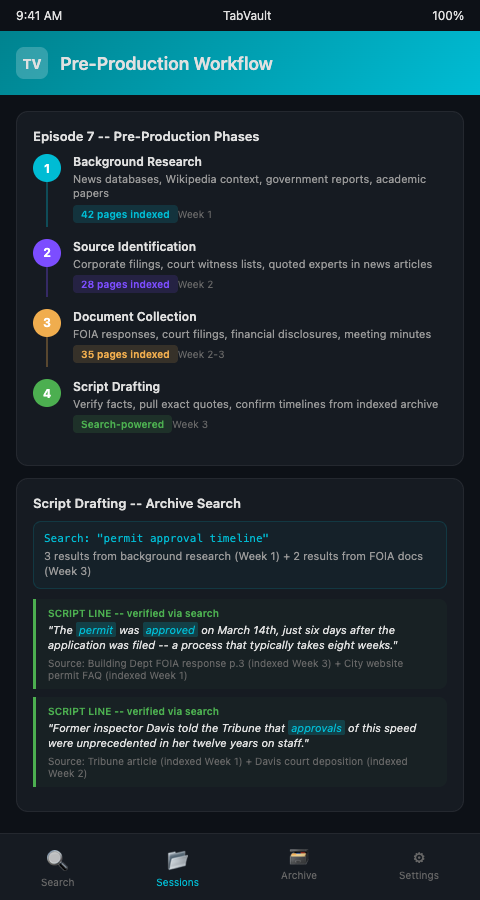
Script drafting. This is where tab search pays its largest dividend. As you write the script, you need to verify facts, pull exact quotes from documents, and confirm timelines. Instead of reopening dozens of tabs or hunting through handwritten notes, you search your indexed sessions. The exact court filing language, the precise date from a news article, the specific wording of a FOIA response -- all retrievable in seconds.
Producers already using digital research workflows will recognize this as an extension of existing practice. The difference is that tab search pre-production creates a single searchable layer across all research types rather than siloing them into separate tools.
Fitting Tab Search Into Your Existing Workflow
The key to research workflow integration is not replacing your current tools but adding a searchable index layer beneath them.
Keep your project management tool. If you use Airtable, Notion, or a spreadsheet to track your episode production timeline, keep it. The ICIJ uses dedicated platforms like Datashare for document analysis alongside project management tools. TabVault does not replace your task tracker -- it gives you a searchable index of every web page you touched during the research tasks your tracker lists.
Align your sessions with the investigative calendar. Pre-production timelines for investigative podcasts typically span four to twelve weeks before recording begins. Structure your indexed sessions around the milestones in that calendar -- background research in weeks one and two, source identification in weeks three and four, document collection in weeks five and six. When the showrunner asks for a progress update on week four, searching your TabVault archive by date range shows exactly what ground was covered and what remains open. The Pew Research Center found that 71 percent of Americans believe the media should act as a watchdog, which makes thorough pre-production research a direct obligation to the audience.
Dedicate sessions to specific pre-production tasks. Rather than mixing background research, source identification, and document review in a single marathon session, separate them. This produces cleaner indexed blocks that are easier to search later. A session dedicated entirely to court record research for episode seven produces a focused, searchable set of results. Producers who integrate tab search into genetic genealogy workflows use similar session-segmentation strategies.
Search your archive before starting new research. At the beginning of each pre-production day, search your TabVault archive for the current episode's key terms. You may discover that a previous episode's research already covered ground you were about to re-investigate. This is particularly valuable for series that revisit themes or subjects across multiple episodes.
Advanced Pre-Production Research Tools and Tactics
Fact-check against your own research history. During script review, search your indexed sessions for every factual claim in the draft. If a claim does not produce a hit in your archive, either the supporting research was not done in the browser or it was not done at all. This functions as a built-in fact-checking layer.
Build interview prep from indexed sessions. Before an interview, search your archive for the interviewee's name. Every page where they appeared -- court documents, news articles, corporate filings -- surfaces in one search. This gives you a comprehensive briefing document assembled from your own research history instead of a last-minute Google search.
Verify coverage completeness before advancing to production. At the end of pre-production, search your TabVault archive for each key entity, date, and location in the episode outline. If a critical claim lacks an indexed source, that gap is visible before recording begins -- not during fact-checking under deadline pressure. The Bureau of Justice Statistics tracks case processing data across state courts of general jurisdiction, and producers investigating court-related stories can use BJS benchmarks to confirm whether their research covers the relevant court levels and jurisdictions. This verification step converts a subjective sense of "enough research" into a measurable inventory of indexed evidence.
Hand off pre-production research to production staff. When a researcher completes pre-production and hands the episode to a producer for recording, the indexed session archive transfers the full research context. The producer can search the archive to understand what was investigated, what was found, and what remains open. This handoff problem is something producers managing indexing strategies deal with at every stage transition.
If your investigative podcast's pre-production phase generates weeks of browser research that evaporates before the script is written, the gap between research and production is costing you accuracy and time. TabVault makes every pre-production research session permanently searchable, so the details that matter most are always one query away. Join the waitlist to close the gap between what you researched and what makes it into your episodes.