Understanding Private Indexing for Veterinary Client Records
The Privacy Gap in Every Veterinary Browser
A veterinary emergency clinician searches "Smith golden retriever xylitol ingestion 3/15" in her browser's address bar to find a page she visited during a recent case. Chrome's autocomplete suggests the full search string to the next person who types "Smith" on the same workstation — a colleague, a locum vet, a veterinary technician. The client's name, their pet's breed, the toxin involved, and the date of the incident are now exposed through browser suggestion history. No HIPAA violation occurred — the Health Insurance Portability and Accountability Act does not apply to veterinary medicine — but the American Veterinary Medical Association's Principles of Veterinary Medical Ethics establish a professional obligation to protect client confidentiality that is functionally analogous.
This privacy exposure is built into how browsers work. Browser history, search suggestions, and cloud-synced bookmarks transmit information to external servers by default. Google Chrome syncs browsing history to Google's servers when sync is enabled. Firefox offers similar sync functionality through Mozilla accounts. Every URL visited, every search query entered, and every bookmark created may pass through third-party infrastructure.
For veterinary practices, this default architecture creates a client record confidentiality tab search problem. Clinicians routinely access client records through web-based practice management systems like eVetPractice or Cornerstone. They research toxins based on specific patient presentations that include client-identifying details. They may access laboratory results, radiograph reports, or referral correspondence through browser-based portals. Each of these interactions leaves traces in browser history and sync systems that are outside the practice's control.
The Federal Trade Commission provides guidance on data security practices for businesses that handle consumer information, and while veterinary practices are not HIPAA-covered entities, clients increasingly expect the same standard of data privacy from their veterinarians that they expect from their physicians. HIPAA-like veterinary compliance is becoming a competitive differentiator and a professional expectation, even without a regulatory mandate.
Veterinary data privacy browser configurations — clearing history, disabling sync, using private browsing modes — are partial solutions that create their own problems. Clearing history eliminates the retrieval capability that clinicians depend on. Disabling sync prevents access to saved passwords and bookmarks across devices. Private browsing mode prevents all history retention, including the clinician's own ability to return to previously researched pages.
How Private Local Indexing Solves the Privacy-Retrieval Tradeoff
The core tension is between privacy and retrieval. Clinicians need to search their past research to avoid redundant work. They also need to protect client information from exposure through browser sync and shared workstation history. These goals conflict when using standard browser tools because those tools store data remotely and expose it through shared interfaces.
Private indexing resolves this tension by storing all indexed content locally — on the clinician's machine, not on any third-party server. TabVault turns chaotic browser sessions into a searchable private database, indexing the full text of every page visited during research sessions, but that index lives on the local device. No cloud sync. No third-party storage. No autocomplete suggestions that expose client-adjacent search terms to other workstation users.
Secure veterinary research indexing through TabVault means a clinician can search "Johnson Labrador rodenticide brodifacoum" in her local index and retrieve every page she consulted during that case — without the search query or the results appearing in browser history, cloud sync, or workstation-shared suggestion databases. The search stays local. The results stay local. The index stays local.
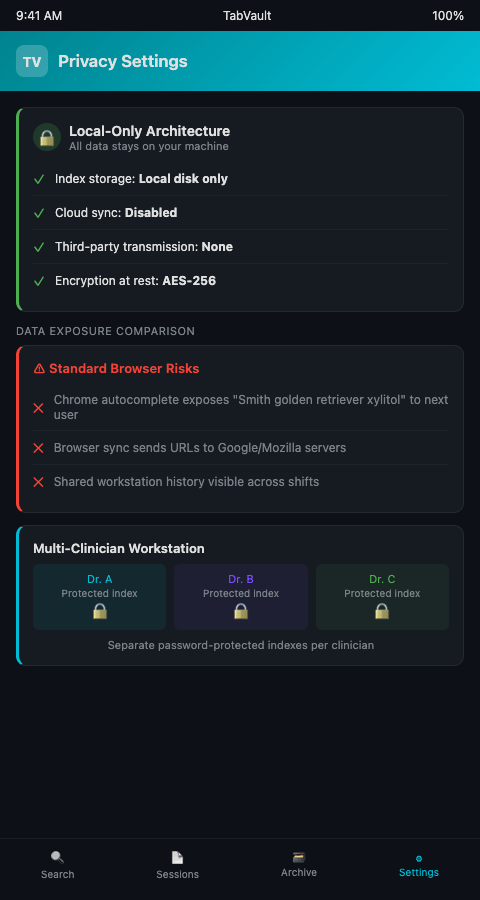
This architecture matters for multi-clinician practices where workstations are shared. In a typical emergency veterinary hospital, two or three clinicians may use the same computer during different shifts. Browser history from the morning clinician's research is visible to the evening clinician unless history is manually cleared — which destroys the morning clinician's ability to return to her own research. Private indexing gives each clinician a separate, locally stored, password-protected index that does not leak into shared browser state.
Client record confidentiality tab search through a local index also protects against data breach scenarios that affect cloud-synced browser data. If a browser sync account is compromised, the attacker gains access to every URL visited and every search query entered — potentially exposing client names, pet identifiers, toxin exposures, and case dates. A local-only index is protected by the workstation's own access controls rather than the browser vendor's cloud security.
The emergency vet protocol management approach benefits from local indexing because protocol pages often contain institution-specific dosing guidelines and internal contact information that should not sync to external servers. The same privacy architecture supports the indexed research workflow for residents working in teaching hospitals where client records are used for educational purposes under institutional oversight.
Architectural salvage dealers working with competitive market intelligence face a parallel concern about keeping indexed data private from competitors, and the same local-first indexing architecture addresses both use cases — different domains, identical privacy requirements.
Veterinary data privacy browser concerns extend beyond client records to institutional protocols. Many veterinary hospitals maintain proprietary treatment protocols, formulary preferences, and internal contact directories that staff access through web-based portals. When a clinician consults the hospital's intranet protocol page during an emergency, browser sync could transmit that URL — revealing institutional information — to Google or Mozilla's servers. Private local indexing captures the protocol content without transmitting any data outside the practice's network. The indexed content stays on the workstation, available for search, invisible to external parties.
The HIPAA-like veterinary compliance landscape is also evolving. Several states have enacted or proposed veterinary medical records confidentiality statutes that impose specific data handling obligations on veterinary practices. The AVMA's model veterinary practice act recommends confidentiality protections for client information. As these standards tighten, practices that have already implemented local-only data architectures for their clinical research tools will face fewer compliance adjustments than those relying on cloud-synced browser tools that transmit data to third parties by default.
Privacy Practices for Veterinary Index Management
Local indexing addresses the architecture-level privacy problem. These practices extend protection at the workflow level.
Separate clinical and personal browsing. The same principle that drives private competitive intelligence in other industries applies here. Use the indexed browser profile exclusively for clinical research. Personal browsing — shopping, social media, email — should use a separate browser profile or a different browser entirely. This separation ensures your clinical index contains only professional content and your personal browsing does not appear in a clinical search context.
Encrypt the index at rest. If your workstation is shared or physically accessible to non-clinical staff, enable full-disk encryption or use an encrypted volume for the index storage location. The National Institute of Standards and Technology provides frameworks for data protection that veterinary practices can adapt to their operational scale. Even without a HIPAA mandate, encryption at rest is a defensible best practice for any data store containing client-adjacent information.
Establish retention policies for your index. Unlike browser history, which expires automatically in 90 days, an indexed archive persists indefinitely by default. For client-facing data, establish a retention schedule — perhaps retaining case-related indexed pages for the duration of the medical record retention period required by your state veterinary practice act, then purging entries older than the retention window.
Audit index access. If multiple clinicians in your practice use indexed archives on shared workstations, each should maintain a separate index with separate access credentials. Regular audits — verifying that each index is accessible only to its owner — prevent accidental cross-clinician data exposure.
Document your privacy practices. As HIPAA-like veterinary compliance expectations grow, practices that can document their data handling procedures are better positioned for client trust, liability protection, and eventual regulatory compliance. Your indexed archive's local-only architecture is a documentable privacy control — note it in your practice's data handling policy alongside your electronic medical records procedures.
Privacy and Search Are Not Mutually Exclusive
The belief that you must choose between searchable research and client data privacy is based on the limitations of browser-native tools, not on any fundamental tradeoff. Private indexing gives veterinary clinicians full-text search across their entire research history while keeping every byte of indexed data on their local machine. TabVault's local-first architecture means your clinical research stays private, your client data stays protected, and your ability to retrieve past case research stays intact. Join the waitlist and bring privacy-first search to your veterinary practice.
TabVault stores every indexed page on your local machine — never on third-party cloud servers, never synced through Google or Mozilla accounts, never visible in shared browser autocomplete suggestions. Your search for a specific rodenticide case protocol stays between you and your workstation. The ASPCA consultation reference you pulled up during a sensitive case remains in your private archive, inaccessible to anyone without your local credentials. This local-first architecture means your clinical research library grows in exactly the same way as a cloud-synced solution, but with the privacy guarantees that veterinary client confidentiality demands and that browser-native tools structurally cannot provide.